Quick answer: With irregular income, build the budget on your lowest typical month (here $2,800, against an average of $4,533), keep income in a holding account and pay yourself a fixed monthly salary from it. Extra in good months goes first to a buffer of one to three months of expenses, then to savings and goals.
A standard budget assumes each month looks like the last. If you earn commissions, tips or freelance income, some months are feast and others famine. The solution is to smooth your income so spending is steady.
Key takeaways
- Use your lowest typical month as the baseline for fixed costs.
- Create a holding account; pay yourself a steady “salary” from it.
- Build a buffer first, then add savings and extras in strong months.
- Set aside taxes from every payment; see self-employment tax.
- Treat strong months as the way to fund weak ones, not as a raise.
Step 1: See the pattern
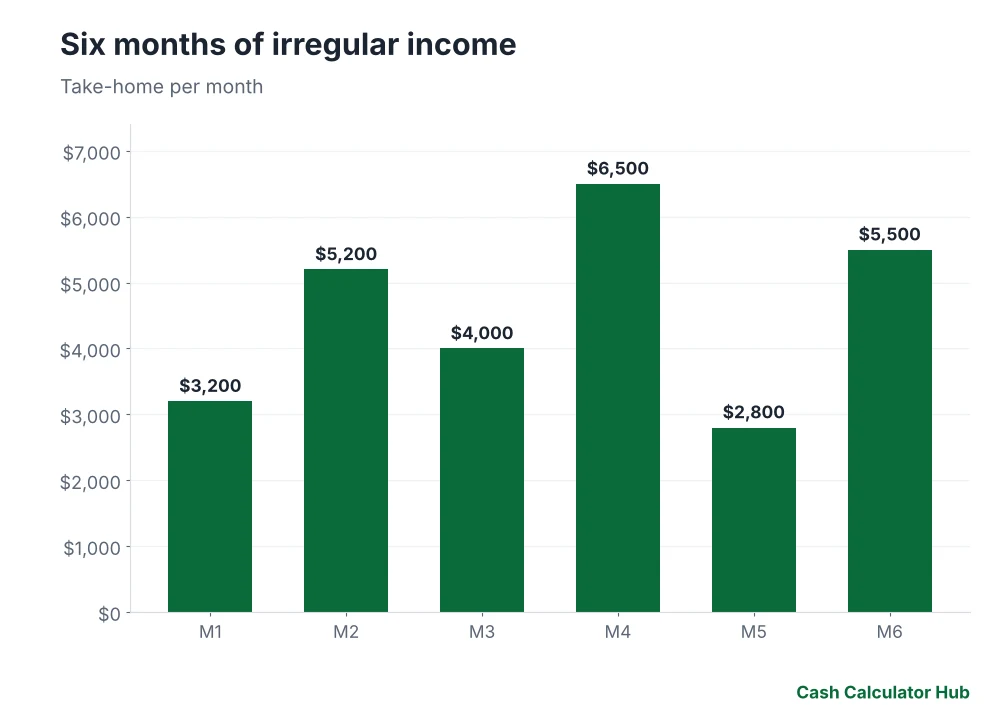
Six months of take-home income:
| Month | Income |
|---|---|
| Month 1 | $3,200 |
| Month 2 | $5,200 |
| Month 3 | $4,000 |
| Month 4 | $6,500 |
| Month 5 | $2,800 |
| Month 6 | $5,500 |
| Average | $4,533 |
| Lowest | $2,800 |
Step 2: Build on the baseline
Set your fixed budget (rent, utilities, insurance, debt minimums) to fit within $2,800. Anything above is a bonus.
Step 3: Use a holding account
- Deposit all income into one account.
- Transfer a fixed salary to checking on the 1st and 15th.
- Let the holding account balance cover down months.
Salary target: start at the baseline, or at about 90% of the average ($4,080) once the buffer is full.
Step 4: Fill the buffer
| Buffer months | Needs at $2,800 a month |
|---|---|
| 1 | $2,800 |
| 2 | $5,600 |
| 3 | $8,400 |
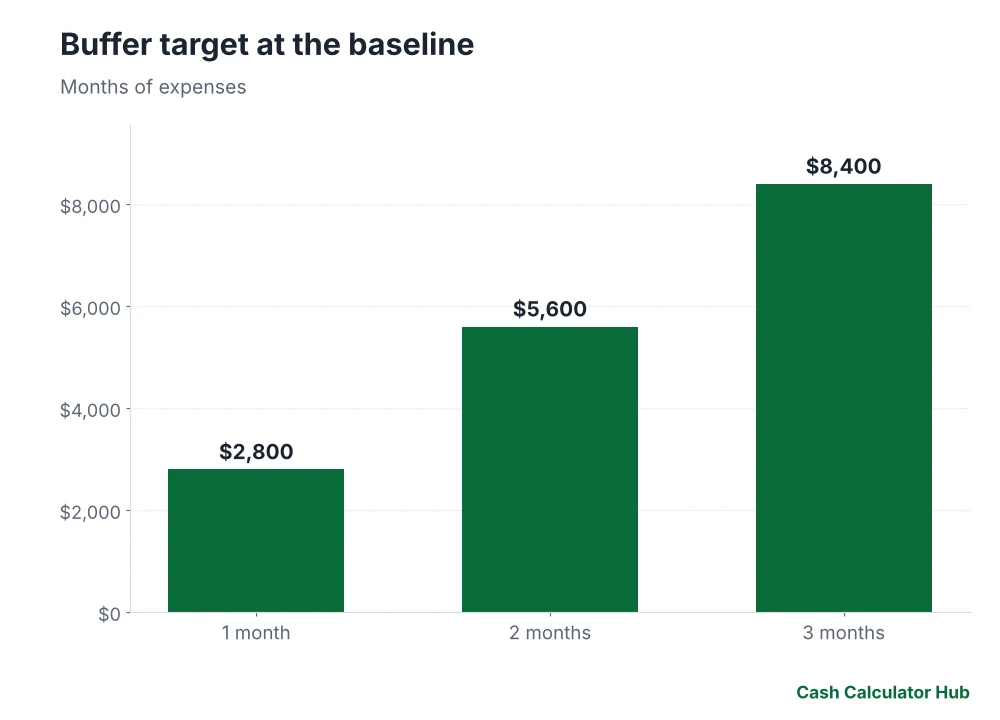
See emergency fund size, and aim for the upper end for volatile income.
Step 5: Set aside taxes
If you are self-employed, set aside 25% to 30% of each payment for federal and self-employment tax; see self-employment tax.
Strong-month rules
Example split for extra income: 50% to the buffer until full, then 25% savings, 25% fun. A written rule prevents overspending after a big month.
Weak months
Cut variable categories first: dining, entertainment, subscriptions (audit). Use sinking funds for irregular costs, and a zero-based plan each month.
Tools
Use the budget planner and savings calculator. For hourly rates, see hourly to salary. More: budgeting tools.
Frequently asked questions
How do I budget with irregular income?
Base your budget on your lowest typical month, use a holding account and pay yourself a fixed salary.
How big should the emergency fund be for freelancers?
Many aim for 3 to 6 months of expenses, or more if income is highly variable.
How much should I save for taxes?
Often 25% to 30% of self-employment income, depending on your situation.
What do I do in a good month?
Fill the buffer first, then save, invest or pay down debt according to a preset rule.
What if my income drops below my baseline?
Cut variable spending, draw on the buffer and review your fixed costs.
Sources and further reading
- IRS: Self-employment tax
- Consumer Financial Protection Bureau
- MyMoney.gov: Financial literacy resources
How the numbers were made: Every figure on this page was calculated from the formulas and assumptions stated above and rounded to the nearest dollar. Rates, limits and rules are for 2026 unless noted; confirm current figures with the sources listed before acting.
Keep reading
- The 50/30/20 Budget Rule: How It Works, and How to Adjust It
- Hourly to Salary: What Is $25 an Hour Per Year?
- Debt Avalanche vs Snowball: A Four-Debt Example With Real Numbers
- How Couples Should Split Expenses: 50/50, Proportional or Shared Pot?
- Lifestyle Creep: How Rising Spending Eats Your Raises (and How to Stop It)
- Subscription Audit: How Much Small Recurring Charges Really Cost You
This guide is general information, not financial, tax or legal advice. Figures use stated assumptions and 2026 rules and will differ from your situation; check current rules and talk to a licensed professional before you decide. Full disclaimer.