Quick answer: High-yield savings or a CD?
Both are safe places for cash. Both are typically insured by the FDIC (or NCUA at credit unions) up to $250,000 per depositor, per institution, per ownership category. The question is not safety, it is how much liquidity you want to give up and what you think rates will do.
The core difference
High-yield savings account: variable rate, which the bank can change any day. You can withdraw whenever you want (with limits on some accounts).
Certificate of deposit (CD): fixed rate for a fixed term (3 months to 5 years). You earn the rate no matter what happens to the market, but you pay a penalty for pulling money out early.
That makes a CD a bet that rates will be lower than today over the term, and a savings account a bet that they will not.
Five years, three paths
The rates here are illustrative. Online savings accounts and CDs have recently paid roughly 4% APY, but check current offers. Suppose $20,000 sits in one of two places:
- A 5-year CD at 4.1% APY: $24,542 after five years.
- A savings account starting at 4.0%. If rates drop to 2.75%, it ends around $23,348. If they rise to 4.75%, it ends around $25,098.
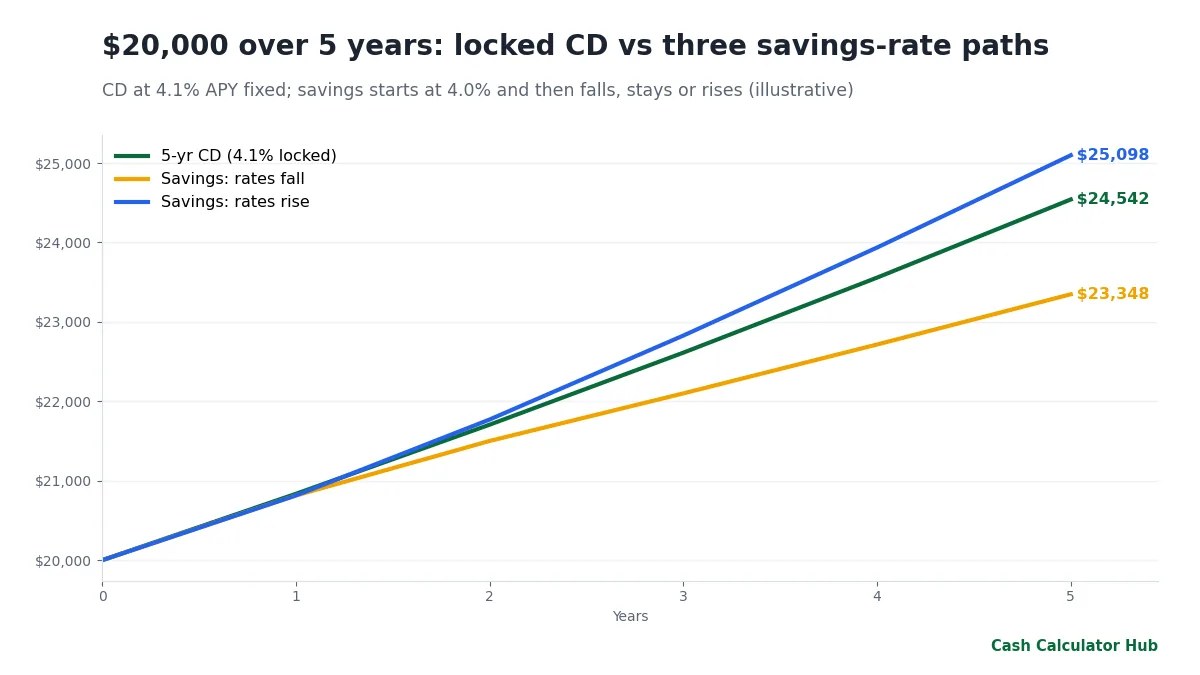
When rates are falling, the CD wins by about $1,194. When they rise, the savings account can win by $556. If you honestly do not know, splitting between the two gets you an average of the outcomes.
The cost of breaking a CD
Early withdrawal penalties are commonly expressed in months of interest: for example 3 months of interest on a 1-year CD, 6 months on a 2-year, up to 12 months on a 5-year. On $20,000 at 4.1%, six months of interest is about $410. Withdraw early in year one and the penalty can take back the interest you earned, and sometimes a little principal. Always read the penalty section before you buy.
What your interest is worth after tax and inflation
Interest on both is taxed as ordinary income at your federal rate, plus state tax in most states. Inflation also takes a bite. With headline inflation running about 3.4% in mid-2026 per the BLS, a 4% account is a small real gain at best:
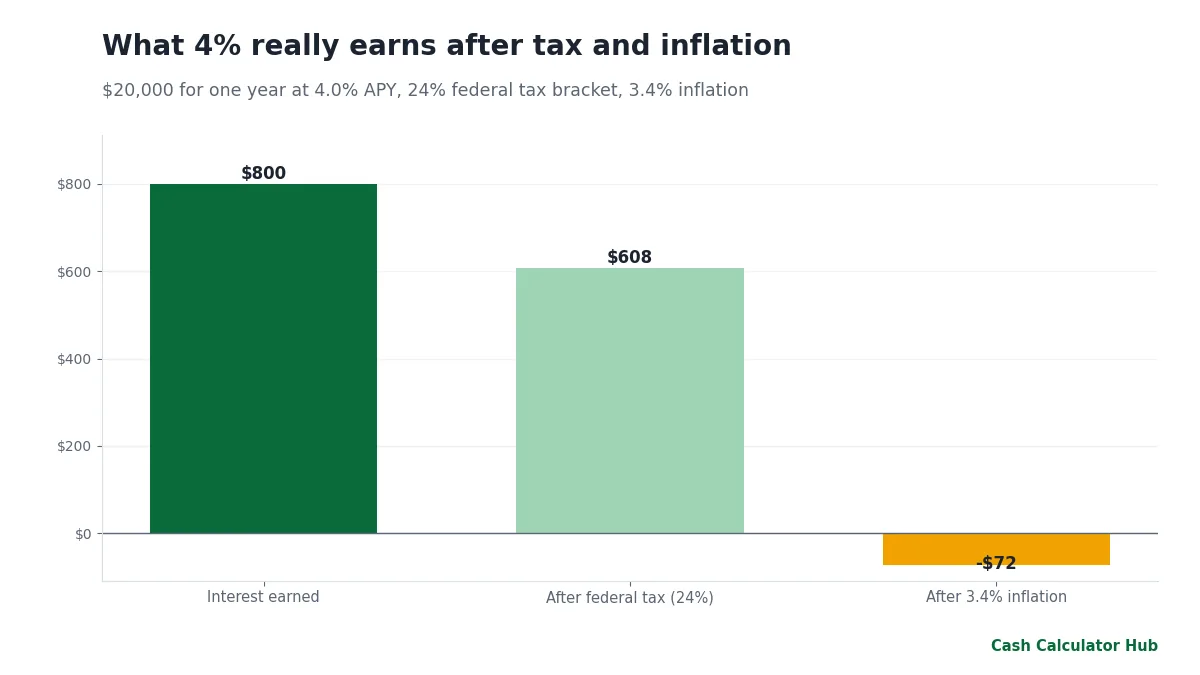
That is not a reason to avoid cash. It is a reminder of what cash is for: emergency funds, near-term goals (a down payment in 18 months, tuition next fall) and money you cannot afford to lose. For goals more than 5 years away, the long-term growth numbers look very different.
A CD ladder splits the difference
With a ladder, you divide your money across several CDs with staggered maturities. For example, $20,000 in four $5,000 CDs maturing at 1, 2, 3 and 4 years. Each time one matures you either use the cash or roll it into a new 4-year CD. You get some money back every year, and you capture longer-term rates without locking everything up.
Which should you choose?
- Emergency fund: savings account. Do not lock up money you may need on short notice.
- Money you will need on a known date: a CD that matures right before then.
- Money you will not touch for a while, in a falling-rate environment: longer CD terms.
- When rates are rising: shorter terms or savings so you can reinvest at higher rates.
- Brokered CDs and Treasury bills are other options that can be sold before maturity, with price risk.
Run the numbers with the CD calculator, which includes tax and an early-withdrawal estimate, and the savings calculator for regular deposits. For different time frames, the interest calculator compares simple and compound interest. If this is for a house fund, see how much down payment you need. More: investment calculators.
How to compare offers
- Compare APY, not the stated rate. APY includes compounding.
- Check the minimum deposit. Some top rates require $1,000 or more.
- Read the penalty clause. The penalty is often a number of days of interest, but some banks can reach into principal.
- Confirm FDIC or NCUA coverage and which ownership category you are using. Joint accounts and trusts can raise the covered amount.
- Watch for promotional teaser rates on savings accounts that drop after a few months.
- Consider brokered CDs and Treasury bills if you hold more than the insured limit. Treasury interest is exempt from state income tax, which matters in high-tax states.
A simple split for a typical household
Many people divide cash into three tiers: an emergency fund in a high-yield savings account (three to six months of expenses), a “known goal” bucket in short CDs or a Treasury ladder, and long-term money invested for growth. The mix depends on your job stability and how soon you need each piece. If you are unsure what your emergency fund should be, see the 50/30/20 budget guide for how to set the savings share.
Is a CD better than a savings account right now?
Compare today’s rates. If the best CD rate is clearly above the savings rate and you will not need the money, a CD can win. If they are similar, savings gives you flexibility for free.
Are CDs FDIC insured?
Yes, at insured banks, up to $250,000 per depositor, per bank, per ownership category.
What happens to a CD when it matures?
Most renew automatically for the same term at the current rate unless you instruct the bank otherwise. There is usually a grace period of about a week to withdraw or change.
Is savings interest taxable?
Yes, as ordinary income, including interest credited to accounts you did not withdraw.
Sources and further reading
How the numbers were made: Every figure on this page was calculated from the formulas and assumptions stated above and rounded. Rates, limits and rules are for 2026 unless noted; confirm current figures with the sources listed before acting.
Keep reading
- Compound Interest on $10,000: What It Becomes in 10, 20 and 30 Years
- How Much Down Payment Do You Really Need for a House?
- The 50/30/20 Budget Rule: How It Works, and How to Adjust It
- How Expense Ratios Quietly Cost You Six Figures
- ROI vs IRR vs CAGR: Which Return Number Should You Trust?
- What Was $100 Worth in 2000? Inflation, Calculated
This guide is general information, not financial, tax or legal advice. Figures use stated assumptions and 2026 rules and will differ from your situation; check current rules and talk to a licensed professional before you decide. Full disclaimer.