Quick answer: The Rule of 72 estimates the years for money to double: 72 divided by the annual percentage rate. At 6% it takes about 12 years, at 7% about 10.3 years, at 9% about 8 years. It works for returns, inflation and debt, and is accurate to within a few hundredths of a year for rates around 6% to 10%.
The rule of 72 is a mental shortcut for compound growth. It turns a hard exponent into a division you can do in your head, and it helps you sense how fast investments, prices or debts grow.
Key takeaways
- Doubling time ≈ 72 ÷ annual rate (in percent).
- It is most accurate between about 6% and 10%; use 69.3 for continuous compounding.
- Works backward: rate needed ≈ 72 ÷ years to double.
- Applies to inflation: at 3% prices double in 24 years.
- Applies to debt: a 24% card balance doubles in about 3 years if unpaid.
Accuracy
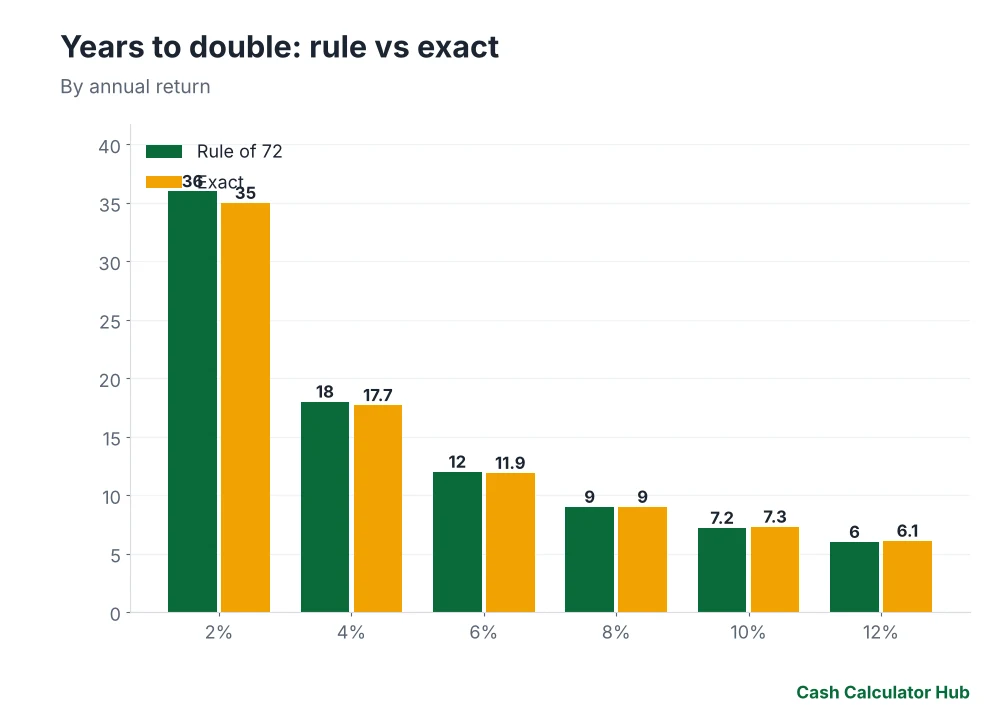
| Rate | Rule of 72 | Exact (ln 2 ÷ ln(1+r)) | Error |
|---|---|---|---|
| 2% | 36.0 years | 35.00 years | +1.00 |
| 3% | 24.0 years | 23.45 years | +0.55 |
| 4% | 18.0 years | 17.67 years | +0.33 |
| 5% | 14.4 years | 14.21 years | +0.19 |
| 6% | 12.0 years | 11.90 years | +0.10 |
| 7% | 10.3 years | 10.24 years | +0.04 |
| 8% | 9.0 years | 9.01 years | -0.01 |
| 9% | 8.0 years | 8.04 years | -0.04 |
| 10% | 7.2 years | 7.27 years | -0.07 |
| 12% | 6.0 years | 6.12 years | -0.12 |
Examples
- Investments: $10,000 at 7% doubles to $20,000 in about 10.3 years and quadruples in about 21. See compound interest on $10,000.
- Inflation: at 3% a year, prices double in 24 years; at 5%, in 14.4. See what $100 was worth.
- Debt: an unpaid balance at 24% doubles in 3 years. See card interest.
- Fees: a 1% fee reduces the doubling speed meaningfully: 7% → 6% moves doubling from 10.3 to 12 years; see expense ratios.
- Reverse: to double in 8 years you need about 72 ÷ 8 = 9% a year.
Doubling over a lifetime
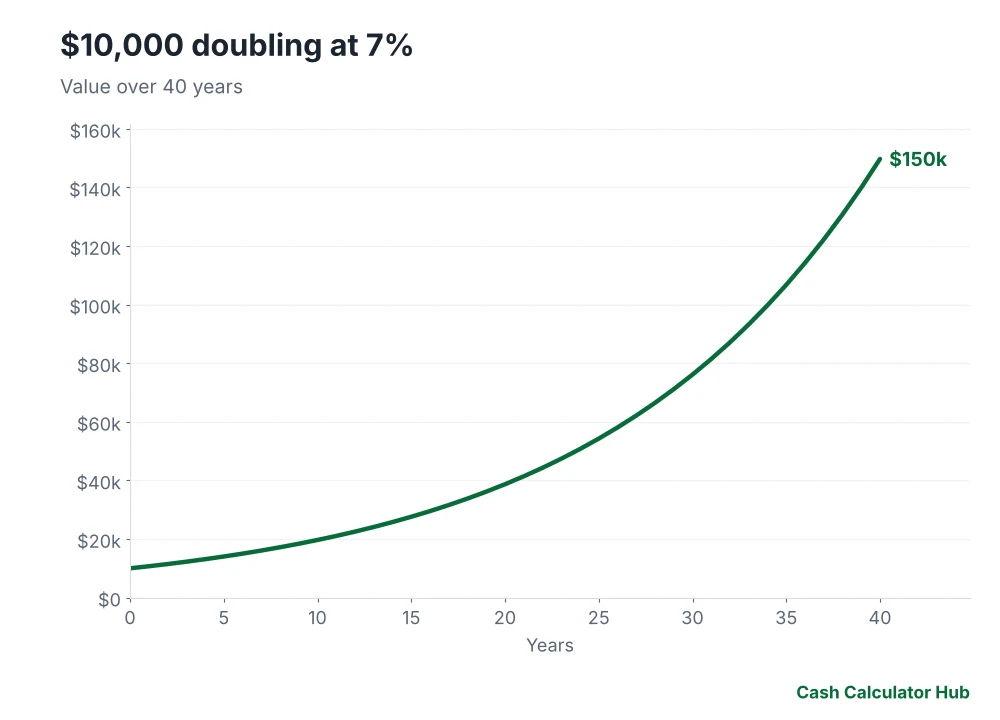
Starting with $10,000 at 7% for 40 years: about 3.9 doublings.
| Years | Doublings | Value |
|---|---|---|
| 10 | 1.0 | $19,672 |
| 20 | 1.9 | $38,697 |
| 30 | 2.9 | $76,123 |
| 40 | 3.9 | $149,745 |
Variations
- Rule of 69.3 or 70: better for continuous or small rates.
- Rule of 114 and 144: years to triple and quadruple (114 ÷ r and 144 ÷ r).
- Rule of 115: triple in 115 ÷ r years.
Limits
The rule assumes a constant rate and reinvested gains, ignoring taxes and fees. Actual returns vary; use calculators for precise planning. See real returns.
Tools
Use the compound interest calculator, future value calculator and average return calculator. More: business and everyday tools.
Frequently asked questions
What is the Rule of 72?
A shortcut: divide 72 by the annual rate of return to estimate the years needed for money to double.
How accurate is the Rule of 72?
Very accurate for rates between roughly 6% and 10%; slightly off at very low or high rates.
Does the Rule of 72 work for inflation?
Yes. Divide 72 by the inflation rate to estimate how long prices take to double.
How do I find the rate needed to double in a set time?
Divide 72 by the number of years.
What is the Rule of 114?
A similar shortcut for tripling: 114 divided by the rate gives years to triple.
Sources and further reading
How the numbers were made: Every figure on this page was calculated from the formulas and assumptions stated above and rounded to the nearest dollar. Rates, limits and rules are for 2026 unless noted; confirm current figures with the sources listed before acting.
Keep reading
- Compound Interest on $10,000: What It Becomes in 10, 20 and 30 Years
- How Long Does It Take to Save $1 Million?
- What Was $100 Worth in 2000? Inflation, Calculated
- Cash Flow vs Profit: Why Profitable Businesses Still Run Out of Cash
- The True Cost of an Employee: Why a $70,000 Salary Costs About $90,000
- How to Set a Freelance Hourly Rate: From Income Goal to Billable Hours
This guide is general information, not financial, tax or legal advice. Figures use stated assumptions and 2026 rules and will differ from your situation; check current rules and talk to a licensed professional before you decide. Full disclaimer.