
Quick answer: An HSA (health savings account) is generally better if you qualify: the 2026 limit is $4,400 for self-only and $8,750 for family coverage, the money rolls over, can be invested and is tax-free for medical costs. A health FSA allows $3,400 and is mostly use-it-or-lose-it. A $4,400 HSA contribution saves about $1,305 in 2026 for someone in the 22% bracket paying 7.65% payroll tax.
Both accounts let you pay medical expenses with pre-tax dollars. The key differences are who can open them, how much you can contribute and what happens to the money you do not spend. The HSA requires a high-deductible health plan (HDHP); the FSA does not.
Key takeaways
- HSA 2026 limits: $4,400 self-only, $8,750 family, plus $1,000 catch-up at age 55.
- FSA 2026 limit: $3,400, with limited carryover or a grace period if the employer allows it.
- HSAs offer triple tax benefits: deductible going in, tax-free growth and tax-free withdrawals for medical expenses.
- HSA money is yours, rolls over every year and can be invested; FSAs belong to the employer plan year.
- You cannot contribute to an HSA while enrolled in Medicare.
Comparison
| Feature | HSA | Health FSA |
|---|---|---|
| Needs a high-deductible plan | Yes | No |
| 2026 limit | $4,400 / $8,750 family | $3,400 |
| Catch-up | $1,000 at 55+ | None |
| Rollover | All of it, forever | Limited |
| Invest balance | Yes | No |
| Owned by | You | Employer plan |
| Payroll tax savings | Yes (through payroll) | Yes |
| Non-medical withdrawals | Taxed plus 20% penalty before 65 | Not allowed |
Tax savings in dollars
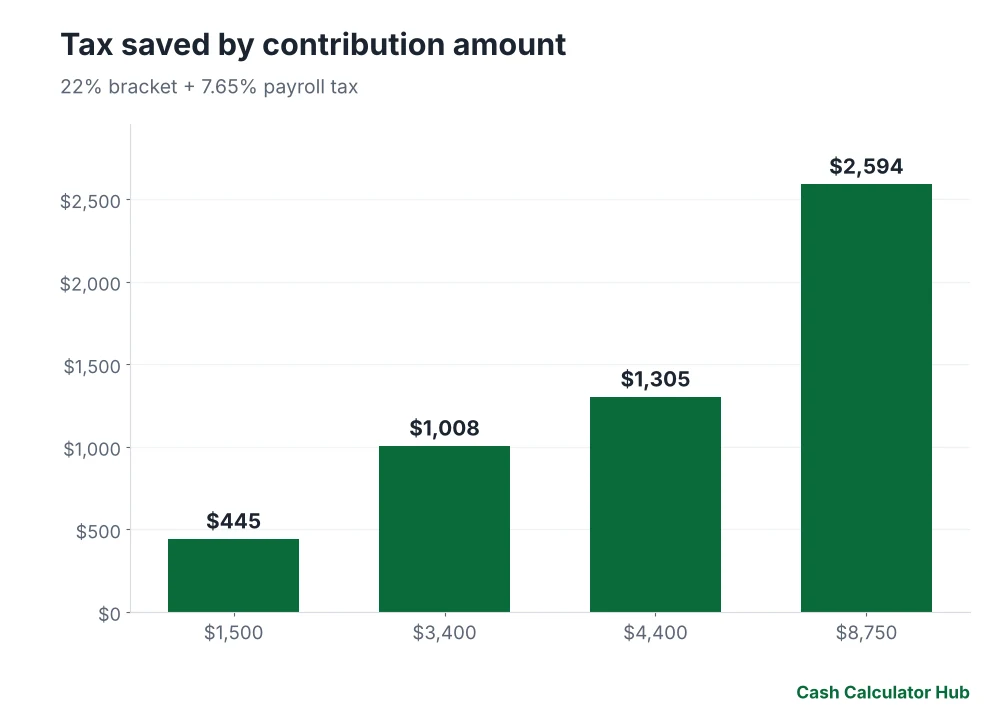
A worker in the 22% bracket contributing $4,400 through payroll saves income tax of $968 and payroll tax of $337, a total of $1,305.
| Contribution | Income tax saved (22%) | FICA saved (7.65%) | Total |
|---|---|---|---|
| $1,500 | $330 | $115 | $445 |
| $3,400 | $748 | $260 | $1,008 |
| $4,400 | $968 | $337 | $1,305 |
| $8,750 | $1,925 | $669 | $2,594 |
The investing advantage
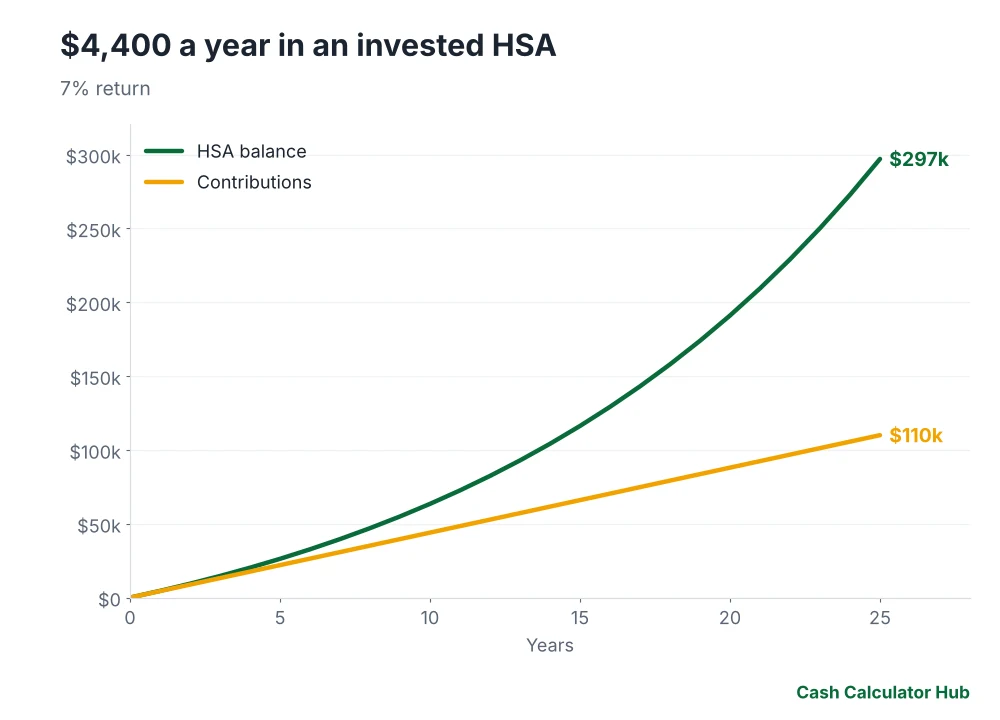
If you pay current medical costs from other funds and let the HSA grow, it can become a retirement account. $4,400 a year at 7% for 25 years grows to about $297,026.
After age 65, non-medical withdrawals are taxed like a traditional IRA (no penalty), and medical withdrawals stay tax-free. Keep receipts; you can reimburse yourself years later.
When an FSA makes sense
- Your plan is not HSA-eligible.
- You expect predictable expenses, such as orthodontia or a scheduled procedure.
- Your employer offers a limited-purpose FSA that works with an HSA for dental and vision.
Spend FSA funds by the plan deadline.
Is a high-deductible plan worth it?
Compare total costs: premiums plus expected out-of-pocket maximum. Include the HSA tax savings and any employer contribution. If you are healthy and have savings, an HDHP with an HSA often costs less overall; if you have high medical use, a traditional plan might.
Where it fits
HSA first after an employer match makes sense for many people; see which account first. Include healthcare costs in retirement planning.
Tools
Use the investment calculator for HSA growth and the income tax calculator for tax savings. More: tax tools.
Frequently asked questions
What is the difference between an HSA and an FSA?
An HSA is owned by you, rolls over, can be invested and requires a high-deductible plan. An FSA is employer-based, has a lower limit and is mostly use-it-or-lose-it.
What are the 2026 HSA limits?
$4,400 for self-only coverage and $8,750 for family coverage, plus $1,000 catch-up for people 55 and older.
What is the 2026 FSA limit?
$3,400 per employee.
Can I have both an HSA and an FSA?
Only a limited-purpose FSA for dental and vision can be combined with an HSA.
What happens to an HSA when I turn 65?
You can still use it tax-free for medical costs, and non-medical withdrawals are taxed as income without a penalty.
Sources and further reading
- IRS Publication 969: HSAs and other tax-favored health plans
- IRS: Tax topics and forms
- Medicare.gov: Your Medicare costs
How the numbers were made: Every figure on this page was calculated from the formulas and assumptions stated above and rounded to the nearest dollar. Rates, limits and rules are for 2026 unless noted; confirm current figures with the sources listed before acting.
Keep reading
- 2026 401(k) and IRA Contribution Limits, Explained
- Where to Invest First: 401(k), HSA, Roth IRA or a Taxable Account?
- 2026 Federal Tax Brackets and Standard Deduction, Explained With Examples
- Take-Home Pay on $50K, $75K and $150K Salaries (2026 Federal Taxes)
- Estate and Gift Tax Basics 2026: $15 Million Exemption and $19,000 Annual Gifts
- Overtime and Bonus Pay: Why the Tax Looks So High and How Much You Really Keep
This guide is general information, not financial, tax or legal advice. Figures use stated assumptions and 2026 rules and will differ from your situation; check current rules and talk to a licensed professional before you decide. Full disclaimer.