
Quick answer: Saving $1,000 a month at 7% takes about 28 years to reach $1 million.
“How long to save a million” is the kind of query people type at 11 p.m. when they have decided to take their finances seriously. It is a good question because the answer is more hopeful than most people expect, and more dependent on time than on income.
The monthly amount you need
Assume you start from zero and earn a steady 7% annual return, compounded monthly. The required monthly contribution to hit $1,000,000:
| Years | Monthly saving | Total you contribute |
|---|---|---|
| 20 | $1,920 | $460,717 |
| 25 | $1,234 | $370,338 |
| 30 | $820 | $295,089 |
| 35 | $555 | $233,197 |
| 40 | $381 | $182,870 |
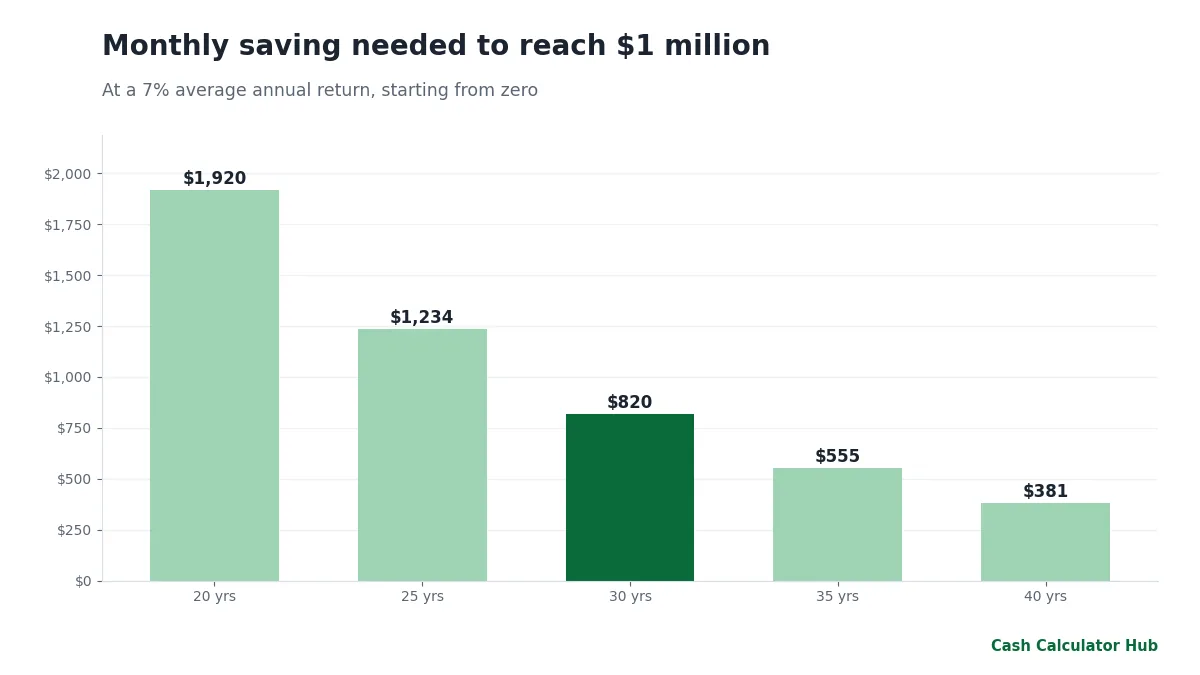
Look at the right-hand column. Over 40 years you put in $182,870 and the market adds the rest, which is why a 25-year-old needs a fraction of what a 45-year-old needs. At 30 years the required amount is $820 a month; at 20 years it is $1,920.
It depends on the return (a lot)
The same plan at 5% needs substantially more:
| Years | Needed at 5% | Needed at 7% | Needed at 9% |
|---|---|---|---|
| 20 | $2,433 | $1,920 | $1,497 |
| 30 | $1,202 | $820 | $546 |
| 40 | $655 | $381 | $214 |
That spread is why investing for the long term in diversified assets matters, and why fees (see expense ratios and your final balance) matter too.
Fixed amount, variable time
If you pick a monthly number instead, how long does it take?
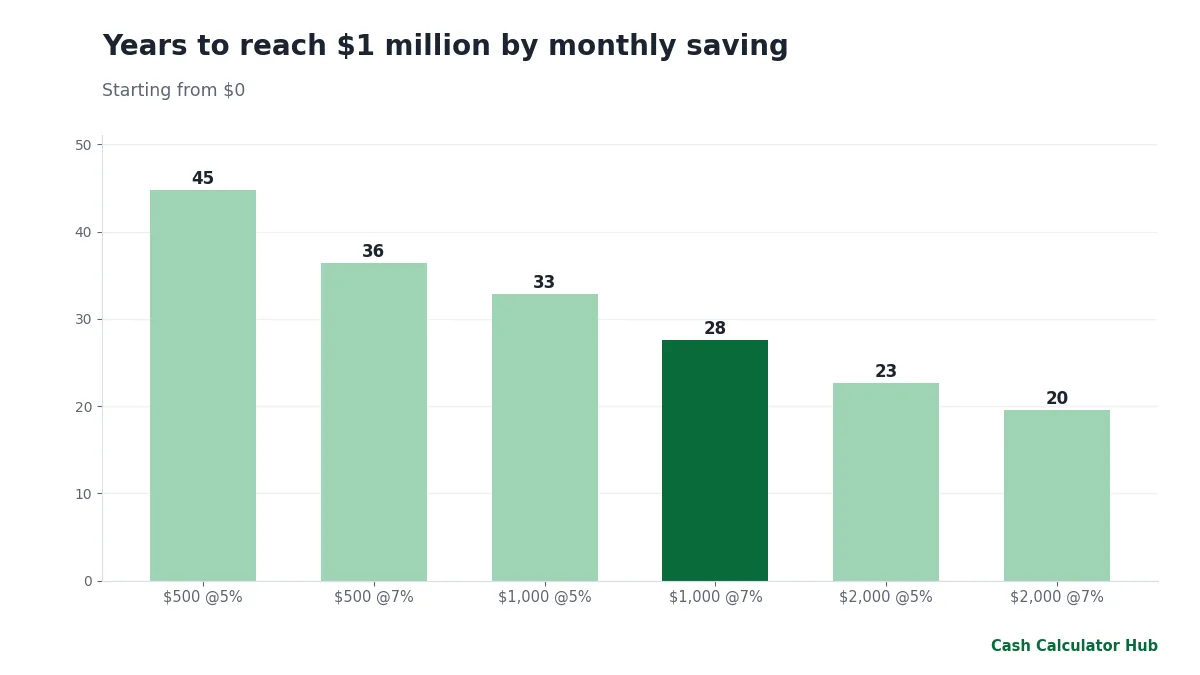
Saving $1,000 a month at 7% takes about 27.6 years. At 5% it takes about 32.9. Saving $2,000 gets you there in about 19.6 years at 7%. A big chunk of the answer comes from the starting balance. If you already have $100,000, the timeline shortens by a surprising number of years; the investment calculator can solve for any of the four variables (start, deposit, return, time).
$1 million is not what it used to be
At 3% inflation, $1,000,000 in 30 years will buy what about $411,987 buys today. That is not a reason to skip the goal; it is a reason to target a number in today’s dollars and let the calculator inflate it. A better target for many people is a retirement income number, not a balance. Use the retirement guide for that, and the retirement calculator to run the inflation-adjusted version.
What $1 million could pay you
A common planning rule is to withdraw 4% a year, which would give about $40,000 a year, adjusted for inflation, from $1 million. If you have Social Security on top, that can be a comfortable retirement in many places. The 4% figure is a guideline, not a guarantee; there is more on that in our retirement guide.
Ways to get there sooner
- Capture the full 401(k) match first. It is an instant return. See the 2026 limits in our 401(k) and IRA limits guide.
- Raise your contribution when you get a raise. Put half of every raise into savings before you see it.
- Keep costs low. Low-cost index funds keep more of your return.
- Do not interrupt compounding. Withdrawing and restarting is the most expensive habit.
- Pay off high-interest debt first. A 22% card is a negative investment. Start with the debt payoff calculator if that is you.
Run a plan
Put your starting balance, monthly deposit and expected return in the savings calculator or the future value calculator. To see the effect of the compounding, read what $10,000 becomes over 30 years. Explore all investment tools.
What a head start is worth
If you already have savings, the timeline shortens a lot. Saving $1,000 a month at 7%:
| Starting balance | Years to $1 million |
|---|---|
| $0 | 27.6 |
| $25,000 | 25.7 |
| $50,000 | 23.9 |
| $100,000 | 21.0 |
Starting with $50,000 saves about 4 years. Starting with $100,000 saves about 7. That is why one-time windfalls (inheritance, bonus, home sale) are worth investing instead of spending.
The raise trick
A raise is the easiest time to increase savings because you never feel the money. If you commit half of each raise, a 3% annual raise on a $60,000 salary adds about $75 a month to savings every year. After ten years that is roughly $750 more per month than you started with, with almost no pain. The savings calculator lets you model increasing deposits.
Is $1 million enough to retire?
For some people yes, for others no. A $40,000 a year withdrawal plus Social Security works for many households outside high-cost areas, but it depends on your expenses.
How much should I save per month to be a millionaire by 65?
At 7%, about $381 a month from age 25 or $820 from age 35.
Does a 7% return make sense?
It is a common long-run illustration for stock-heavy portfolios before inflation. Actual returns will vary, sometimes widely.
How long to save $1 million on a $60,000 salary?
If you save 15% of $60,000 ($750 a month), it takes about 31 years at a 7% return. $914,978 is where 30 years gets you, so a raise or a higher return would bring the date closer.
Sources and further reading
How the numbers were made: Every figure on this page was calculated from the formulas and assumptions stated above and rounded. Rates, limits and rules are for 2026 unless noted; confirm current figures with the sources listed before acting.
Keep reading
- How Expense Ratios Quietly Cost You Six Figures
- How Much Do You Need to Retire? A Practical Way to Find Your Number
- 2026 401(k) and IRA Contribution Limits, Explained
- Rent vs Buy: How Long Until Buying a Home Wins?
- Compound Interest on $10,000: What It Becomes in 10, 20 and 30 Years
- Dollar-Cost Averaging vs Lump Sum: Which Is Better for $120,000?
This guide is general information, not financial, tax or legal advice. Figures use stated assumptions and 2026 rules and will differ from your situation; check current rules and talk to a licensed professional before you decide. Full disclaimer.