
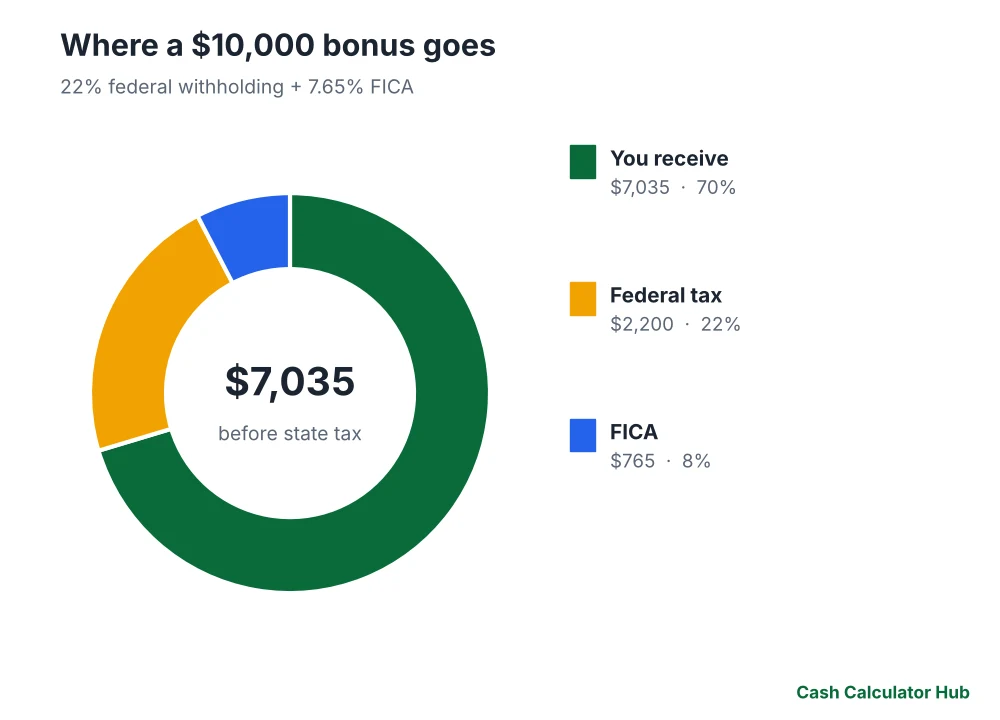
Quick answer: Employers often withhold federal income tax on bonuses at a flat 22%, plus 7.65% for Social Security and Medicare. On a $10,000 bonus that is $2,200 plus $765, leaving about $7,035 before state tax. Bonuses are taxed as regular income when you file, so the withholding may be too high or too low; the true cost depends on your marginal bracket.
A bonus does not get taxed at a special rate. It is added to your wages for the year. The flat withholding rate is only the employer’s method for estimating the tax. You settle the difference when you file.
Key takeaways
- Flat supplemental withholding is 22% federally (37% on supplemental wages over $1 million).
- Social Security and Medicare apply as usual: 7.65%.
- Your real tax is your marginal bracket (10% to 37%) on the extra income.
- If withheld too much, you get it back at filing; if too little, you owe.
- From 2025 to 2028, a deduction applies to the premium part of overtime pay, up to $12,500 ($25,000 joint) with income limits.
A $10,000 bonus
| Item | Amount |
|---|---|
| Bonus | $10,000 |
| Federal withholding (22%) | −$2,200 |
| Social Security + Medicare (7.65%) | −$765 |
| Net paycheck amount (no state tax) | $7,035 |
What you actually owe
The tax depends on your marginal bracket, shown with a single filer’s 2026 brackets:
| Bracket | Tax on $10,000 | Withheld at 22% | Difference |
|---|---|---|---|
| 12% | $1,200 | $2,200 | $1,000 refund |
| 22% | $2,200 | $2,200 | even |
| 24% | $2,400 | $2,200 | $200 owed |
| 32% | $3,200 | $2,200 | $1,000 owed |
If you are in the 12% bracket, 22% over-withholds; at 24% or 32% it under-withholds. See 2026 brackets.
Overtime
Overtime is regular income, and your employer withholds it with your regular paycheck formula, which can look high because a larger paycheck is annualized. Under federal law, non-exempt employees get at least one and a half times their regular rate over 40 hours a week. See hourly to salary.
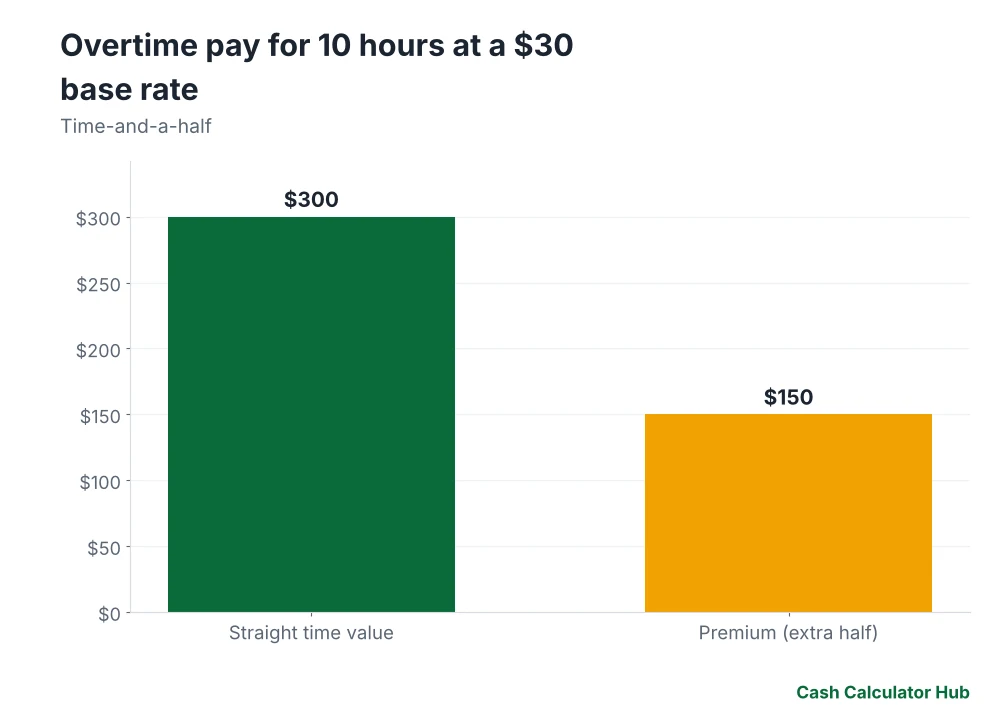
Example: 10 hours of overtime at a regular rate of $30 earns time-and-a-half of $45 an hour: $450. The premium portion (the extra half) is $150.
Overtime deduction, 2025 to 2028
A temporary federal deduction applies to the premium (the “half” in time-and-a-half) portion of qualified overtime, up to $12,500 per year ($25,000 for joint filers), phasing out for higher incomes. It reduces income tax but not FICA. Check IRS guidance for details.
Get the withholding right
- If a large bonus is coming, adjust your W-4; see W-4 guide.
- Consider a 401(k) contribution from the bonus; see 2026 limits.
- Ask HR whether the bonus is paid with the regular check (aggregate method) or separately.
- Keep track of state withholding rules.
What to do with a bonus
Common choices: build the emergency fund, pay down high-interest debt (card payoff), or invest (lump sum or DCA).
Tools
Use the take-home paycheck calculator and income tax calculator. More: tax tools.
Frequently asked questions
Why is tax on my bonus so high?
Employers often withhold federal tax at a flat 22% plus payroll taxes, which can exceed your real marginal rate. Any excess is refunded when you file.
Are bonuses taxed differently than salary?
Not at filing: they are ordinary income. Only the withholding method differs.
How is overtime taxed?
As ordinary income, plus FICA. A temporary deduction may apply to the premium portion for 2025 to 2028.
Can I reduce tax on a bonus?
Contribute to a 401(k) or HSA through payroll, or adjust your W-4.
What is supplemental wages withholding?
A flat percentage, 22% federally, that employers can apply to bonuses and certain other irregular pay.
Sources and further reading
How the numbers were made: Every figure on this page was calculated from the formulas and assumptions stated above and rounded to the nearest dollar. Rates, limits and rules are for 2026 unless noted; confirm current figures with the sources listed before acting.
Keep reading
- How Much Is a $100,000 Salary After Taxes in 2026?
- Hourly to Salary: What Is $25 an Hour Per Year?
- 2026 Federal Tax Brackets and Standard Deduction, Explained With Examples
- Take-Home Pay on $50K, $75K and $150K Salaries (2026 Federal Taxes)
- Estate and Gift Tax Basics 2026: $15 Million Exemption and $19,000 Annual Gifts
- HSA vs FSA: Which Health Account Is Better and What Are the 2026 Limits?
This guide is general information, not financial, tax or legal advice. Figures use stated assumptions and 2026 rules and will differ from your situation; check current rules and talk to a licensed professional before you decide. Full disclaimer.