Quick answer: The Child Tax Credit for 2026 is $2,200 per qualifying child under 17, and up to $1,700 per child is refundable (the Additional Child Tax Credit, 15% of earned income above $2,500). The credit begins to phase out at $200,000 of modified AGI ($400,000 for married filing jointly), reducing by $50 for each $1,000 above the threshold.
The Child Tax Credit is one of the largest tax benefits for families. Because it is a credit rather than a deduction, it subtracts directly from tax owed. For many families it offsets thousands of dollars of tax.
Key takeaways
- Credit amount: $2,200 per qualifying child under 17 at year-end.
- Refundable portion: up to $1,700 per child, equal to 15% of earned income above $2,500.
- Phase-out begins at $200,000 (single) or $400,000 (joint) of modified AGI: $50 less per $1,000 above.
- The child must have a Social Security number valid for work, and you must claim them as a dependent.
- A separate $500 credit exists for other dependents.
Credit amounts at a glance
| 2026 | |
|---|---|
| Credit per qualifying child | $2,200 |
| Refundable (ACTC) maximum per child | $1,700 |
| Phase-out threshold, single / head of household | $200,000 |
| Phase-out threshold, married filing jointly | $400,000 |
| Reduction | $50 per $1,000 (or fraction) above threshold |
| Credit for other dependents | $500 |
Examples
| Children | Filing status | MAGI | Phase-out reduction | Credit |
|---|---|---|---|---|
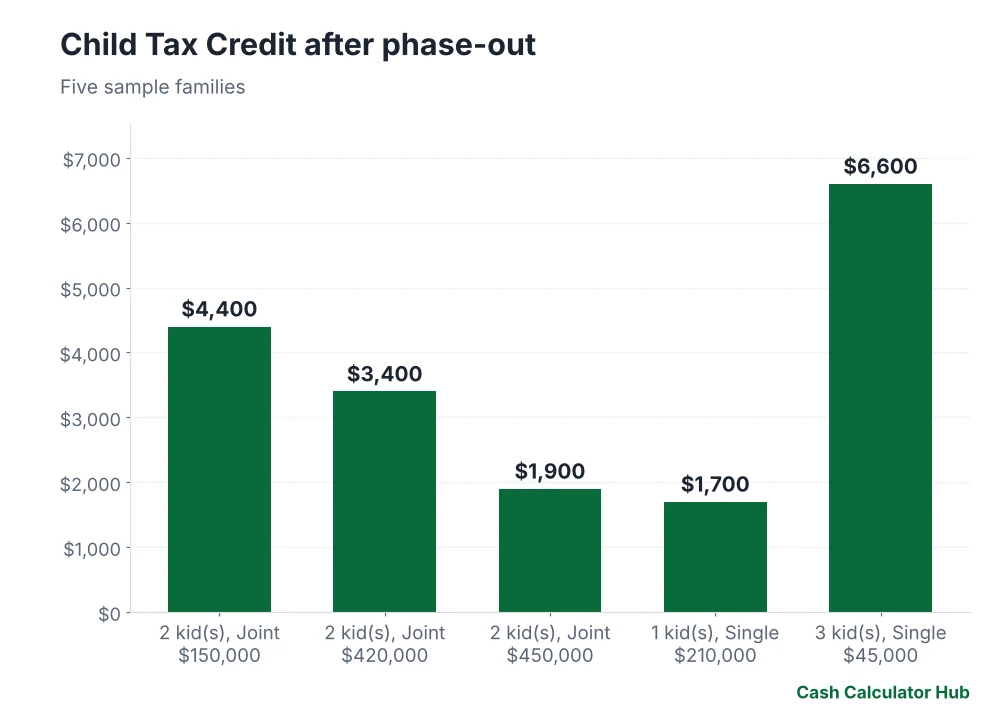
| 2 | Joint | $150,000 | $0 | $4,400 |
| 2 | Joint | $420,000 | $1,000 | $3,400 |
| 2 | Joint | $450,000 | $2,500 | $1,900 |
| 1 | Single | $210,000 | $500 | $1,700 |
| 3 | Single | $45,000 | $0 | $6,600 |
The refundable part
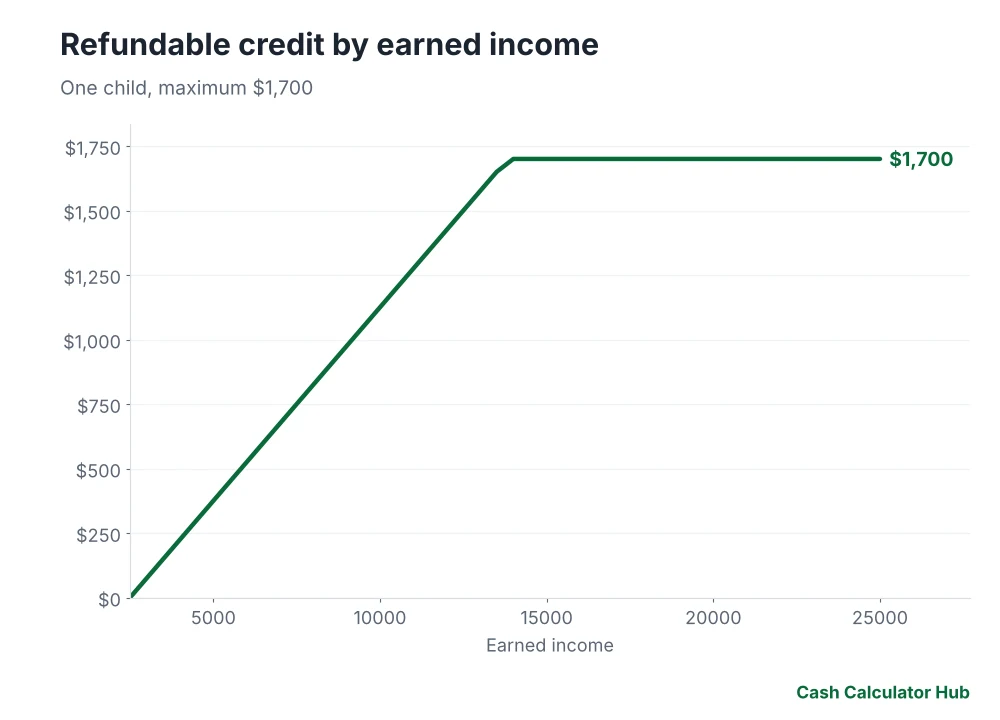
If the credit exceeds your tax, you may get up to $1,700 per child as a refund. The refundable amount is 15% of earned income over $2,500.
Example: a single parent earning $12,000 with one child. The credit is $2,200, but income tax is $0 after the standard deduction. Refundable credit = 15% × ($12,000 − $2,500) = $1,425.
| Earned income | Refundable credit (one child, max $1,700) |
|---|---|
| $2,500 | $0 |
| $10,000 | $1,125 |
| $14,000 | $1,700 |
| $20,000 | $1,700 |
Who qualifies
- Age under 17 at the end of the tax year.
- Your son, daughter, stepchild, foster child, sibling or descendant.
- Lived with you more than half the year.
- Did not provide more than half of their own support.
- U.S. citizen, national or resident alien, with a valid SSN.
How it affects withholding
Claiming the credit on Form W-4 Step 3 reduces withholding. See W-4 guide. Other family tax items: the dependent care credit, education credits and the marriage-related rules in marriage tax.
Credit versus deduction
A $2,200 credit cuts tax by $2,200. A $2,200 deduction at 22% would save only $484. See deductions versus credits.
Planning
- Use the credit with a 529 plan or an emergency fund.
- Check state credits; many states have their own.
- Update the W-4 after the child is born.
Tools
Estimate your tax with the income tax calculator and your paycheck with the take-home paycheck calculator. More: tax tools.
Frequently asked questions
How much is the Child Tax Credit for 2026?
$2,200 per qualifying child under 17, with up to $1,700 refundable.
At what income does the Child Tax Credit phase out?
Starting at $200,000 for single filers and $400,000 for married couples filing jointly, reducing by $50 per $1,000.
Is the Child Tax Credit refundable?
Partly. Up to $1,700 per child can be refunded, based on 15% of earned income above $2,500.
What age must the child be?
Under 17 at the end of the tax year.
Do I need a Social Security number for my child?
Yes, the child needs an SSN valid for employment issued before the due date of the return.
Sources and further reading
How the numbers were made: Every figure on this page was calculated from the formulas and assumptions stated above and rounded to the nearest dollar. Rates, limits and rules are for 2026 unless noted; confirm current figures with the sources listed before acting.
Keep reading
- Marriage Tax Penalty or Bonus: Who Pays More in 2026?
- 2026 Federal Tax Brackets and Standard Deduction, Explained With Examples
- How Much Is a $100,000 Salary After Taxes in 2026?
- Take-Home Pay on $50K, $75K and $150K Salaries (2026 Federal Taxes)
- Estate and Gift Tax Basics 2026: $15 Million Exemption and $19,000 Annual Gifts
- Overtime and Bonus Pay: Why the Tax Looks So High and How Much You Really Keep
This guide is general information, not financial, tax or legal advice. Figures use stated assumptions and 2026 rules and will differ from your situation; check current rules and talk to a licensed professional before you decide. Full disclaimer.