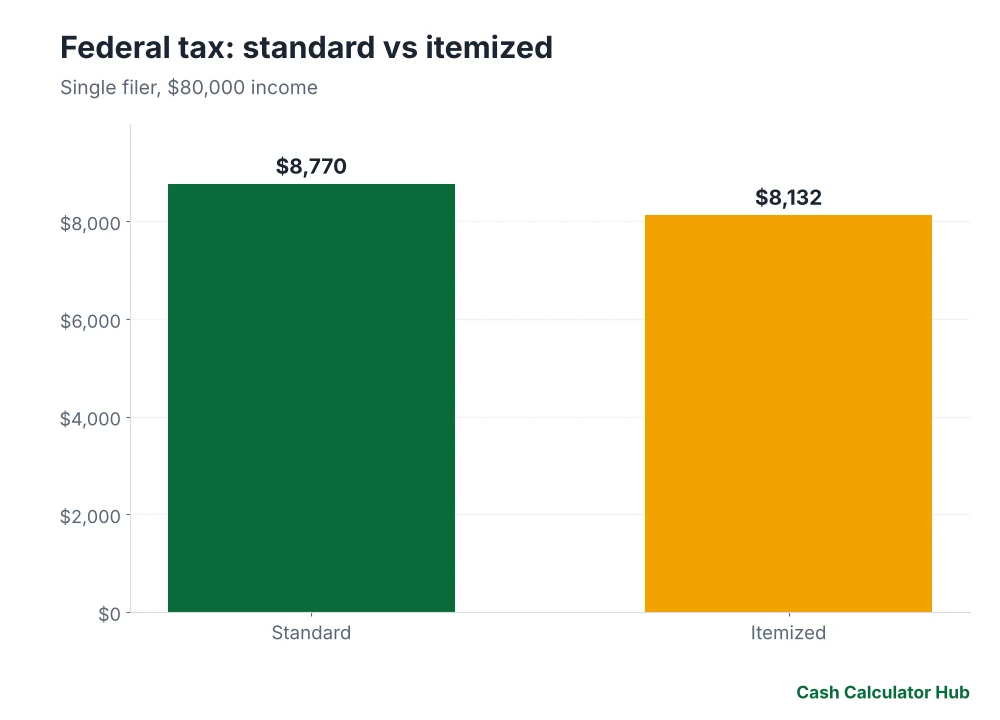
Quick answer: For 2026 the standard deduction is $16,100 for single filers, $32,200 for married couples filing jointly and $24,150 for heads of household. Itemize only if your deductible expenses (mortgage interest, state and local taxes up to the SALT cap, charitable gifts and medical costs over 7.5% of income) add up to more. In the example below, $19,000 of itemized expenses beats the standard deduction and saves $638 of federal tax.
Every taxpayer subtracts either the standard deduction or the total of their itemized deductions from income, whichever is larger. Because the standard deduction is high, most filers take it. The question is whether you are close enough to the line to check.
Key takeaways
- 2026 standard deduction: $16,100 single, $32,200 married filing jointly, $24,150 head of household.
- Extra standard deduction for age 65+ or blind; a new $6,000 senior deduction may also apply through 2028.
- Itemized deductions: mortgage interest, state and local taxes (SALT, capped at about $40,000), charity, and medical costs above 7.5% of AGI.
- You can only use one method for the year; married couples filing separately must both use the same.
- Bunching deductions into alternate years can help when you are near the line.
The comparison
Example: single filer, $80,000 income.
| Item | Amount |
|---|---|
| Mortgage interest | $9,000 |
| State and local taxes (under the cap) | $8,000 |
| Charitable gifts | $2,000 |
| Itemized total | $19,000 |
| Standard deduction | $16,100 |
| Standard | Itemized | |
|---|---|---|
| Taxable income | $63,900 | $61,000 |
| Federal tax | $8,770 | $8,132 |
| Difference | $638 saved |
2026 standard deductions
| Filing status | Standard deduction |
|---|---|
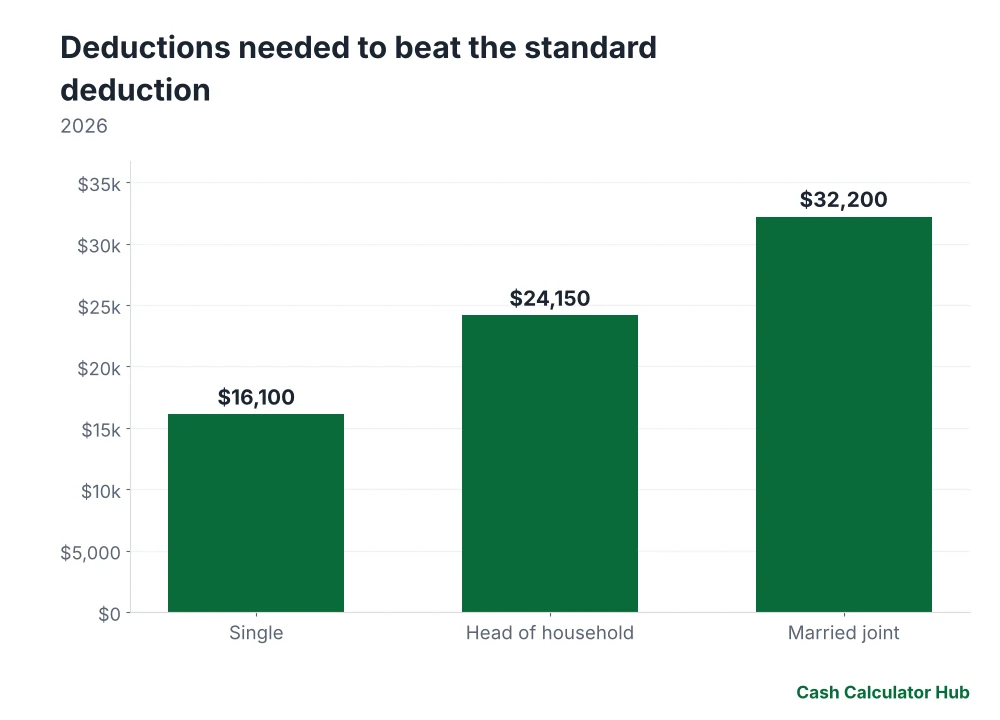
| Single | $16,100 |
| Married filing jointly | $32,200 |
| Head of household | $24,150 |
What counts as an itemized deduction
- Mortgage interest on up to $750,000 of loan balance. See property tax and your mortgage.
- State and local taxes (income or sales tax plus property tax) capped at about $40,000 for most filers, phasing down for very high incomes.
- Charitable contributions to qualified organizations, generally up to 60% of AGI for cash gifts.
- Medical and dental expenses exceeding 7.5% of AGI.
- Mortgage insurance premiums (restored for 2026) for those who itemize. See PMI.
How many people need to itemize?
You need roughly $16,100 of deductions as a single filer, or $32,200 for a couple, before itemizing helps. A couple with a $400,000 mortgage at 7% pays about $28,000 of interest in year one, plus property tax and state income tax, which can pass $32,200.
Bunching
If your itemized total is below the standard deduction most years, you can bunch: pay two years of charitable gifts or property tax in a single year (using a donor-advised fund for gifts), itemize that year and take the standard deduction the next.
Above-the-line deductions
Some deductions reduce income whether you itemize or not: HSA contributions, traditional IRA contributions (if eligible), student loan interest up to $2,500 and half of self-employment tax. See HSA versus FSA.
Credits are different
Deductions reduce taxable income; credits reduce tax directly. See deductions versus credits.
Tools
Estimate with the income tax calculator, compare with take-home paycheck calculator and see the brackets in 2026 brackets. More: tax tools.
Frequently asked questions
What is the standard deduction for 2026?
$16,100 for single filers, $32,200 for married couples filing jointly and $24,150 for heads of household.
Should I itemize or take the standard deduction?
Itemize only if your allowed itemized deductions exceed the standard deduction for your filing status.
What is the SALT cap?
A limit on the deduction for state and local taxes, about $40,000 for most filers in 2026 under current law.
Can I take the standard deduction and itemize?
No. You must choose one or the other each year.
What is bunching deductions?
Concentrating deductible expenses, such as charity, into one year so you can itemize that year and take the standard deduction the next.
Sources and further reading
How the numbers were made: Every figure on this page was calculated from the formulas and assumptions stated above and rounded to the nearest dollar. Rates, limits and rules are for 2026 unless noted; confirm current figures with the sources listed before acting.
Keep reading
- 2026 Federal Tax Brackets and Standard Deduction, Explained With Examples
- How Much Is a $100,000 Salary After Taxes in 2026?
- Marriage Tax Penalty or Bonus: Who Pays More in 2026?
- How to Read Your Paycheck: Gross Pay, Withholding and Net Pay Explained
- FICA Taxes Explained: Social Security and Medicare Withholding in 2026
- W-2 vs 1099: How Much More You Must Charge to Match an Employee Salary
This guide is general information, not financial, tax or legal advice. Figures use stated assumptions and 2026 rules and will differ from your situation; check current rules and talk to a licensed professional before you decide. Full disclaimer.