Quick answer: SAVE has ended and the new RAP plan began July 1, 2026. On $40,000 at 6.5% the standard 10-year payment is $454.
Student loan rules are changing in ways that matter to your bill. This guide explains the situation as of October 2026 and shows how to compare your options with arithmetic. Federal programs change often, so always confirm details on studentaid.gov or with your servicer.
What changed
- The SAVE plan has ended. A court order and the 2025 budget law ended it. Borrowers who were enrolled had to choose a new plan; servicers began giving notice in July 2026, with a window of about 90 days. If you took no action you may be moved to a standard plan automatically, with payments due this fall.
- A new Repayment Assistance Plan (RAP) became available July 1, 2026. It is an income-driven plan with payments that scale with income, starting at a low minimum and rising to as much as 10% of adjusted gross income at higher incomes, with a term of up to 30 years.
- New loans from July 1, 2026 have fewer repayment options: a standard plan and RAP.
- Limits on some types of borrowing, including Grad PLUS for new borrowers, have changed. Check current rules if you plan to borrow.
The arithmetic of any repayment plan
Whatever the plan, you owe interest on the balance. A fixed-term plan uses the same formula as any loan:
Payment = P × r ÷ (1 − (1 + r)^−n)
For $40,000 at 6.5%:
| Term | Monthly payment | Total interest |
|---|---|---|
| 10 years | $454 | $14,503 |
| 15 years | $348 | $22,720 |
| 20 years | $298 | $31,575 |
| 25 years | $270 | $41,025 |
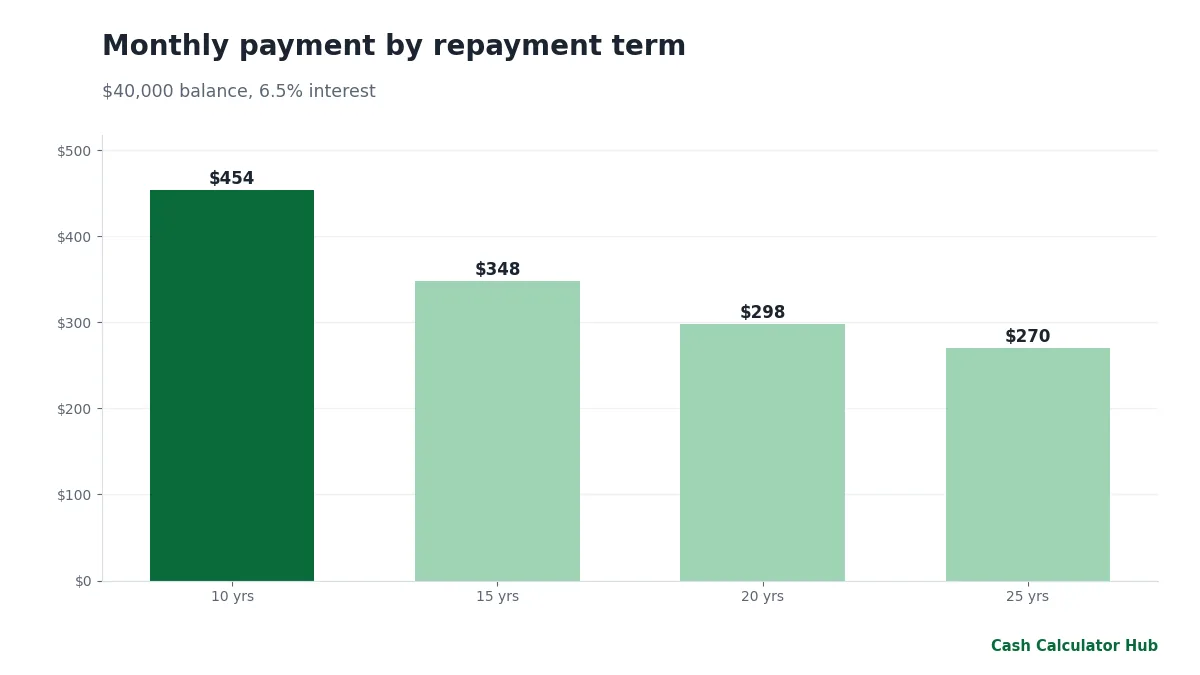
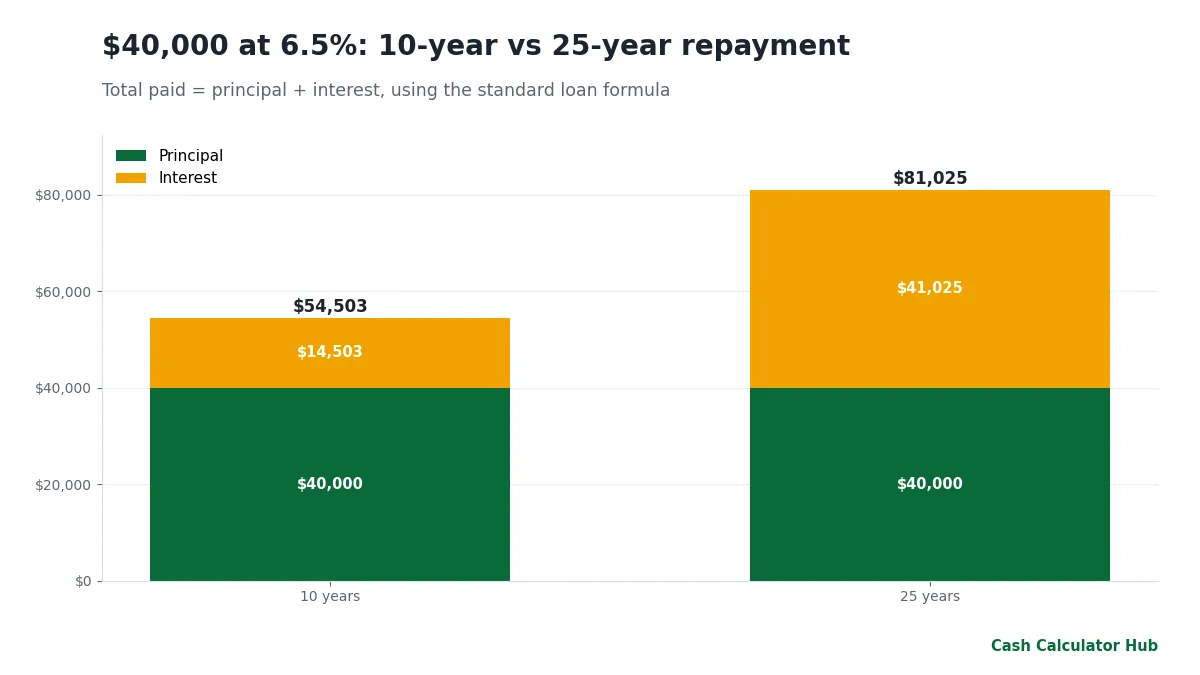
Moving from 10 to 25 years cuts the payment by $184 a month but adds $26,522 in interest. Income-driven plans work differently: the payment depends on income rather than the balance, and any remaining balance may be forgiven after a set number of years (with possible tax implications, depending on the law at that time).
Choosing a plan: questions to ask
- Can I afford the standard payment? If so, it is usually the cheapest in total interest.
- Is my income low relative to my debt? Income-driven plans can make sense if the standard payment is more than 10% to 15% of income, especially if you work in public service (check eligibility for forgiveness programs).
- Does the payment cover the interest? If not, the balance can grow. Learn how your plan treats unpaid interest.
- Is it a federal or a private loan? Private loans do not have these plans.
- Does marriage change my payment? Filing jointly can raise the income used; see the marriage tax guide.
Interest accrual
On unsubsidized loans, interest accrues during school and grace periods. If it capitalizes (is added to the balance), you pay interest on interest later. The student loan calculator models interest accrued before repayment and shows the payments.
Extra payments
Adding $100 a month to the 10-year plan above would shorten payoff by about 2.3 years and save about $3,632. Make sure the extra goes to principal. Use the repayment calculator to test your own amounts.
Refinancing: be careful
Refinancing federal loans into a private loan can lower your rate if your credit and income are strong, but you lose federal protections, income-driven plans and any forgiveness programs. Do not refinance if you may need those. If you only have private loans, use the personal loan calculator to compare rates and fees. If rates are high, the benefit may be small. Mortgage rates have also risen recently; see how student loan payments affect a mortgage application.
What to do this month
- Log in to your servicer and note your loan types, balances and rates.
- Use the federal Loan Simulator on studentaid.gov to compare your plans.
- Choose and confirm your plan before any deadline.
- Set up autopay (often a 0.25% rate discount).
- Include the payment in your budget; see the 50/30/20 rule.
More tools: loans and debt calculators and the loan calculator for any fixed payment.
Programs and tax breaks to check
- Public Service Loan Forgiveness (PSLF). For borrowers working full time for qualifying government or nonprofit employers, remaining federal Direct Loan balances may be forgiven after 120 qualifying payments. Plan choice and employment certification matter, so confirm current rules.
- Employer repayment help. Some employers contribute to your loans, and recent law allows employers to make certain tax-advantaged payments toward student loans. Ask HR.
- Student loan interest deduction. Up to $2,500 of interest can be deducted, subject to income phase-outs.
If you cannot make the payment
Contact your servicer before you miss one. Options include switching to an income-driven plan, a deferment or forbearance in specific situations, and rehabilitation if you are in default. Default can bring wage garnishment and collection costs, so avoid it. Interest generally continues to accrue during forbearance, which is why a lower income-based payment is often better than pausing.
Keep it in your budget
Add the payment to your monthly plan using the 50/30/20 rule and review it each year when your income changes, since income-driven plans recalculate with new income documentation. Test extra payments in the repayment calculator.
What happened to the SAVE plan?
It ended after court action and the 2025 budget law. Borrowers have been moved to other plans.
What is RAP?
The Repayment Assistance Plan, an income-driven plan that began July 1, 2026. Confirm the current formula on studentaid.gov.
Should I pay off student loans early?
If the rate is higher than what you would earn investing and you have an emergency fund, yes; otherwise balance it with your retirement contributions.
Will my loans be forgiven?
Only under specific programs and conditions. Do not count on forgiveness without confirming eligibility.
Sources and further reading
- Federal Student Aid
- IRS Topic 456: Student loan interest deduction
- Consumer Financial Protection Bureau
How the numbers were made: Every figure on this page was calculated from the formulas and assumptions stated above and rounded. Rates, limits and rules are for 2026 unless noted; confirm current figures with the sources listed before acting.
Keep reading
- Marriage Tax Penalty or Bonus: Who Pays More in 2026?
- Debt-to-Income Ratio for a Mortgage: What Lenders Allow
- The 50/30/20 Budget Rule: How It Works, and How to Adjust It
- 529 College Savings Plans: How Much to Save and How the Tax Rules Work
- APR vs APY: What’s the Difference and Why It Matters for Loans and Savings
- Credit Score Factors: What Moves Your Score and by How Much
This guide is general information, not financial, tax or legal advice. Figures use stated assumptions and 2026 rules and will differ from your situation; check current rules and talk to a licensed professional before you decide. Full disclaimer.