
Quick answer: A 50% markup is only a 33% margin.
Ask a small-business owner what their profit is and you will often hear “I mark everything up 50%.” Ask what percentage of revenue is profit and the answer is usually something different, usually lower than they think. These two numbers are both correct, but they are not the same number.
The definitions
- Markup = (price − cost) ÷ cost. It tells you how much you add on top of your cost.
- Gross margin = (price − cost) ÷ price. It tells you what share of each sales dollar is profit before other expenses.
The only difference is the denominator.
An example
A product costs you $60 and you sell it for $100. Profit is $40.
- Markup: $40 ÷ $60 = 66.7%
- Margin: $40 ÷ $100 = 40%
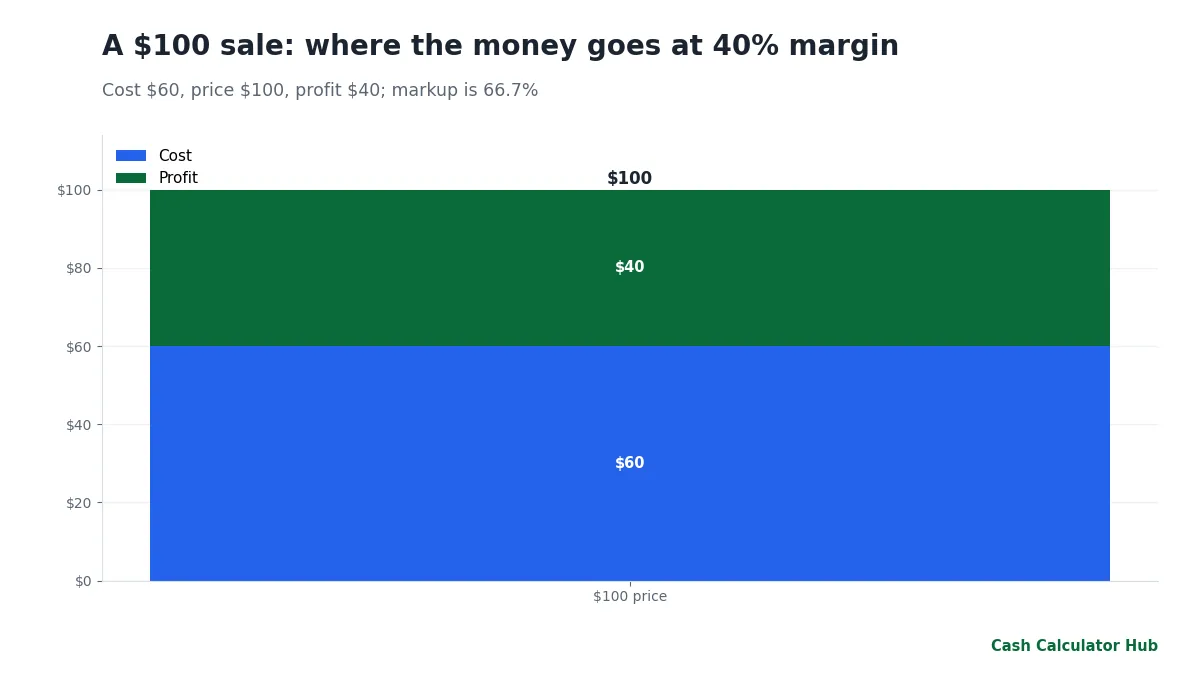
Same sale, two percentages. Neither is wrong, but you must know which one you are using.
Conversion table
| Markup | Margin | Margin | Markup | |
|---|---|---|---|---|
| 20% | 16.7% | 20% | 25.0% | |
| 30% | 23.1% | 30% | 42.9% | |
| 50% | 33.3% | 40% | 66.7% | |
| 100% | 50.0% | 50% | 100.0% | |
| 200% | 66.7% | 60% | 150.0% |
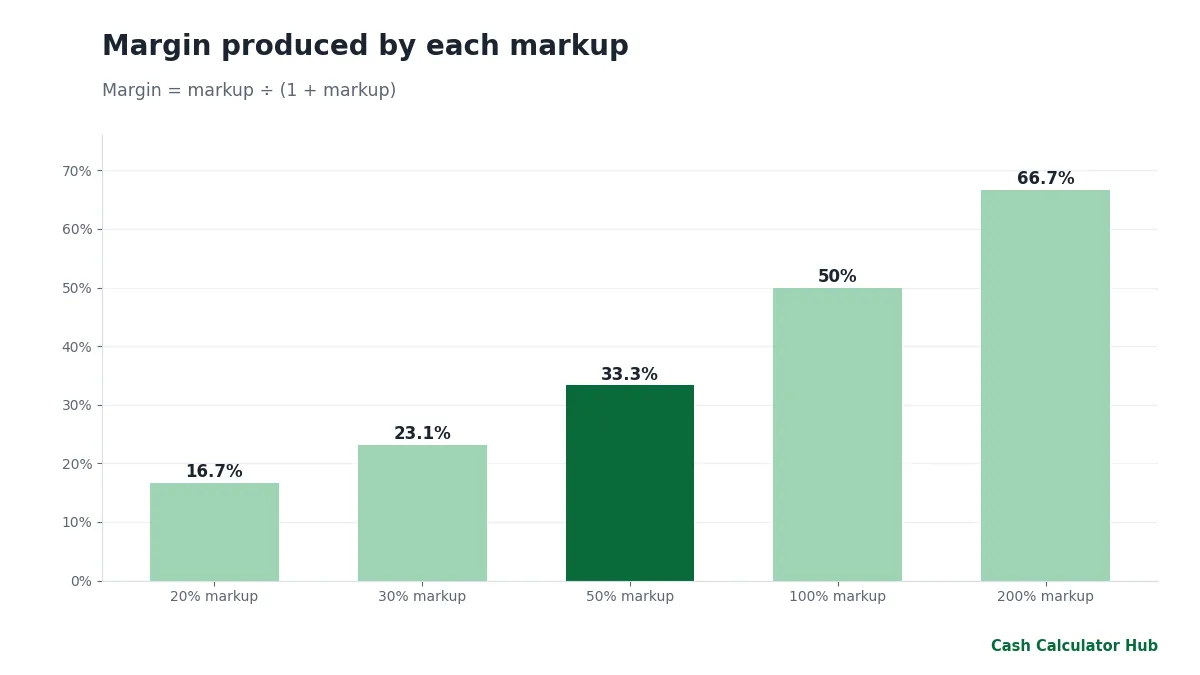
Formulas: margin = markup ÷ (1 + markup) and markup = margin ÷ (1 − margin).
The mistake that costs money
Suppose you want a 40% margin and you mistakenly add a 40% markup to cost. A $60 item sells for $84, not $100. Profit is $24, a margin of only 28.6%. On 1,000 sales a year, that is a shortfall of $16,000. To get a true 40% margin, divide the cost by (1 − 0.40): $60 ÷ 0.60 = $100.
Which should you use?
- Margin is what financial statements use, and what you compare against operating costs, so it is the better measure of profitability. Many retailers and software companies talk in margin.
- Markup is convenient when pricing from cost (“keystone” pricing is a 100% markup, or 50% margin), common in retail, construction and wholesale.
Gross margin is not profit
Gross margin leaves out rent, salaries, marketing, fees and taxes. If your gross margin is 40% and operating costs are 35% of revenue, your operating margin is 5%. Always check that the gross margin you price at can cover the rest. Payment processing fees of about 3%, discounts and returns reduce it further. See how discounts change it in the discount calculator: a 20% discount on a 40% margin item can cut profit in half.
Related measurements
- ROI measures return on money invested, not on sales. See ROI, IRR and CAGR.
- Commissions change your effective margin if you pay salespeople; model them in the commission calculator.
- Sales tax is not part of your revenue; learn how it works in the sales tax by state guide.
Calculate it
The margin calculator finds margin, markup, cost, price and profit from any two of the values. For ROI and profit margin on a project, use the ROI and profit margin calculator, and the depreciation calculator for equipment costs. See business and everyday tools.
What a discount does to margin
An item costs $60 and sells for $100 (40% margin, $40 profit). If you discount it:
| Discount | Sale price | Profit | Margin |
|---|---|---|---|
| 0% | $100 | $40 | 40.0% |
| 10% | $90 | $30 | 33.3% |
| 20% | $80 | $20 | 25.0% |
| 30% | $70 | $10 | 14.3% |
A 20% discount cuts profit in half. To make up the lost profit with volume you need to sell twice as many units. That is a hard sell if you are discounting because demand is weak.
Pricing a service business
Services have costs too: labor, tools, software, insurance and your own time. Calculate the cost of delivering one hour of work, including a share of overhead, and then use the margin formula. If a contractor’s fully loaded cost is $45 an hour and they want a 35% margin, the price is $45 ÷ 0.65 = $69.23 an hour. Check the result against what the market will pay and decide whether to change the cost or the offering. For commissions on top, see the commission calculator.
What is a good profit margin?
It depends on the industry. Grocery gross margins are low, around 25% to 30%; software is often above 70%. Compare with your peers.
Can margin exceed 100%?
No. Markup can, margin cannot.
How do I price for a target margin?
Price = cost ÷ (1 − target margin).
Is gross margin the same as net margin?
No. Net margin subtracts all expenses and taxes.
Sources and further reading
How the numbers were made: Every figure on this page was calculated from the formulas and assumptions stated above and rounded. Rates, limits and rules are for 2026 unless noted; confirm current figures with the sources listed before acting.
Keep reading
- ROI vs IRR vs CAGR: Which Return Number Should You Trust?
- Sales Tax by State: Base Rates, No-Tax States and How to Calculate Total Tax
- Percentage Increase and Decrease: Formulas, Examples and the 20% Trap
- Successive Discounts: Why 20% Off Plus 10% Off Is Not 30% Off
- Gross Margin vs Operating Margin vs Net Margin: What Each Tells You
- Break-Even Analysis: How Many Units or How Much Revenue You Need to Cover Costs
This guide is general information, not financial, tax or legal advice. Figures use stated assumptions and 2026 rules and will differ from your situation; check current rules and talk to a licensed professional before you decide. Full disclaimer.