
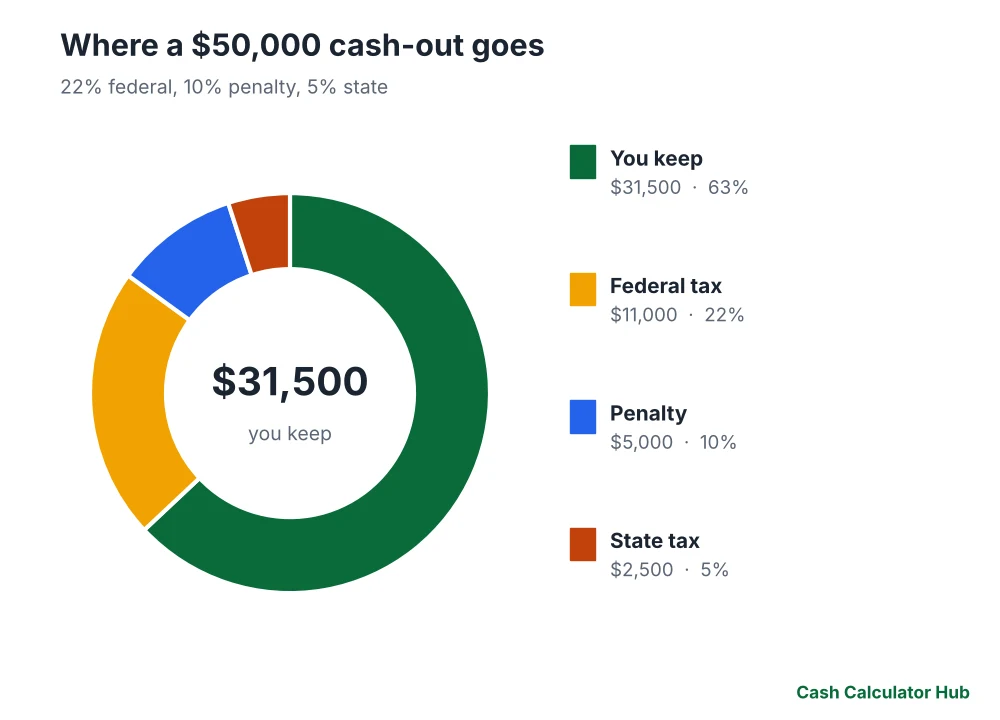
Quick answer: When you leave a job you can leave your 401(k) where it is, roll it into your new employer’s plan, roll it into an IRA or cash it out. Cashing out is usually the worst choice: a $50,000 balance could shrink to about $31,500 after 22% federal tax, a 10% penalty and 5% state tax, while a rollover to an IRA keeps the whole $50,000 growing tax-deferred.
Most workers have several jobs over a career, and leftover 401(k) balances are often forgotten. The choice you make when you leave affects fees, investment options and taxes. The key is to move the money directly and avoid cashing out.
Key takeaways
- Four options: leave it, roll to the new 401(k), roll to an IRA, or cash out.
- A direct rollover avoids tax and withholding; an indirect rollover requires 20% withholding and a 60-day deadline.
- Cashing out a $50,000 balance at age 40 in the 22% bracket with 5% state tax leaves about $31,500.
- Rolled over at 7%, $50,000 grows to about $271,372 in 25 years.
- Compare fees, investment menu, creditor protection and loan features before choosing.
The four options
| Option | Pros | Cons |
|---|---|---|
| Leave it | No action; maybe low institutional fees | Easy to forget; no more contributions |
| Roll to new 401(k) | One account; may allow loans; creditor protection | Limited investment menu; plan must accept rollovers |
| Roll to an IRA | Wide choice of investments and low-cost funds | May lose federal protections in some states; pro-rata effects for backdoor Roth |
| Cash out | Immediate cash | Taxes, 10% penalty if under 59½, lost growth |
What cashing out costs
$50,000 cashed out at 40, with 22% federal tax, a 10% early-withdrawal penalty and 5% state tax:
| Amount | |
|---|---|
| Balance | $50,000 |
| Federal tax (22%) | −$11,000 |
| Penalty (10%) | −$5,000 |
| State tax (5%) | −$2,500 |
| You receive | $31,500 |
The cash-out also adds $50,000 to your taxable income that year, which might push you into a higher bracket. See 2026 brackets.
What a rollover is worth
Left alone at 7%:
| Years | Growth of $50,000 |
|---|---|
| 10 | $98,358 |
| 15 | $137,952 |
| 20 | $193,484 |
| 25 | $271,372 |
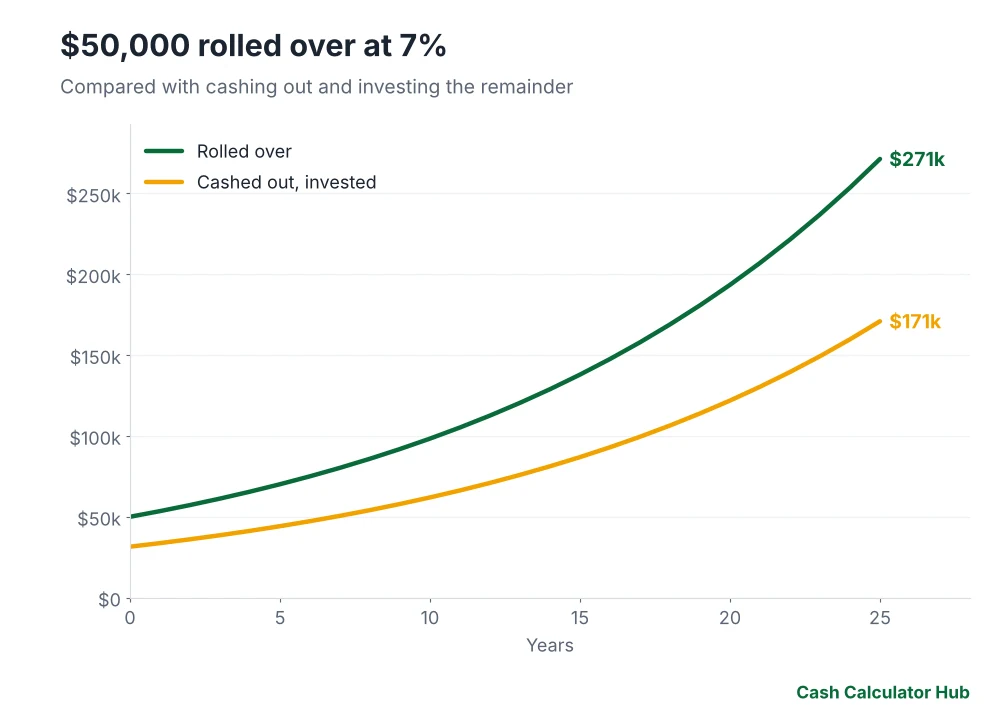
The $31,500 you would receive after cashing out, even invested at 7% for 25 years, grows to only $170,964.
Direct versus indirect rollover
- Direct rollover: the old plan sends the money straight to the new account. No withholding and no tax.
- Indirect rollover: the plan sends you a check with 20% withheld. You have 60 days to deposit the full amount (including the withheld 20% from your own pocket) in the new account, or the unreplaced part is taxable.
Always ask for a direct rollover.
Compare before deciding
- Fees: expense ratios and plan administration fees. See expense ratios.
- Investment menu: index funds and target-date funds.
- Services: loans, advice, and Roth in-plan conversions.
- Protection: federal ERISA protection versus state IRA protection against creditors.
- Roth balances: roll Roth 401(k) money to a Roth IRA, and note the five-year rule; see Roth vs traditional.
- Company stock: consider net unrealized appreciation tax treatment before rolling it.
- Rule of 55: if you leave your employer at 55 or later, you may take penalty-free withdrawals from that employer’s 401(k) but not from an IRA.
Small balances
Plans may force out balances under $7,000 into an IRA or cash out balances below $1,000. Respond to notices.
Tools
The 401(k) calculator shows growth; the retirement calculator projects income. For contribution limits see 2026 limits. More: retirement tools.
Frequently asked questions
What should I do with my old 401(k)?
In most cases, leave it or roll it into your new employer’s plan or an IRA. Avoid cashing out because of taxes and penalties.
Is a 401(k) rollover taxable?
A direct rollover to another 401(k) or IRA is not taxable. A Roth conversion or cash-out is.
How long do I have to roll over a 401(k)?
With an indirect rollover you have 60 days. A direct rollover has no such deadline problem.
Should I roll my 401(k) into an IRA?
It can offer more investment choices and lower fees, but compare protections, the rule of 55 and any impact on backdoor Roth contributions.
What is the penalty for cashing out a 401(k)?
A 10% additional tax if you are under 59½, plus ordinary income tax on the amount, unless an exception applies.
Sources and further reading
How the numbers were made: Every figure on this page was calculated from the formulas and assumptions stated above and rounded to the nearest dollar. Rates, limits and rules are for 2026 unless noted; confirm current figures with the sources listed before acting.
Keep reading
- 2026 401(k) and IRA Contribution Limits, Explained
- Roth vs Traditional 401(k) and IRA: How to Decide
- How Expense Ratios Quietly Cost You Six Figures
- Solo 401(k) vs SEP IRA: Which Retirement Plan Is Better for the Self-Employed?
- Sequence of Returns Risk: Why Bad Years Early in Retirement Matter Most
- Medicare Costs in Retirement: Premiums, Deductibles and IRMAA Surcharges
This guide is general information, not financial, tax or legal advice. Figures use stated assumptions and 2026 rules and will differ from your situation; check current rules and talk to a licensed professional before you decide. Full disclaimer.