Quick answer: A 1% expense ratio sounds tiny. On $10,000 plus $500 a month for 30 years at 7% it costs about $121,482.
A fund’s expense ratio is deducted from your balance quietly, a little every day, and never shows up as a bill. That is exactly why it is so powerful, in the wrong direction. The Investment Company Institute and others have shown average equity mutual fund fees fall each year, but the spread between the cheapest and most expensive funds is still wide.
The arithmetic
An expense ratio of 1.00% means $1.00 of every $100 you hold is taken per year. If the fund earns 7% before costs, you net 6%. That 1-point difference compounds, because the money that was taken would have kept earning too.
Assume $10,000 to start, $500 a month for 30 years, and a 7% gross return:
| Fund type | Net return | Ending balance | Cost versus cheapest |
|---|---|---|---|
| 0.05% index fund | 6.95% | $683,965 | $0 |
| 0.50% fund | 6.50% | $623,007 | $60,958 |
| 1.00% fund | 6.00% | $562,483 | $121,482 |
| 1.00% + 5.75% load | 6.00% | $530,140 | $153,825 |
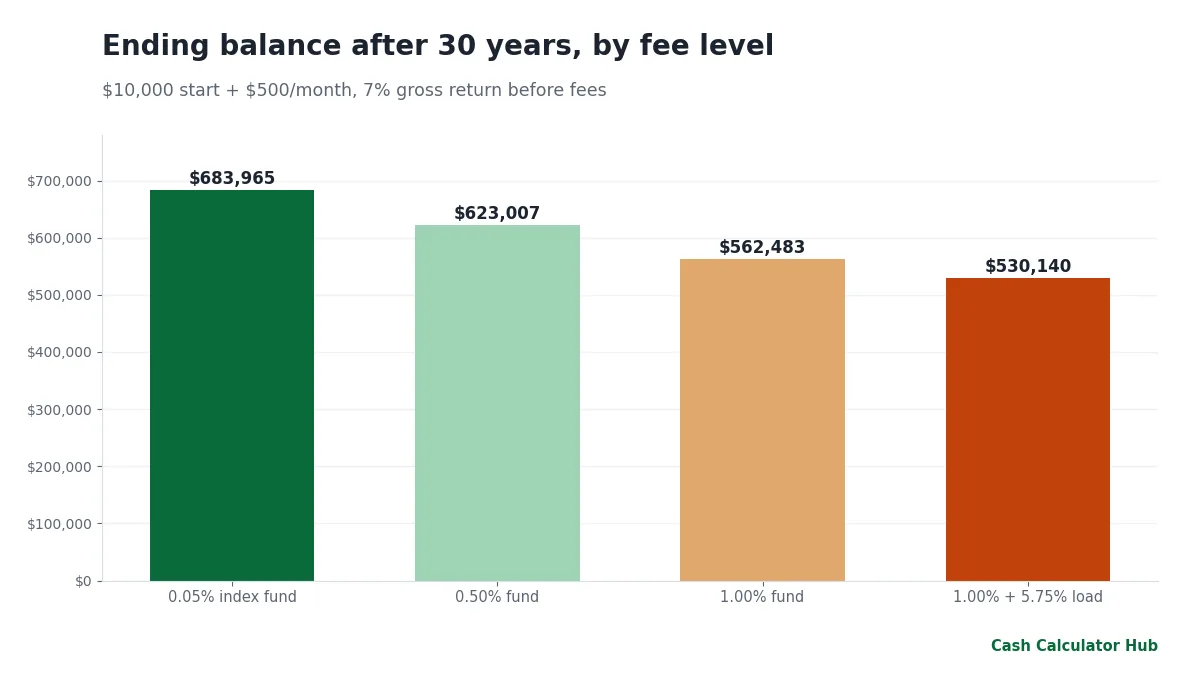
The 1.00% fund leaves you $121,482 short, or 18% of what the cheapest fund produced, even though you contributed the same. Add a 5.75% front-end sales load on every deposit and the loss rises to $153,825.
The gap compounds in your disfavor
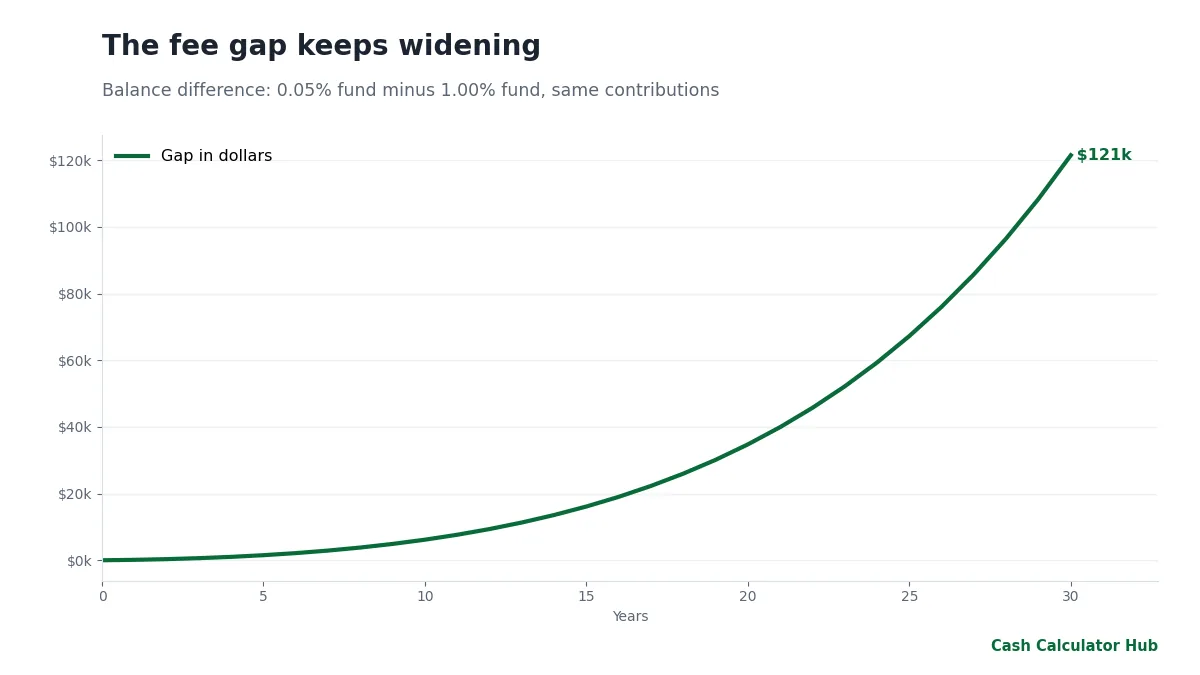
For the first ten years the difference looks small: $6,168. By year 20 it is $34,753, and by year 30 it is $121,482. This is why people shrug at fees early in their careers and regret it late.
What is in “the cost” of a fund
- Expense ratio: the yearly percentage taken out for management, administration and marketing. It is in the fund’s prospectus and on any fund page.
- Sales loads: commissions paid when you buy (front-end), when you sell (back-end) or each year through 12b-1 fees (level load).
- Trading costs inside the fund: not part of the expense ratio. Low-turnover index funds minimize them.
- Advisory fees: if you pay an advisor 1% on top, you are on the 2% line of this table.
- Taxes: actively managed funds tend to distribute more capital gains, which creates a tax bill in taxable accounts.
Does a higher fee buy better performance?
On average, no. Research from S&P Dow Jones Indices has repeatedly found that the majority of actively managed domestic stock funds underperform their benchmark over 10 and 15-year periods, and that a fund doing well in one period is not reliably likely to repeat. That does not mean no active manager is worth the fee. It does mean you should expect to prove it before paying 0.8% more per year.
Where to find your costs
- Look up each fund by ticker on the fund company’s website or on a major fund-research site and find the “total expense ratio” (sometimes “net expense ratio”).
- Check the account statement for an advisory fee line.
- Ask whether your 401(k) offers an index-fund option; plan menus differ widely.
- Check the load schedule if you hold funds purchased through a broker.
Quick actions
- Switch to a low-cost index fund if the tax cost of selling is small or the account is tax-advantaged. In a taxable account, selling can trigger capital gains, so compare.
- In a 401(k), pick the lowest-cost diversified option. See 2026 401(k) and IRA limits.
- Avoid front-end loads when a no-load equivalent exists.
Test your own funds
The mutual fund calculator lets you enter expense ratio, loads and taxes to see the net result. The average return calculator converts real results into compound annual growth, and the investment calculator projects your plan. For the effect of time, read compound interest on $10,000. More: investment calculators.
A three-step fee audit
- List every fund and account you own, including old 401(k)s. Write down the expense ratio next to each.
- Find the weighted average. Multiply each fund’s ratio by its share of your portfolio. If the result is above about 0.5%, look for cheaper equivalents.
- Look for overlap. Owning several funds that hold the same stocks costs fees without adding diversification.
Reading a 401(k) fund menu
Plan menus often hide cheap options at the bottom. Look for funds named for a broad market index (large-cap blend, total market, aggregate bond) and compare their expense ratios with target-date funds and actively managed options. Target-date funds are convenient, but fees vary from about 0.1% to 0.8% depending on the provider. If your plan’s choices are all expensive, still contribute enough to capture the employer match, since a 50% or 100% match outweighs a high fee, then use an IRA for additional savings; see the 2026 limits.
Taxes inside funds
In a taxable account, a fund that trades heavily can distribute capital gains to you even if you did not sell. Index funds and ETFs tend to distribute less. The mutual fund calculator has a tax input so you can see the effect.
What is a good expense ratio?
For broad index funds, 0.03% to 0.20% is common. For actively managed funds, under 0.75% is cheaper than average.
Is the expense ratio charged separately from my balance?
No, it is deducted from the fund’s assets, so it lowers the fund’s daily price and its reported returns.
Do ETFs have expense ratios?
Yes. Many index ETFs have very low ones. Trading commissions at most brokers are now zero.
Is paying a financial advisor worth it?
It can be if advice improves your behavior, taxes or planning. Just count the fee in your total cost, and compare it with the value you receive.
Sources and further reading
How the numbers were made: Every figure on this page was calculated from the formulas and assumptions stated above and rounded. Rates, limits and rules are for 2026 unless noted; confirm current figures with the sources listed before acting.
Keep reading
- 2026 401(k) and IRA Contribution Limits, Explained
- Compound Interest on $10,000: What It Becomes in 10, 20 and 30 Years
- Savings Account vs CD: Which Earns More for Your Cash?
- How Long Does It Take to Save $1 Million?
- ROI vs IRR vs CAGR: Which Return Number Should You Trust?
- Index Fund vs ETF vs Mutual Fund: Differences, Costs and Taxes
This guide is general information, not financial, tax or legal advice. Figures use stated assumptions and 2026 rules and will differ from your situation; check current rules and talk to a licensed professional before you decide. Full disclaimer.