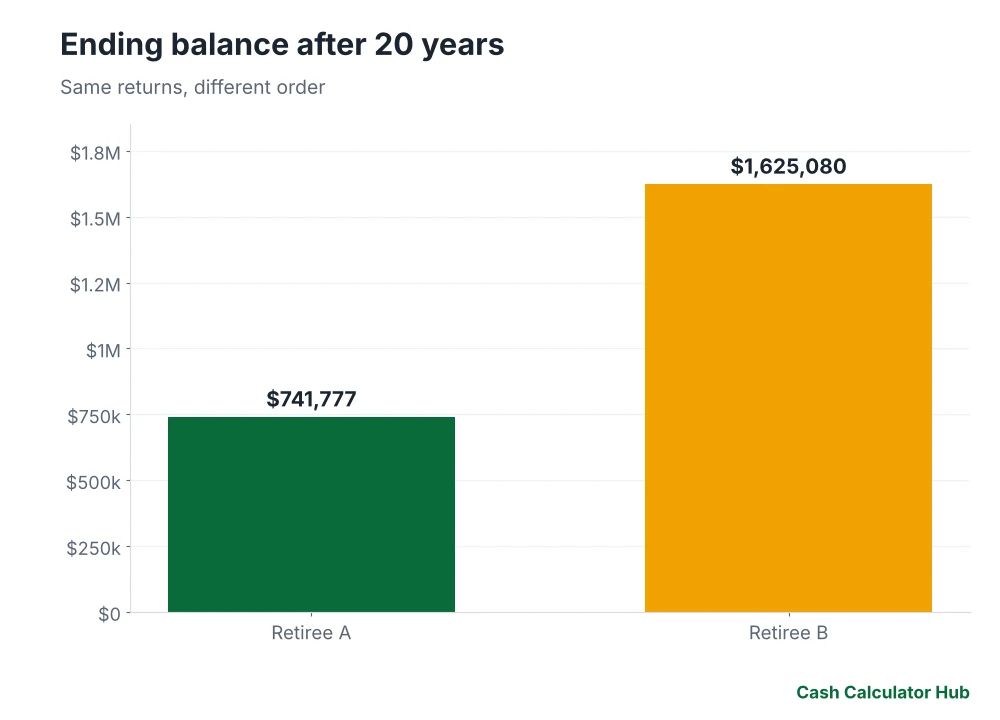
Quick answer: Sequence of returns risk is the danger that poor market returns arrive early in retirement, when you are also withdrawing money. In this example, two retirees take the same $40,000 (rising 3% yearly) from $1 million and earn the same 20 annual returns in opposite order. After 20 years, one has $741,777 and the other $1,625,080.
While you are saving, the order of returns does not change your final balance: multiplication is commutative. Once you withdraw regularly, it does. Selling shares in a down market locks in losses, leaving fewer shares to recover.
The example uses these 20 yearly returns (average 6.6%, compound 6.1%): -20%, -8%, 5%, 12%, 10%, 15%, -3%, 18%, 9%, 7%, 12%, -5%, 14%, 8%, 20%, 6%, 10%, -2%, 13%, 11%. Retiree A gets them in this order, so a bad year comes first; Retiree B gets them reversed, so the same bad year comes last.
Key takeaways
- Same returns, different order: Retiree A ends with $741,777; Retiree B ends with $1,625,080.
- The first 5 to 10 years of retirement carry the most risk.
- Reduce risk with a cash buffer, a flexible withdrawal rate, a bond or short-term reserve, and guaranteed income.
- A lower starting withdrawal rate gives more room for a bad start.
- Retirees who can cut spending after a down year improve their outcomes significantly.
The two retirees
Both start with $1,000,000, withdraw $40,000 in year one (4%), raise it 3% each year for inflation and invest in the same portfolio.
| Year | Return, A | Balance A | Return, B | Balance B |
|---|---|---|---|---|
| 1 | -20% | $768,000 | 11% | $1,065,600 |
| 2 | -8% | $668,656 | 13% | $1,157,572 |
| 3 | 5% | $657,531 | -2% | $1,092,833 |
| 5 | 10% | $706,706 | 6% | $1,175,557 |
| 10 | 7% | $767,334 | 12% | $1,540,469 |
| 15 | 20% | $811,034 | 15% | $1,992,770 |
| 20 | 11% | $741,777 | -20% | $1,625,080 |
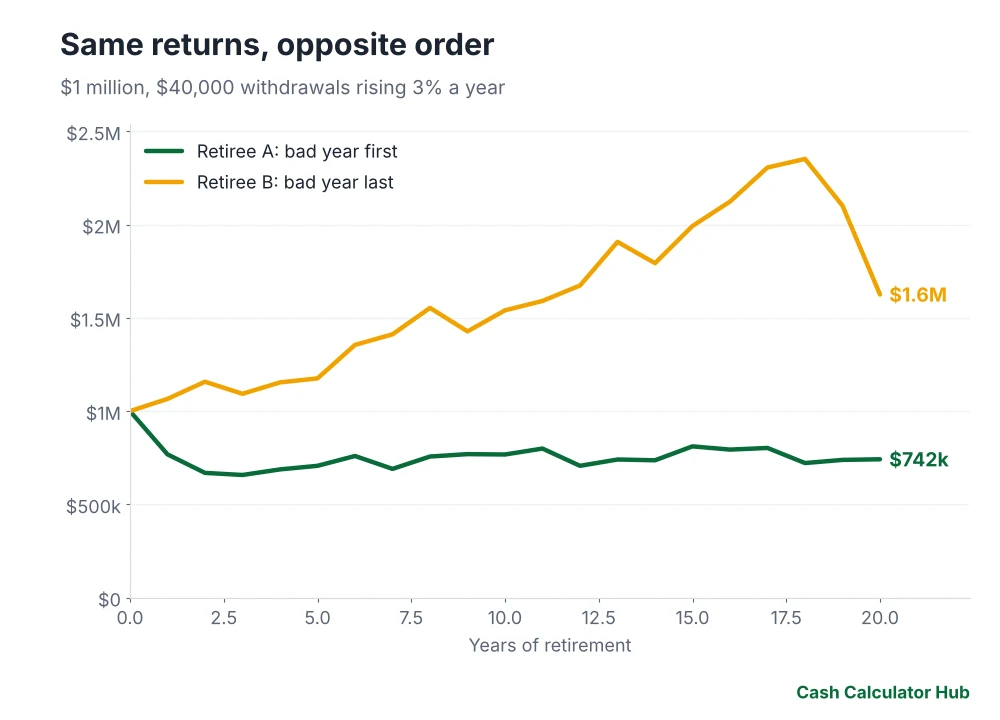
After 20 years, B has 2.2 times as much as A, even though both earned the same returns. Early losses combined with withdrawals shrink the base that has to recover.
Why the order matters
When the portfolio drops 20% and you withdraw $40,000, you sell shares at low prices. Those shares are gone and cannot participate in the rebound. If the big loss comes late, you have already banked years of gains.
Ways to reduce the risk
- Hold a cash or short-term bond reserve of one to three years of spending (the “bucket” approach). In a downturn, draw from the reserve and let stocks recover.
- Be flexible. Skip inflation increases or cut spending 5% to 10% after a down year; see safe withdrawal rates.
- Start lower. A 3.5% starting rate leaves more room than 4.5%.
- Cover essentials with guaranteed income: Social Security, pensions and annuities; see pension choices.
- Stay diversified and rebalance; see rebalancing.
- Work part-time or delay retirement in a down market.
- Delay Social Security to build a larger inflation-adjusted base.
What a spending cut does
If Retiree A skips inflation raises in the first three years, the ending balance rises. Flexibility early is worth more than flexibility late.
Accumulation phase
For people still saving, the opposite is true: poor returns early are good because you buy at low prices; see dollar-cost averaging.
Tools
Test scenarios with the retirement calculator and investment calculator. Check allocations in stocks versus bonds. More: retirement tools.
Frequently asked questions
What is sequence of returns risk?
The risk that poor investment returns occur early in retirement while you are withdrawing money, which can permanently reduce how long your portfolio lasts.
Why does the order of returns matter in retirement?
Because withdrawals during a downturn sell more shares at low prices, leaving fewer to benefit from the recovery.
How can I protect against sequence risk?
Hold a cash reserve, be flexible with spending, start with a lower withdrawal rate, use guaranteed income and diversify.
Does sequence risk matter while I am saving?
Not in the same way. When contributing regularly, early losses can help because you buy more shares at lower prices.
What are retirement buckets?
A strategy of dividing money into short-term cash, intermediate bonds and long-term stocks so that near-term spending does not rely on selling stocks in a downturn.
Sources and further reading
How the numbers were made: Every figure on this page was calculated from the formulas and assumptions stated above and rounded to the nearest dollar. Rates, limits and rules are for 2026 unless noted; confirm current figures with the sources listed before acting.
Keep reading
- How Much Do You Need to Retire? A Practical Way to Find Your Number
- The 4% Rule: Safe Withdrawal Rates From 3% to 5%, With Real Numbers
- Stocks vs Bonds: How to Choose Your Asset Allocation
- FIRE Explained: How Your Savings Rate Sets the Years Until Financial Independence
- 401(k) Rollover Options When You Leave a Job: What to Do With Your Old Plan
- Solo 401(k) vs SEP IRA: Which Retirement Plan Is Better for the Self-Employed?
This guide is general information, not financial, tax or legal advice. Figures use stated assumptions and 2026 rules and will differ from your situation; check current rules and talk to a licensed professional before you decide. Full disclaimer.