Quick answer: Roth or traditional? If your tax rate is the same later, they tie.
The Roth versus traditional debate generates more heat than it deserves. The choice comes down to one comparison: the tax rate you pay on the money now versus the rate you will pay when you take it out.
How each account taxes you
- Traditional: contributions reduce taxable income now (if deductible); withdrawals in retirement are taxed as ordinary income.
- Roth: contributions are made with after-tax money; qualified withdrawals (age 59½ and the account open five years) are tax-free.
Why they tie when rates match
Put $10,000 of pre-tax income into a traditional account at a 22% tax rate and it grows for 30 years at 7%, becoming $76,123. Withdraw it all at a 22% rate and you keep $59,376.
With a Roth you pay the 22% first, so only $7,800 goes in, and it grows to $59,376. Tax-free. Same answer. Multiplication does not care about order.
Three scenarios
| Scenario | Traditional (after tax) | Roth |
|---|---|---|
| Same rate: 22% / 22% | $59,376 | $59,376 |
| Lower later: 24% / 12% | $66,988 | $57,853 |
| Higher later: 12% / 24% | $57,853 | $66,988 |
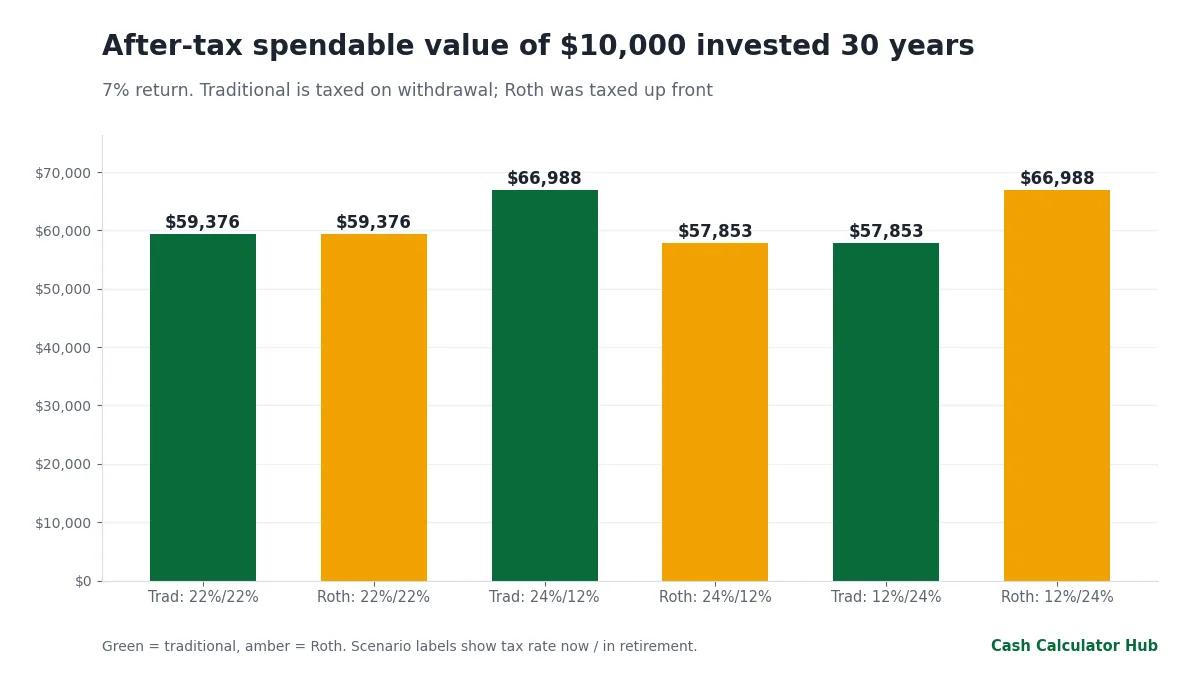
If you expect a lower rate in retirement (you are at your peak earnings now), traditional wins. If you expect a higher one (early career, or tax rates rising), Roth wins. Because nobody knows future tax law, many people split between the two.
Reasons that favor Roth beyond the rate
- No required minimum distributions from a Roth IRA during your life, and none from Roth 401(k) accounts since 2024. See the RMD guide.
- Tax diversification. Having both gives you control over taxable income in retirement, which helps with Medicare surcharges and Social Security taxation.
- Heirs inherit tax-free growth (within the 10-year rule).
- Contributions can be withdrawn from a Roth IRA at any time without tax or penalty, which gives it some emergency-fund flexibility. Do not count on this, though.
- The tax-deduction math is hidden. A $7,500 Roth contribution has the same take-home cost as a larger traditional one, so “maxing out” Roth actually moves more after-tax money into the account.
Reasons that favor traditional
- You are in a high bracket now and expect to be lower later.
- You need the deduction to qualify for other benefits or credits.
- You are close to an income limit that the deduction would bring you under.
Income limits and 2026 rules
Roth IRA contributions phase out between $153,000 and $168,000 (single) and $242,000 and $252,000 (married jointly). Roth 401(k) has no income limit. See all limits in the 2026 limits guide.
A simple default
If you are not sure: take the full employer match (traditional or Roth based on the plan), put a Roth IRA next, and use the federal tax brackets to check where your marginal rate sits. At the 10% to 12% brackets, Roth is usually attractive. At 32% and above, traditional is usually attractive. In between, either is reasonable.
Run the comparison
The Roth IRA calculator projects growth and compares with a traditional IRA, and the IRA calculator shows the deduction. To see the tax rate you pay now, use the income tax calculator. More in retirement calculators.
Rules worth knowing
- Five-year rule. Earnings from a Roth IRA are tax-free only if the account has been open for five years and you are 59½ or older (or meet another exception).
- Contributions versus earnings. You can withdraw your Roth IRA contributions at any time without tax or penalty. Earnings are different.
- Roth 401(k)s. They have no income limit and the same $24,500 limit as the traditional version. Employer matches may go into a traditional pre-tax account, depending on the plan.
- Roth conversions. You can convert traditional money to Roth and pay tax on the amount converted. This is most attractive in a year with unusually low income.
A practical order
For many households: contribute to the 401(k) up to the match, fund a Roth IRA if you qualify, and then return to the 401(k), choosing Roth or traditional based on your tax bracket. If you are unsure, a split is reasonable, since nobody can predict tax rates 30 years out. Use the income tax calculator to see your current marginal bracket first.
Can I have both a Roth and traditional account?
Yes. The IRA limit is shared across both.
Is Roth better for young people?
Often, because their tax rate tends to be lower early in their careers. It is not a rule.
Can the government change the tax-free status of Roth?
Tax law can change. Diversifying between Roth and traditional is a hedge against that.
What about converting traditional to Roth?
You pay tax now on the converted amount. It can make sense in low-income years. Seek advice before large conversions.
Sources and further reading
How the numbers were made: Every figure on this page was calculated from the formulas and assumptions stated above and rounded. Rates, limits and rules are for 2026 unless noted; confirm current figures with the sources listed before acting.
Keep reading
- Required Minimum Distributions: Age 73 or 75, and How to Calculate Yours
- 2026 401(k) and IRA Contribution Limits, Explained
- 2026 Federal Tax Brackets and Standard Deduction, Explained With Examples
- How Much Do You Need to Retire? A Practical Way to Find Your Number
- Social Security at 62 vs 67 vs 70: When Does Waiting Pay Off?
- How Much Is a $100,000 Salary After Taxes in 2026?
This guide is general information, not financial, tax or legal advice. Figures use stated assumptions and 2026 rules and will differ from your situation; check current rules and talk to a licensed professional before you decide. Full disclaimer.