Quick answer: To compare, find the return the monthly pension implies. At age 62, giving up a $400,000 lump sum for $2,500 a month is like earning about 5.3% a year if you live to 85 and 6.2% if you live to 90. If you can safely earn more than that on the lump sum and do not need guaranteed income, take the lump sum; otherwise, the monthly pension protects against outliving your money.
Some employers offer a choice at retirement: a lifetime monthly payment or a single lump sum. The decision is hard to undo and worth thousands of dollars, but it can be reduced to three questions: what return does the pension imply, how long might you live, and how much risk can you take?
The example: a pension of $2,500 a month (no cost-of-living increase) starting at age 62, or a $400,000 lump sum.
Key takeaways
- Implied return of the pension if you live to 80: 3.5%; to 85: 5.3%; to 90: 6.2%; to 95: 6.7%.
- The longer you live, the better the pension looks compared with the lump sum.
- Lump-sum values depend on interest rates at the time: higher rates mean smaller lump sums.
- The pension is insured up to limits by the PBGC if the plan fails; check your plan’s funding.
- A pension without inflation protection loses purchasing power over time.
What each choice gives you
| Monthly pension | Lump sum | |
|---|---|---|
| Amount | $2,500 per month, $30,000 a year, from age 62 | $400,000 now |
| Inflation protection | Usually none (check yours) | You invest it, so it can grow |
| Longevity risk | Paid for life | You could run out |
| Estate value | Survivor option only | Remainder goes to heirs |
| Taxes | Ordinary income | Taxable unless rolled to an IRA |
The implied return
Treat the pension as a payment stream and find the interest rate at which the payments to a given age are worth $400,000 today:
| If you live to | Years of payments | Implied annual return |
|---|---|---|
| 80 | 18 | 3.5% |
| 85 | 23 | 5.3% |
| 90 | 28 | 6.2% |
| 95 | 33 | 6.7% |
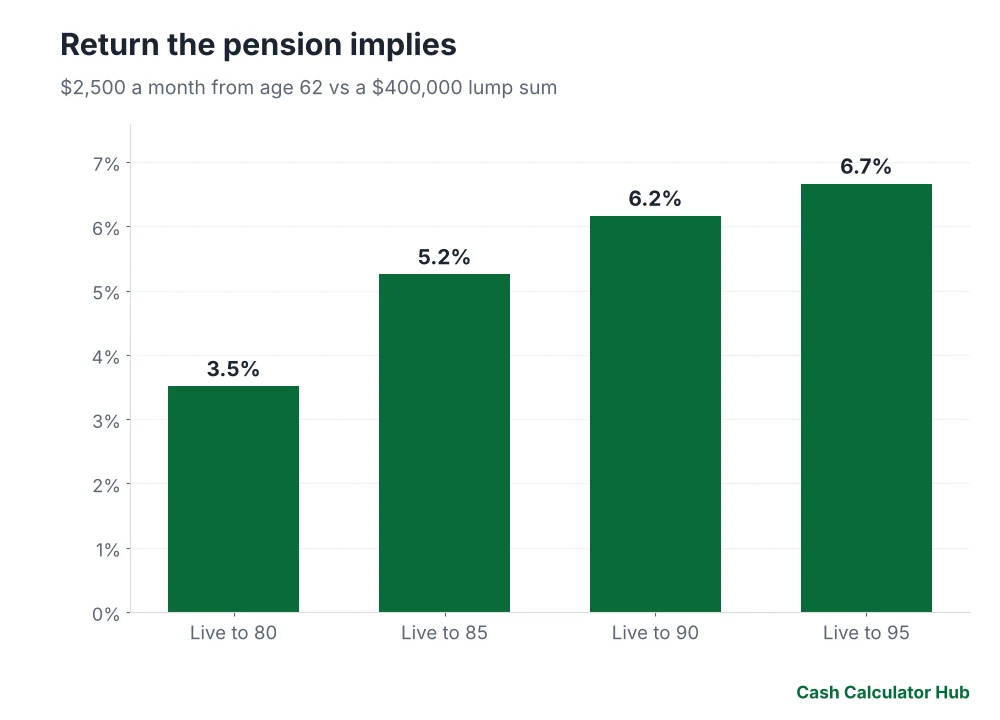
If you live to 90 you would need to earn about 6.2% a year on the lump sum to match the pension, in a portfolio that also funds withdrawals. That is a high bar for conservative investments, so the pension looks attractive for people with average or better health.
What the lump sum would need to earn
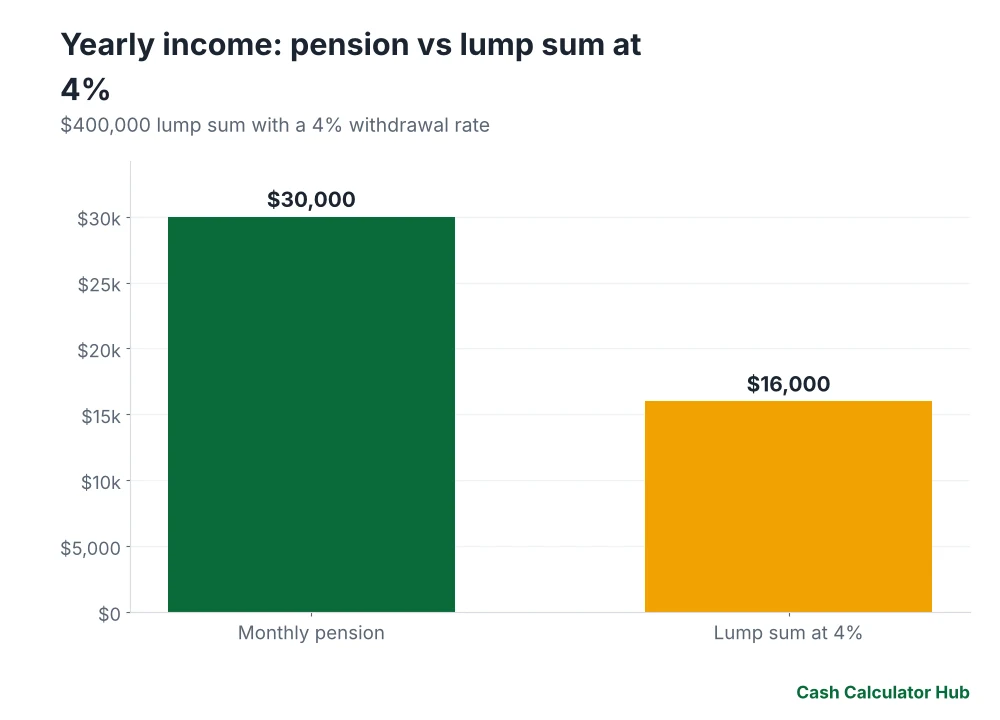
Withdrawing $30,000 a year from $400,000 is a 7.5% withdrawal rate, far above the 3.5% to 4% rule of thumb; see safe withdrawal rates. At a 4% rate, $400,000 would support $16,000 a year, about 47% less than the pension.
Factors that favor the lump sum
- Poor health or shorter life expectancy.
- Desire to leave money to heirs.
- Other guaranteed income, like Social Security, that already covers essentials.
- Concern about the employer’s finances. PBGC insurance covers private pensions up to limits, but benefits above the cap may be cut.
- Investing skill and discipline.
- High lump-sum value because rates are low when the offer is calculated.
Factors that favor the monthly pension
- Good health and family longevity. Longer life improves the value of lifetime payments.
- No other guaranteed income beyond Social Security.
- A spouse who needs survivor protection. Compare the single-life and joint-and-survivor options.
- Lower risk tolerance, or fear of poor investment decisions.
Joint and survivor options
Taking the highest single-life payment may leave a surviving spouse with nothing. Joint options pay less now but continue 50%, 75% or 100% after the death of the pensioner. Compare the lower payment with the cost of life insurance as an alternative.
Taxes
A lump sum rolled into an IRA stays tax-deferred. A lump sum paid to you is taxable in one year, plus possible early-withdrawal penalties under age 59½. Monthly pensions are taxed as ordinary income as received.
Questions to ask the plan
- How is the lump sum calculated, and which interest rate is used?
- Does the monthly pension include a cost-of-living adjustment?
- What are the survivor options and their reductions?
- What is the plan’s funding status, and is it PBGC-insured?
- How long do I have to decide?
Compare with the calculators
Use the pension calculator for payments and the annuity payout calculator for income from a fixed sum. The present value calculator values the stream. For Social Security timing, see claiming age. More: retirement tools.
Frequently asked questions
Should I take the pension lump sum or monthly payments?
If you are in good health and need guaranteed income, the monthly pension is often better. If you have other income, health concerns or want to leave an inheritance, the lump sum can be better. Compare the implied return.
How is a pension lump sum calculated?
The plan discounts your future monthly payments using interest rates set by law and plan rules. Higher rates produce smaller lump sums.
Is a pension safe?
Private pensions are insured by the PBGC up to limits. Public pensions depend on the state or local plan’s funding.
Can I roll a lump sum into an IRA?
Yes. A direct rollover avoids immediate tax and keeps the money tax-deferred.
Do pensions have cost-of-living adjustments?
Some do, many private pensions do not. Without one, inflation reduces the real value of the payments over time.
Sources and further reading
How the numbers were made: Every figure on this page was calculated from the formulas and assumptions stated above and rounded to the nearest dollar. Rates, limits and rules are for 2026 unless noted; confirm current figures with the sources listed before acting.
Keep reading
- How Much Do You Need to Retire? A Practical Way to Find Your Number
- Social Security at 62 vs 67 vs 70: When Does Waiting Pay Off?
- Required Minimum Distributions: Age 73 or 75, and How to Calculate Yours
- Social Security Spousal and Survivor Benefits: What You Can Get
- How Much Should You Have Saved for Retirement by Age? Benchmarks for 30 to 67
- Backdoor Roth IRA Explained: Steps, the Pro-Rata Rule and Pitfalls
This guide is general information, not financial, tax or legal advice. Figures use stated assumptions and 2026 rules and will differ from your situation; check current rules and talk to a licensed professional before you decide. Full disclaimer.