
Quick answer: A common order is: (1) get the full 401(k) employer match, (2) pay off high-interest debt, (3) fund an HSA if eligible, (4) contribute to a Roth or traditional IRA, (5) raise 401(k) contributions toward the $24,500 limit, and (6) invest in a taxable account. The order is driven by return, tax benefit and flexibility.
There is no single correct sequence, but there is a sequence that works for most people. It puts guaranteed returns first (employer match and debt payoff), then the accounts with the largest tax benefits, and leaves flexible taxable money for last.
The 2026 limits that matter: 401(k) employee deferral $24,500, IRA $7,500, HSA $4,400 (self-only) or $8,750 (family). See the full limits guide.
Key takeaways
- The employer match is a 50% to 100% instant return; take all of it first.
- Paying off debt costing more than about 8% usually beats investing.
- An HSA has a triple tax benefit: deductible going in, tax-free growth, and tax-free for medical costs.
- Roth versus traditional depends on today’s tax bracket versus retirement’s.
- Taxable accounts are flexible but have no special tax advantages.
The order, step by step
| Step | Where | Why | 2026 limit |
|---|---|---|---|
| 1 | 401(k) up to the match | Free money, immediate return | Match varies |
| 2 | Pay down debt above about 8% | Guaranteed return equal to the interest rate | n/a |
| 3 | HSA (if on a high-deductible health plan) | Triple tax benefit | $4,400 self / $8,750 family |
| 4 | Roth or traditional IRA | More fund choices, tax diversification | $7,500 ($8,600 at 50+) |
| 5 | Rest of the 401(k) | Large tax-deferred space | $24,500 (+$8,000 at 50+) |
| 6 | Taxable brokerage | Flexibility, no limits | None |
An emergency fund sits underneath all of this; see how much to keep.
What each step is worth
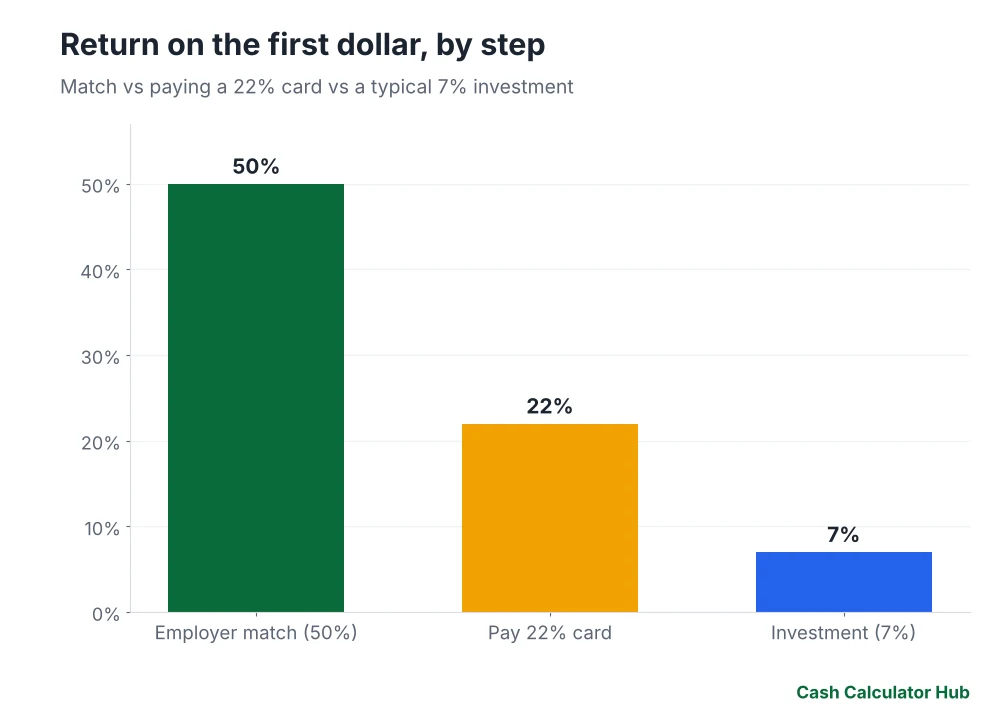
Employer match. If you earn $80,000 and your employer matches 50% of the first 6% you contribute, you give $4,800 and receive $2,400. No other investment promises a 50% return on day one.
Debt payoff. Paying a 22% card is a guaranteed 22% return. Compare against expected investment returns of 7% to 10% that come with risk. See avalanche versus snowball.
HSA. Contributions are pre-tax (or deductible), growth is tax-free, and withdrawals for qualified medical expenses are tax-free. If you can pay current medical costs out of pocket and invest the HSA, it becomes a powerful retirement account.
IRA. The Roth IRA offers tax-free growth and withdrawals in retirement; see Roth versus traditional.
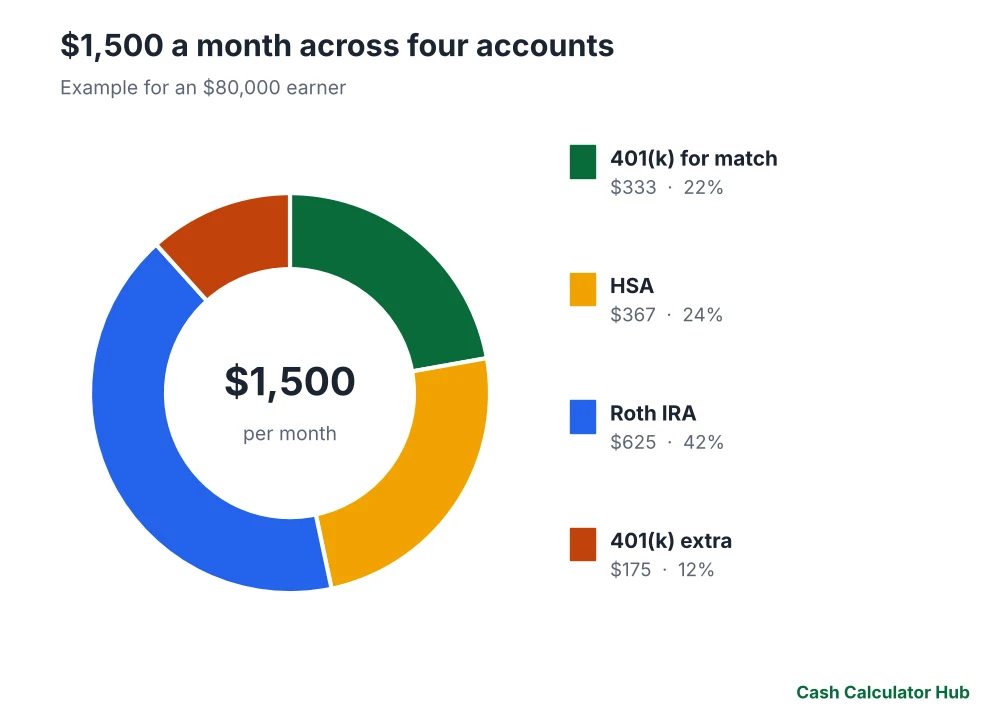
An example: $1,500 a month
Suppose you can invest $1,500 a month, earn $80,000, have a 5% employer match and a $4,400 HSA eligibility:
| Account | Monthly | Yearly |
|---|---|---|
| 401(k) to get the 5% match | $333 | $4,000 |
| HSA | $367 | $4,400 |
| Roth IRA | $625 | $7,500 |
| 401(k) extra | $175 | $2,100 |
| Total | $1,500 | $18,000 |
Traditional or Roth for the 401(k) and IRA?
- Traditional: deduction now, taxed later. Better if your tax rate will be lower in retirement.
- Roth: no deduction now, tax-free later. Better if your rate will be the same or higher, or if you want tax diversification.
If you are not sure, splitting between the two is a reasonable hedge.
When the order changes
- High-cost 401(k). If your plan has high fees, consider contributing only to the match and use an IRA next.
- Not HSA-eligible. Skip step 3.
- Income too high for a Roth IRA. Above the phase-out, consider a backdoor conversion with professional advice.
- Short-term goals. If you will need money before age 59½, use a taxable account or a savings account for those goals.
- Self-employed. Use a solo 401(k) or SEP IRA; see the solo 401(k) guide.
Common mistakes
- Leaving the match uncollected.
- Investing while carrying 20%+ credit card debt.
- Holding the HSA in cash forever.
- Putting retirement money in a taxable account before filling tax-advantaged space.
- Not rebalancing or setting contributions on autopilot.
Plan your contribution
Use the 401(k) calculator, Roth IRA calculator and IRA calculator to compare outcomes, and the take-home paycheck calculator to see the effect on pay. More: retirement tools.
Frequently asked questions
Should I max out my 401(k) or Roth IRA first?
Take the full employer match first, then consider the HSA and IRA, then return to the 401(k). The order is based on match, taxes and flexibility.
Is an HSA better than a 401(k)?
Per dollar, an HSA is the most tax-advantaged account, but it requires a high-deductible health plan and has lower limits.
Should I pay off debt before investing?
Pay off debt with interest above about 8% before extra investing, while still taking the employer match.
When should I use a taxable brokerage account?
After using tax-advantaged accounts, or for goals before retirement age where you need access to the money.
Can I contribute to both a 401(k) and an IRA?
Yes. They have separate limits, though traditional IRA deductibility may phase out with a workplace plan.
Sources and further reading
- IRS: Retirement plans
- IRS Publication 969: HSAs and other tax-favored health plans
- IRS: Individual retirement arrangements (IRAs)
How the numbers were made: Every figure on this page was calculated from the formulas and assumptions stated above and rounded to the nearest dollar. Rates, limits and rules are for 2026 unless noted; confirm current figures with the sources listed before acting.
Keep reading
- 2026 401(k) and IRA Contribution Limits, Explained
- Roth vs Traditional 401(k) and IRA: How to Decide
- How Much Do You Need to Retire? A Practical Way to Find Your Number
- HSA vs FSA: Which Health Account Is Better and What Are the 2026 Limits?
- Solo 401(k) vs SEP IRA: Which Retirement Plan Is Better for the Self-Employed?
- Dividend Yield vs Total Return: What Should Investors Focus On?
This guide is general information, not financial, tax or legal advice. Figures use stated assumptions and 2026 rules and will differ from your situation; check current rules and talk to a licensed professional before you decide. Full disclaimer.