Quick answer: A backdoor Roth IRA is a two-step move: make a nondeductible contribution to a traditional IRA, then convert it to a Roth IRA, which gets around the Roth income limit ($153,000 to $168,000 for single filers in 2026). The pro-rata rule taxes the conversion based on all your pre-tax IRA money: with $92,500 pre-tax and $7,500 after-tax, 92.5% ($6,938) of a $7,500 conversion is taxable.
The Roth IRA is limited to people under certain income levels, but there is no income limit on converting a traditional IRA to a Roth. The backdoor strategy combines the two facts. It is legal and widely used, but it has one rule that surprises people and some paperwork that must be done right.
The 2026 contribution limit is $7,500 ($8,600 at age 50 and over). Roth contributions phase out for single filers at $153,000 to $168,000 of modified adjusted gross income, and for married couples filing jointly at $242,000 to $252,000.
Key takeaways
- Step 1: contribute to a traditional IRA without deducting it. Step 2: convert it to a Roth IRA.
- The pro-rata rule treats all your traditional, SEP and SIMPLE IRAs as one pool when you convert.
- With $92,500 of pre-tax IRA money, converting $7,500 of after-tax money makes 92.5% of the conversion taxable.
- Form 8606 must be filed every year you make a nondeductible contribution or conversion.
- Moving pre-tax IRA money into a 401(k) before year-end can eliminate the pro-rata problem, if your plan accepts roll-ins.
The two steps
- Contribute up to $7,500 to a traditional IRA and do not claim a deduction. This is a nondeductible contribution.
- Convert the balance to a Roth IRA soon after, ideally before it earns much.
If you have no other IRA money, the conversion is almost entirely tax-free, because you already paid tax on the contribution. Over time, the Roth grows tax-free.
The pro-rata rule
The IRS does not let you choose which dollars you convert. It looks at the total of all your traditional, SEP and SIMPLE IRA balances at the end of the year and treats the conversion as a proportional mix of pre-tax and after-tax dollars.
Example: you have $92,500 of pre-tax money in a rollover IRA and you make a $7,500 nondeductible contribution, then convert $7,500.
| Amount | |
|---|---|
| Total IRA balance | $100,000 |
| After-tax (basis) share | $7,500 ÷ $100,000 = 7.5% |
| Tax-free part of the $7,500 conversion | $562 |
| Taxable part | $6,938 |
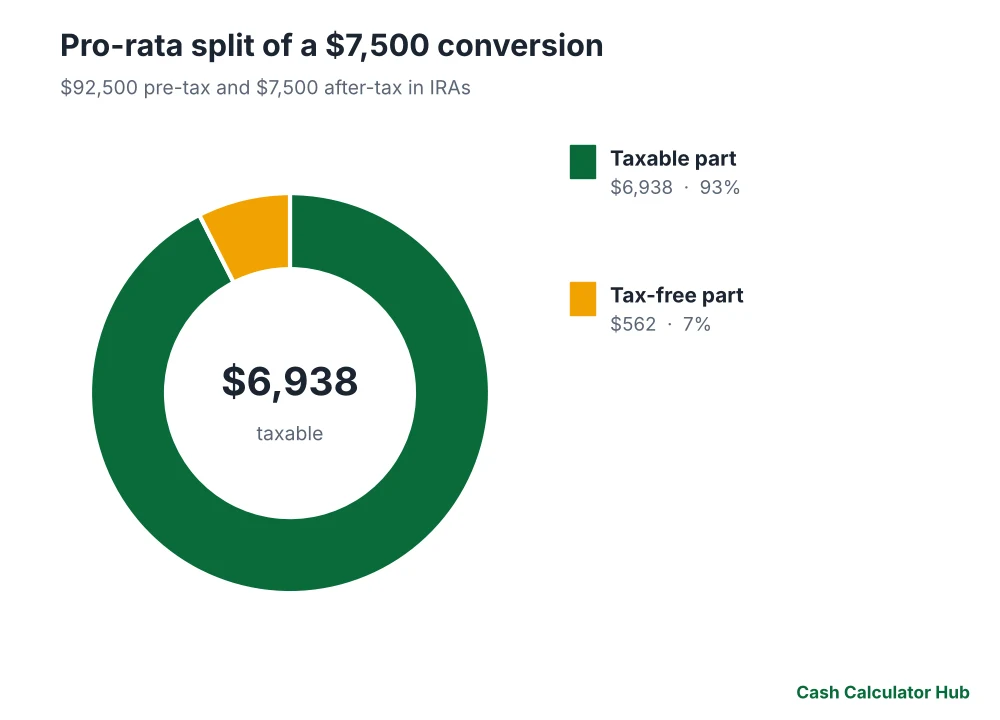
So the conversion adds $6,938 to your taxable income, not zero. Over many years, a backdoor with a big pre-tax IRA balance can become an expensive hassle.
How to avoid pro-rata
- Roll pre-tax IRA money into a workplace 401(k) before December 31 (if the plan accepts rollovers). Then the IRA balance on that date is zero.
- Do the backdoor only when the pre-tax IRA balance is small or zero.
- Convert the entire IRA and pay the tax, if you are comfortable with it; see Roth conversion basics.
Paperwork: Form 8606
File Form 8606 with your tax return for each year you make a nondeductible contribution or conversion. It tracks your basis so you are not taxed twice. Forgetting it can cost you; the IRS may treat the contribution as pre-tax, and there is a penalty for not filing.
Other pitfalls
- The step-transaction doctrine. Some advisers wait a short time between contribution and conversion; there is no official required waiting period.
- Growth between steps is taxable on conversion. Converting immediately reduces this.
- State taxes may apply to the conversion.
- Five-year rule. The converted amount has its own 5-year clock for penalty-free withdrawal under 59½.
- Rules can change. Congress has considered closing the backdoor several times.
Mega backdoor Roth
If your 401(k) permits after-tax contributions and in-plan conversions or in-service withdrawals, you may be able to put much more into Roth: the total contribution limit for all sources is about $72,000 in 2026. This depends entirely on plan features. Ask your plan administrator.
Is it worth it?
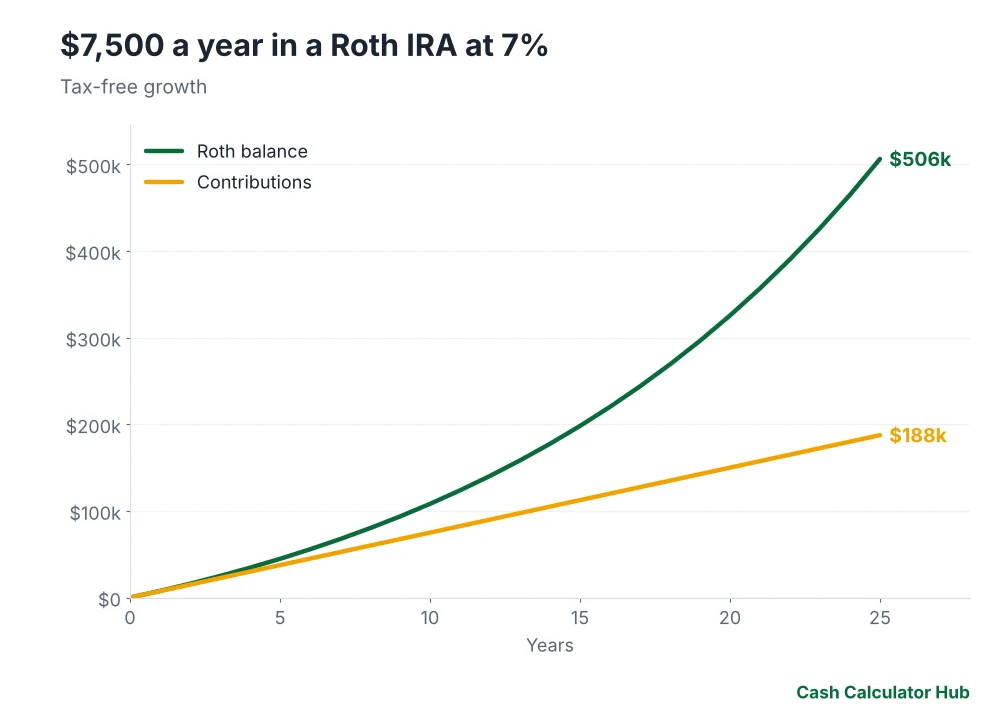
For high earners who have maxed other options and have no large pre-tax IRA, the backdoor Roth is a standard method of getting tax-free growth. Run the numbers: $7,500 a year for 25 years at 7% grows to about $506,295, tax-free. Compare with taxable-account outcomes using the Roth IRA calculator.
Where it fits in the plan
It comes after the 401(k) match, HSA and usually the 401(k) itself; see which account to fund first. Check the annual limits in the 2026 limits guide.
Tools
Use the Roth IRA calculator, IRA calculator and income tax calculator. More: retirement tools. A tax professional can help with Form 8606.
Frequently asked questions
What is a backdoor Roth IRA?
A strategy for high earners: make a nondeductible traditional IRA contribution, then convert it to a Roth IRA, bypassing the Roth income limit.
What is the pro-rata rule?
The IRS treats all your traditional, SEP and SIMPLE IRA balances as one pool, so a conversion is taxed in proportion to the pre-tax share of that pool.
Is the backdoor Roth legal?
Yes, it is currently allowed by law and IRS guidance, though Congress has proposed closing it before.
Do I need to file a special form?
Yes. Form 8606 reports nondeductible contributions and conversions every year you do them.
What are the 2026 Roth IRA income limits?
For 2026 contributions phase out between $153,000 and $168,000 for single filers and $242,000 to $252,000 for married couples filing jointly.
Sources and further reading
How the numbers were made: Every figure on this page was calculated from the formulas and assumptions stated above and rounded to the nearest dollar. Rates, limits and rules are for 2026 unless noted; confirm current figures with the sources listed before acting.
Keep reading
- Roth vs Traditional 401(k) and IRA: How to Decide
- 2026 401(k) and IRA Contribution Limits, Explained
- Roth Conversion Explained: When Paying Tax Now Beats Paying Later
- Pension Lump Sum vs Monthly Payments: How to Compare the Offers
- How Much Should You Have Saved for Retirement by Age? Benchmarks for 30 to 67
- The 4% Rule: Safe Withdrawal Rates From 3% to 5%, With Real Numbers
This guide is general information, not financial, tax or legal advice. Figures use stated assumptions and 2026 rules and will differ from your situation; check current rules and talk to a licensed professional before you decide. Full disclaimer.