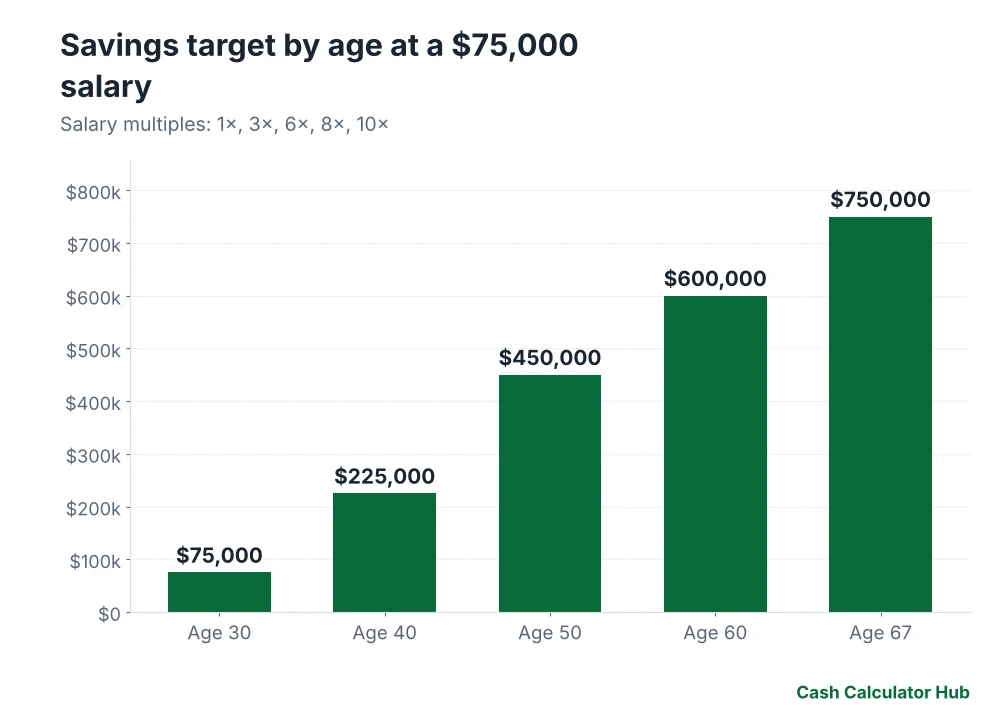
Quick answer: A widely used guideline is to have saved about 1 times your salary by age 30, 3 times by 40, 6 times by 50, 8 times by 60 and 10 times by 67. For a $75,000 salary that means about $75,000 at 30, $225,000 at 40, $450,000 at 50, $600,000 at 60 and $750,000 at 67. These assume saving about 15% of income starting at 25.
Benchmarks turn a vague worry into a number. They are not rules: a person with a pension, a partner with savings or a plan to work part-time in retirement needs less, and someone who wants to retire at 60 needs more.
The multiples below are the Fidelity guidelines and assume a savings rate of 15% (including employer contributions), retirement at 67, and a goal of replacing about 45% of pre-retirement income from savings, with Social Security covering the rest.
Key takeaways
- Benchmarks: 1× at 30, 3× at 40, 6× at 50, 8× at 60 and 10× at 67.
- The dollar amount depends on salary; at $75,000 the 40-year benchmark is $225,000.
- Savings rate is the most important factor: 15% of income, including the employer match, is a common target.
- If you are behind, raising your rate, working a few years longer or delaying Social Security can close much of the gap.
- These are guidelines, not predictions.
Benchmarks in dollars
| Age | Multiple of salary | $50,000 salary | $75,000 salary | $100,000 salary |
|---|---|---|---|---|
| 30 | 1× salary | $50,000 | $75,000 | $100,000 |
| 40 | 3× salary | $150,000 | $225,000 | $300,000 |
| 50 | 6× salary | $300,000 | $450,000 | $600,000 |
| 60 | 8× salary | $400,000 | $600,000 | $800,000 |
| 67 | 10× salary | $500,000 | $750,000 | $1,000,000 |
Where the numbers come from
The multiples assume you start saving at 25, save 15% of pay each year, invest in a mix that gradually shifts from stocks to bonds, and retire at 67. If you start later or want to retire earlier, the targets rise. See how much you need to retire and the 4% rule.
Check against your savings rate
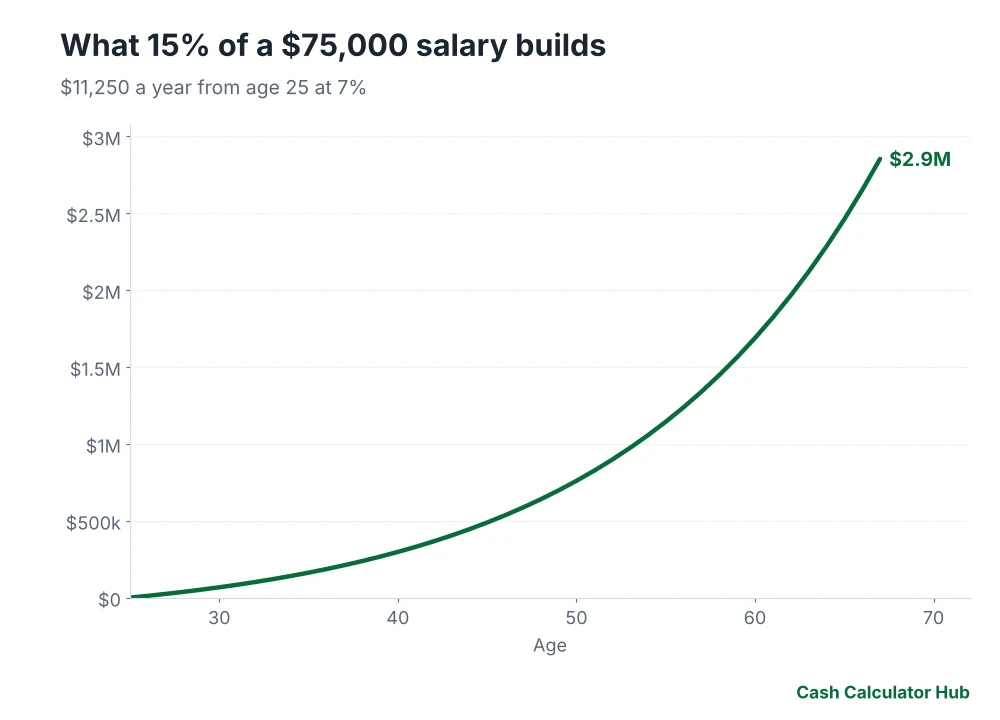
What does a 15% savings rate on a $75,000 salary look like? $11,250 a year. Growing at 7% a year:
| Age | Balance from age 25 at $11,250/year, 7% |
|---|---|
| 30 | $67,118 |
| 40 | $297,152 |
| 50 | $759,442 |
| 60 | $1,688,489 |
| 67 | $2,853,476 |
These are close to the benchmarks, which is the point: the targets follow from steady saving. Salary typically rises, which increases the dollars saved each year.
If you are behind
Being behind is common. These changes have the biggest effect:
- Raise your savings rate. Increase by 1% every six months, or direct raises to savings.
- Capture the full employer match before anything else. See 2026 limits and match math.
- Use catch-up contributions after age 50: $8,000 extra in a 401(k) and $1,100 in an IRA in 2026, and $11,250 for ages 60 to 63.
- Work a few years longer. Each extra year adds contributions, delays withdrawals and raises Social Security.
- Delay Social Security to increase the monthly benefit; see claiming at 62, 67 or 70.
- Reduce costs so you need less income; downsizing and paying off the mortgage help.
Catching up: an example
A 45-year-old with $100,000 saved, $75,000 income and a goal of $750,000 at 67: at 7%, the existing $100,000 grows to about $443,040. The shortfall of $306,960 requires about $522 a month, or 8% of salary. That is a large but possible increase.
What benchmarks leave out
- Pensions and other income. A pension reduces the amount you need.
- Spouse’s savings. Combine household accounts.
- Home equity. A paid-off home reduces expenses.
- Health costs and long-term care. Plan for them; see Medicare costs.
- Spending. Your actual lifestyle matters more than the salary multiple.
How to measure your own plan
Add up retirement accounts, estimate Social Security from your SSA statement and compare the income your savings can provide with your expected spending. Use the retirement calculator, the 401(k) calculator and the Social Security calculator. More: retirement tools.
Frequently asked questions
How much should I have saved for retirement by 40?
A common benchmark is about three times your annual salary, which would be $225,000 for a $75,000 earner.
How much should I have saved by 50?
About six times your salary, or $450,000 at $75,000, according to the Fidelity guideline.
What if I am behind on retirement savings?
Raise your savings rate, take advantage of catch-up contributions after 50, delay retirement or Social Security, and reduce expected expenses.
Do these benchmarks include Social Security?
Yes, they assume Social Security covers part of retirement income and your savings cover the rest.
What percentage of income should I save for retirement?
A common target is 15% of gross income, including any employer match.
Sources and further reading
How the numbers were made: Every figure on this page was calculated from the formulas and assumptions stated above and rounded to the nearest dollar. Rates, limits and rules are for 2026 unless noted; confirm current figures with the sources listed before acting.
Keep reading
- How Much Do You Need to Retire? A Practical Way to Find Your Number
- 2026 401(k) and IRA Contribution Limits, Explained
- Social Security at 62 vs 67 vs 70: When Does Waiting Pay Off?
- Pension Lump Sum vs Monthly Payments: How to Compare the Offers
- Backdoor Roth IRA Explained: Steps, the Pro-Rata Rule and Pitfalls
- Roth Conversion Explained: When Paying Tax Now Beats Paying Later
This guide is general information, not financial, tax or legal advice. Figures use stated assumptions and 2026 rules and will differ from your situation; check current rules and talk to a licensed professional before you decide. Full disclaimer.