
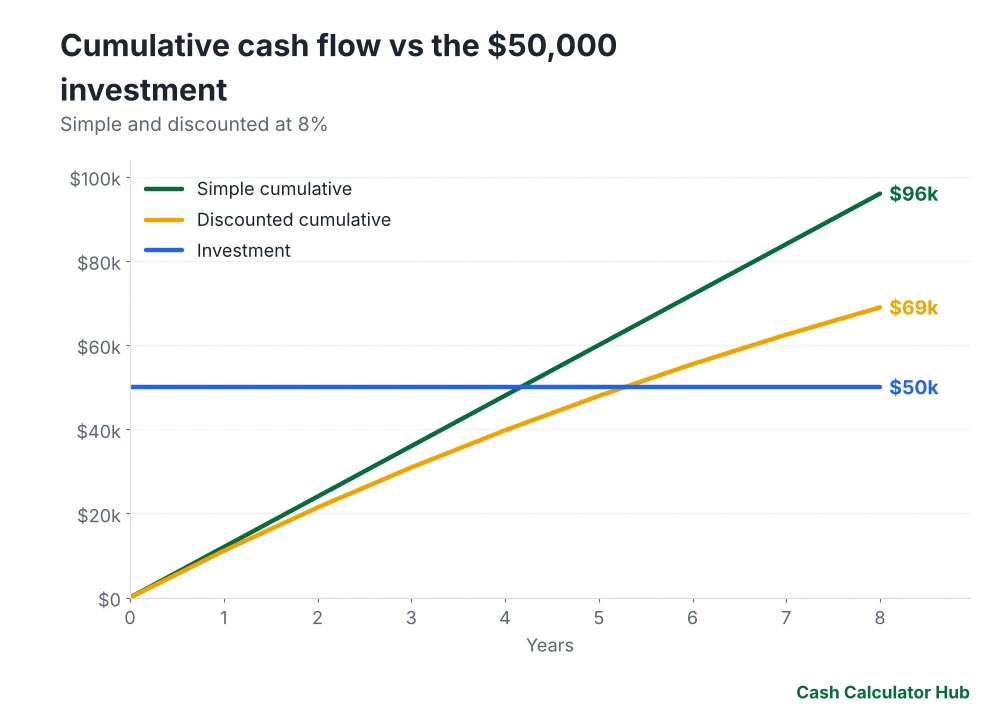
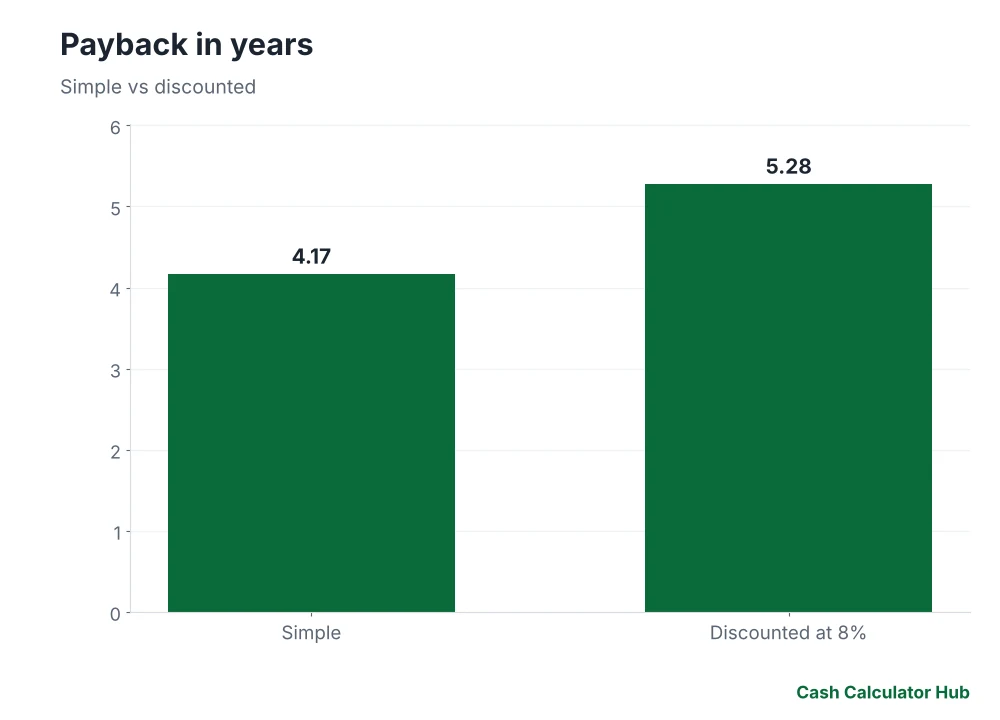
Quick answer: Payback period = initial investment ÷ annual net cash flow. A $50,000 investment returning $12,000 a year pays back in 4.2 years. Discounted payback applies a discount rate to future cash flows: at 8% it takes about 5.3 years.
Payback period is the simplest way to judge how quickly an investment returns your cash: new equipment, a rental improvement, solar panels or a marketing campaign. It is easy to compute and useful for risk, but it ignores what happens after payback and the timing of earlier cash flows.
Key takeaways
- Payback = investment ÷ annual cash flow (for even cash flows).
- Discounted payback uses present values of the cash flows.
- Shorter payback means less risk and faster liquidity.
- Payback ignores cash flows after the payback date; also use NPV or IRR.
- Typical targets vary: a few years for equipment, longer for real estate.
Simple payback
$50,000 ÷ $12,000 per year = 4.17 years.
Discounted payback at 8%
| Year | Cash flow | Discount factor | Present value | Cumulative PV |
|---|---|---|---|---|
| 1 | $12,000 | 0.926 | $11,111 | $11,111 |
| 2 | $12,000 | 0.857 | $10,288 | $21,399 |
| 3 | $12,000 | 0.794 | $9,526 | $30,925 |
| 4 | $12,000 | 0.735 | $8,820 | $39,746 |
| 5 | $12,000 | 0.681 | $8,167 | $47,913 |
| 6 | $12,000 | 0.630 | $7,562 | $55,475 |
| 7 | $12,000 | 0.583 | $7,002 | $62,476 |
The cumulative present value passes $50,000 during year 6, giving a discounted payback of about 5.3 years.
Uneven cash flows
Add cash flows year by year until the cumulative total reaches the investment, then take the fraction of the final year needed.
Example: invest $40,000, cash flows of $8,000, $12,000, $15,000, $15,000. Cumulative: $8,000; $20,000; $35,000; $50,000. After year 3 you have $35,000; need $5,000 more from year 4’s $15,000 → payback = 3 + 5/15 = 3.33 years.
Strengths and limits
| Strength | Limit |
|---|---|
| Simple to compute | Ignores cash after payback |
| Highlights risk and liquidity | Simple version ignores the time value of money |
| Useful for screening | Needs a cutoff chosen by judgment |
Compare with other measures
| Measure | Question | |
|---|---|---|
| Payback | How soon do I get my money back? | |
| NPV | How much value does it add? See [[p:time-value-of-money-npv-and-present-value-explained | NPV]] |
| IRR / ROI | What is the rate of return? See [[p:roi-vs-irr-vs-cagr | ROI, IRR, CAGR]] |
Everyday uses
- Home upgrades: a $12,000 solar system saving $1,500 a year pays back in 8 years.
- Equipment: a $3,000 tool saving $1,000 a year pays back in 3 years.
- Refinancing: see refinance break-even.
Tools
Use the payback period calculator, ROI calculator and IRR calculator. More: business and everyday tools.
Frequently asked questions
What is the payback period?
The time it takes for an investment’s cash flows to recover its initial cost.
How do you calculate payback period?
Divide the initial investment by the annual net cash flow, or accumulate uneven flows until they match the investment.
What is discounted payback?
Payback calculated using the present values of the cash flows, which accounts for the time value of money.
Is a shorter payback period better?
Generally yes for risk and liquidity, but it does not measure total profitability.
What is a good payback period?
It depends on the industry and project; many businesses look for 2 to 5 years on equipment.
Sources and further reading
How the numbers were made: Every figure on this page was calculated from the formulas and assumptions stated above and rounded to the nearest dollar. Rates, limits and rules are for 2026 unless noted; confirm current figures with the sources listed before acting.
Keep reading
- ROI vs IRR vs CAGR: Which Return Number Should You Trust?
- Mortgage Refinance Break-Even Point: Is It Worth It?
- Compound Interest on $10,000: What It Becomes in 10, 20 and 30 Years
- Break-Even Analysis: How Many Units or How Much Revenue You Need to Cover Costs
- Gross Margin vs Operating Margin vs Net Margin: What Each Tells You
- Successive Discounts: Why 20% Off Plus 10% Off Is Not 30% Off
This guide is general information, not financial, tax or legal advice. Figures use stated assumptions and 2026 rules and will differ from your situation; check current rules and talk to a licensed professional before you decide. Full disclaimer.