

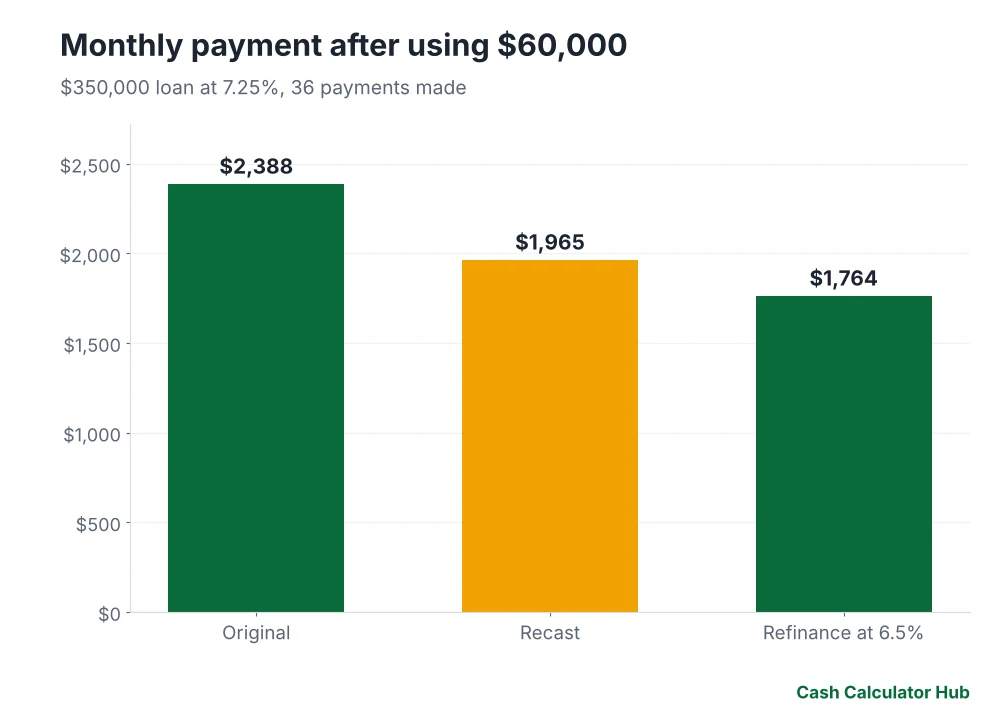
Quick answer: A mortgage recast re-amortizes your balance after a large lump-sum payment, lowering the monthly payment without changing the rate or term. Recasting after a $60,000 payment on a $350,000 loan at 7.25% cuts the payment by about $423 a month for a fee of roughly $150 to $500, with no new closing costs.
If you come into a lump sum from a bonus, an inheritance or the sale of another home, a recast is the cheapest way to turn it into a lower mortgage payment. It is also one of the least-known options, because lenders do not advertise it.
This guide compares three uses of the same $60,000: recast, refinance and simply keep paying the old amount. The loan is $350,000 at 7.25% for 30 years, three years in.
Key takeaways
- After 36 payments the balance is $339,057; a $60,000 lump sum leaves $279,057.
- Recast payment: $1,965 versus the original $2,388, a saving of $423 a month.
- Recasts typically cost $150 to $500; refinances cost 2% to 5% of the loan.
- The rate and term stay the same, so recasting helps most when your rate is already low.
- Government-backed loans (FHA, VA, USDA) generally cannot be recast; many conventional lenders allow it with a minimum lump sum.
What a recast does
Your payment is calculated to pay off the balance over the remaining term. If you send a big lump sum, the balance drops but the payment stays the same unless you ask the servicer to recalculate. A recast does that recalculation. Your rate, your remaining term and your lender stay put.
Three ways to use the same $60,000
| Option | New payment | Interest to the end of the loan | Upfront cost |
|---|---|---|---|
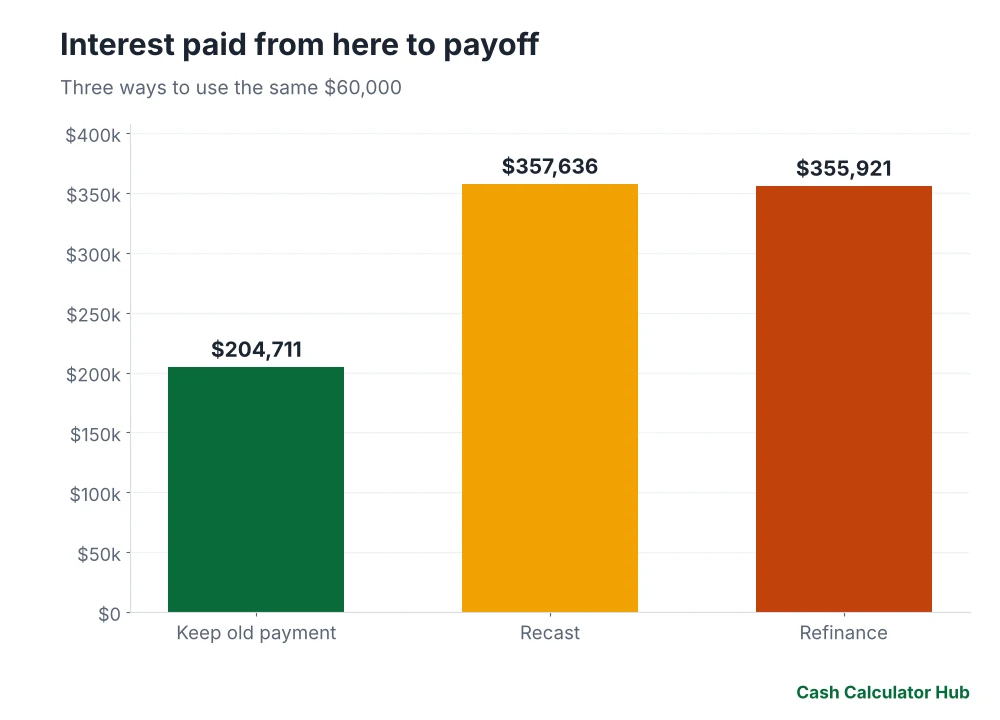
| Do nothing (payment stays $2,388, loan ends sooner) | $2,388 | $204,711 (paid off in 17.0 years) | $0 |
| Recast at 7.25% | $1,965 | $357,636 | about $300 |
| Refinance at 6.5% into a new 30-year loan | $1,764 | $355,921 | about $6,500 |
Paying the lump sum and keeping the old payment is actually the cheapest in total interest, because you keep the high payment and pay the loan off faster. A recast is the right tool when your goal is monthly cash flow, not the lowest lifetime cost.
Recast versus refinance
| Recast | Refinance | |
|---|---|---|
| Changes your rate | No | Yes |
| Changes your term | No | Yes, restarts the clock |
| Costs | Small flat fee | 2% to 5% of the loan |
| Credit check and appraisal | Usually none | Usually yes |
| Needs a lump sum | Yes, often $5,000 to $10,000 minimum | No |
| Best when | Your rate is low and you have cash | Rates fell well below yours |
If today’s rates are higher than your loan’s, refinancing is a bad idea and a recast is the only way to lower the payment. If rates are much lower, run the break-even in the refinance guide first.
Is a recast worth it?
A recast does not save more than the lump sum would save by sitting in the loan: the interest saving comes from the lower balance either way. What the recast adds is a lower required payment. That is valuable if you want room in your budget, or if you want to qualify for another loan using the lower payment.
Think about alternatives for the cash first:
- Emergency fund. A mortgage is a poor place to keep money you may need. Cash locked in home equity is hard to get back.
- High-interest debt. Paying off a 22% card beats a 7% mortgage. See how long cards take to pay off.
- Retirement or investing. Compare a guaranteed 7.25% return with your expected return.
How to request a recast
- Ask your servicer if they offer it and what the minimum payment and fee are.
- Make sure your loan is current and conventional.
- Send the lump sum as a principal-only payment, then submit the recast request.
- Check the new amortization schedule; the new payment starts the following month.
Check the numbers
The mortgage payoff calculator shows the effect of a lump sum, and the amortization calculator gives the new payment. If you are weighing a new loan instead, use the refinance calculator. More: mortgage tools.
Frequently asked questions
What is a mortgage recast?
A recast recalculates your monthly payment after a large principal payment, keeping the same rate and term. It lowers the payment without a new loan.
How much does a recast cost?
Typically $150 to $500 as a flat fee. A refinance costs thousands.
Is a recast better than refinancing?
It is better when your current rate is lower than today’s rates or when you do not want closing costs. A refinance is better when rates have dropped well below your loan’s rate.
Can I recast an FHA or VA loan?
Generally no. Recasting is mostly offered by lenders on conventional loans, and some require a minimum lump sum.
Does a recast change my loan term?
No. The remaining term stays the same; only the monthly payment drops.
Sources and further reading
How the numbers were made: Every figure on this page was calculated from the formulas and assumptions stated above and rounded to the nearest dollar. Rates, limits and rules are for 2026 unless noted; confirm current figures with the sources listed before acting.
Keep reading
- Mortgage Refinance Break-Even Point: Is It Worth It?
- Pay Off Your Mortgage Early: What Extra Payments Really Save
- 15-Year vs 30-Year Mortgage: Which Costs Less Overall?
- Closing Costs Explained: What You Pay and How to Lower It
- ARM vs Fixed-Rate Mortgage: What a 5/1 ARM Really Costs
- Mortgage Discount Points: When Is Paying for a Lower Rate Worth It?
This guide is general information, not financial, tax or legal advice. Figures use stated assumptions and 2026 rules and will differ from your situation; check current rules and talk to a licensed professional before you decide. Full disclaimer.


