Quick answer: Asset allocation is the split of your portfolio between stocks (growth, volatile) and bonds (income, steadier). Under long-run assumptions of 10% for stocks and 5% for bonds, a 60/40 mix returns about 8.0% a year but would have lost around 20% in a 2008-style year, versus 37% for all stocks.
Most of a portfolio’s long-term behavior comes from one decision: how much is in stocks and how much in bonds. Individual picks matter far less.
The numbers below are assumptions, not forecasts. They use long-run historical averages for U.S. stocks (about 10% a year) and bonds (about 5%) and a 2008-style stress year (stocks down 37%, bonds up 5%).
Key takeaways
- Stocks have higher long-run returns and much larger losses; bonds are steadier but grow more slowly.
- A 60/40 mix has been a standard balanced portfolio for decades.
- Your time horizon and your ability to stay calm in a crash matter more than a rule of thumb.
- Under these assumptions, 100% stocks could grow $100,000 to $1,744,940 in 30 years while a 40/60 mix reaches $761,226.
- Rebalance occasionally to keep your target.
Five mixes compared
| Stocks/Bonds | Assumed return | $100,000 after 30 years | Stress-year loss | $100,000 after the stress year |
|---|---|---|---|---|
| 100/0 | 10.0% | $1,744,940 | -37% | $63,000 |
| 80/20 | 9.0% | $1,326,768 | -29% | $71,400 |
| 60/40 | 8.0% | $1,006,266 | -20% | $79,800 |
| 40/60 | 7.0% | $761,226 | -12% | $88,200 |
| 20/80 | 6.0% | $574,349 | -3% | $96,600 |
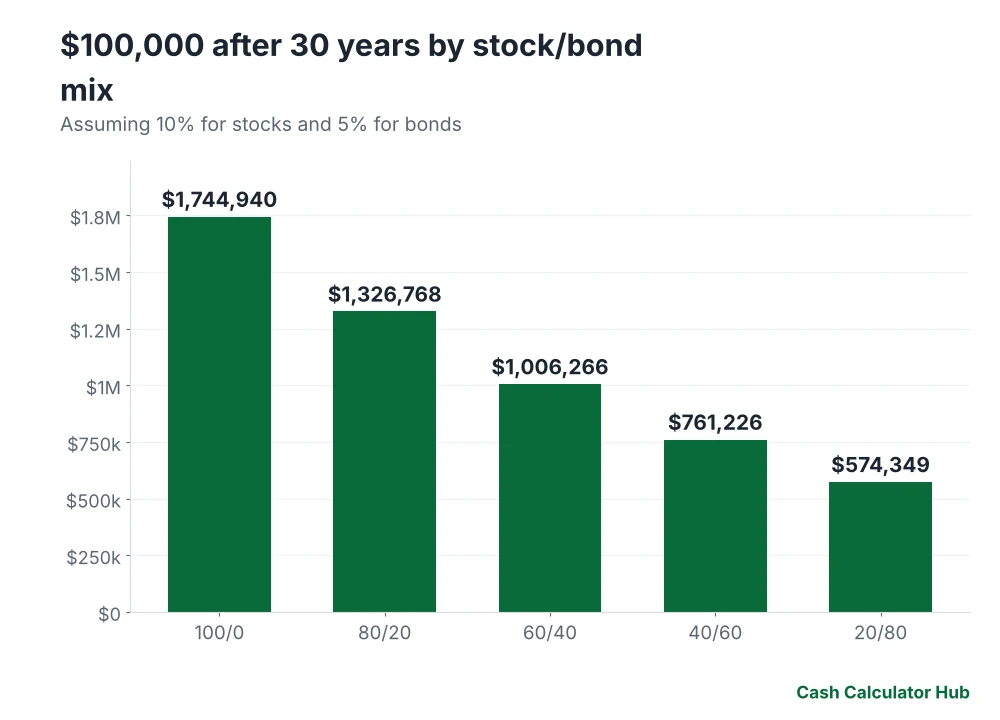
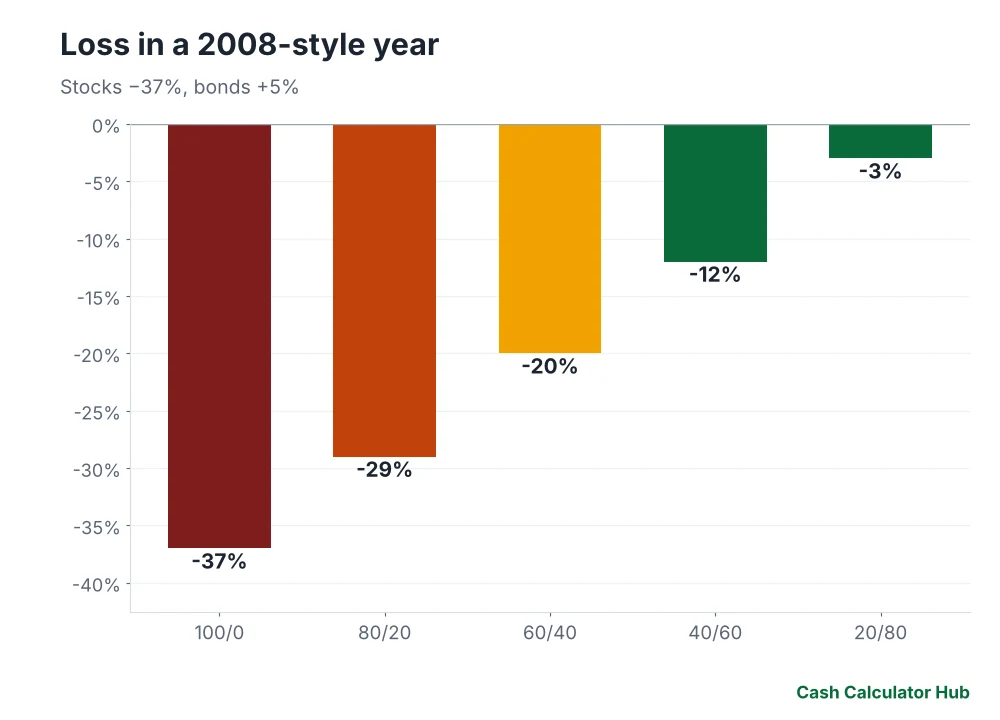
Assumptions: stocks 10% and bonds 5% per year in normal years; a stress year of −37% for stocks and +5% for bonds. Real returns vary a great deal year to year, and bonds also lost value in 2022 when rates rose.
What bonds do for you
- Cushion in downturns. High-quality bonds often hold value when stocks fall.
- Income. Interest payments provide steady cash.
- Dry powder. You can rebalance by selling bonds to buy cheaper stocks.
What stocks do for you
- Growth above inflation over long periods.
- Ownership in thousands of companies through an index fund; see index funds versus ETFs.
How to pick a mix
- Time horizon. Money you need in under 5 years should not be in stocks. Retirement money 30 years away can be mostly stocks.
- Risk capacity. If a 20% loss would force you to change your life, you need more bonds.
- Risk tolerance. If you would sell in a panic, use a mix that you can hold through a bad year.
- Income stability. A stable job allows more stock risk than variable income.
A common rule of thumb is “110 minus your age” in stocks, but it is a starting point, not a plan. Target-date funds adjust the mix automatically as you approach a retirement year.
Does age change the mix?
Younger investors can ride out more volatility because they have time to recover and keep contributing. Near and in retirement, a large decline early can do lasting damage; see sequence of returns risk. Many retirees hold 40% to 60% in stocks to support decades of withdrawals.
Keep the mix with rebalancing
Over time the stronger asset grows to a larger share. Rebalance back to your target once a year or when a position drifts by 5 points. See how rebalancing works.
Taxes
Bonds generate taxable interest, so many investors hold them in tax-deferred accounts like a 401(k) or IRA, and hold stock index funds in taxable accounts for lower tax drag. See which account comes first.
Test it
Compare outcomes with the investment calculator and use the average return calculator to blend returns. For retirement goals, the retirement calculator helps. More: investment calculators.
Frequently asked questions
What is a good stock-to-bond ratio?
It depends on your horizon and risk tolerance. Common balanced mixes are 60/40 for moderate investors, 80/20 for growth and 40/60 for conservative.
Is a 60/40 portfolio still good?
It remains a reasonable balanced allocation, but returns depend on stock and bond conditions. Bonds fell alongside stocks in 2022, so diversification is not a guarantee.
How much should I have in bonds at 50?
There is no set answer, but many investors hold 20% to 40% in bonds in their 50s, then increase the share as retirement nears.
Should I use a target-date fund?
They are a simple option that shifts toward bonds over time. Check the fund’s glide path and fees.
Do bonds always go up when stocks go down?
No. High-quality bonds often cushion stock declines but not always, as the rate hikes of 2022 showed.
Sources and further reading
How the numbers were made: Every figure on this page was calculated from the formulas and assumptions stated above and rounded to the nearest dollar. Rates, limits and rules are for 2026 unless noted; confirm current figures with the sources listed before acting.
Keep reading
- Compound Interest on $10,000: What It Becomes in 10, 20 and 30 Years
- How Much Do You Need to Retire? A Practical Way to Find Your Number
- ROI vs IRR vs CAGR: Which Return Number Should You Trust?
- Index Fund vs ETF vs Mutual Fund: Differences, Costs and Taxes
- Dollar-Cost Averaging vs Lump Sum: Which Is Better for $120,000?
- High-Yield Savings Accounts: APY, Insurance Limits and What You Really Earn
This guide is general information, not financial, tax or legal advice. Figures use stated assumptions and 2026 rules and will differ from your situation; check current rules and talk to a licensed professional before you decide. Full disclaimer.