Quick answer: Your paycheck starts with gross pay, subtracts pre-tax deductions (401(k), health insurance), then federal income tax, Social Security and Medicare, and any state tax to get net pay. For a $78,000 salary paid every two weeks (26 checks), gross pay is $3,000 and take-home is about $2,204 with 6% to a 401(k) and $150 of health premiums per paycheck.
The numbers on a pay stub are not hard once you know the order: gross pay, pre-tax deductions, taxes, after-tax deductions, net pay. This guide uses an example so you can follow the math, then lists common errors to check.
Key takeaways
- Gross $78,000 ÷ 26 = $3,000 per paycheck.
- Pre-tax deductions here: 401(k) $180 and health $150 per paycheck.
- Federal income tax withheld is about $248; FICA about $218 per paycheck.
- Net pay is about $2,204 per paycheck, or $57,309 per year.
- State and local taxes are not included in this example.
Example paycheck: $78,000 salary, biweekly, single filer
| Line | Per paycheck | Per year |
|---|---|---|
| Gross pay | $3,000.00 | $78,000 |
| 401(k) (6%, pre-tax) | −$180.00 | −$4,680 |
| Health premium (pre-tax) | −$150.00 | −$3,900 |
| Federal income tax | −$247.78 | −$6,442 |
| Social Security (6.2%) | −$176.70 | −$4,594 |
| Medicare (1.45%) | −$41.33 | −$1,074 |
| Net pay | $2,204.19 | $57,309 |
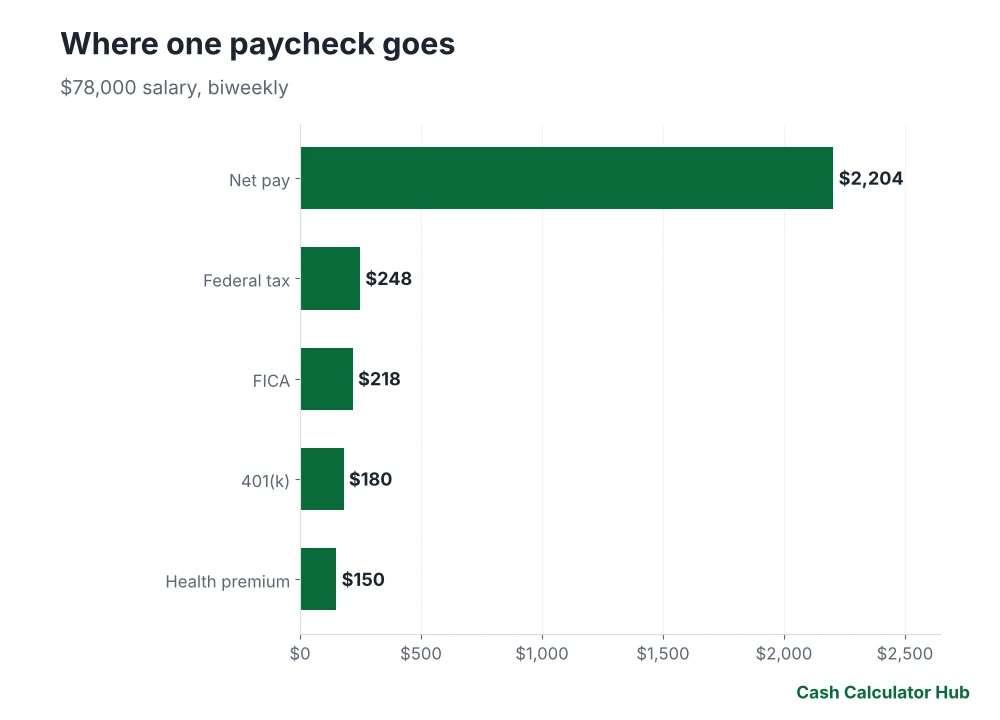
Taxable wages for federal income tax are gross pay minus 401(k) and health premiums: $69,420. After the $16,100 standard deduction, taxable income is $53,320. See standard versus itemized.
Key terms
- Gross pay: earnings before deductions.
- Pre-tax deductions: reduce taxable wages, such as traditional 401(k), health premiums and HSA contributions.
- Withholding: your employer’s estimate of income tax, based on Form W-4. See W-4 guide.
- FICA: Social Security and Medicare; see FICA explained.
- Post-tax deductions: Roth 401(k), garnishments, union dues, disability insurance.
- YTD: year-to-date totals, useful for checking accuracy.
- Net pay: what reaches your bank account.
Check your pay stub for errors
- Gross pay matches your salary or hours worked.
- Overtime is paid at the right rate; see overtime and bonuses.
- Retirement contributions match your election and the employer match is posting.
- Health deductions match your plan.
- Withholding is reasonable against your expected tax.
- YTD totals add up.
Why take-home is lower than you expect
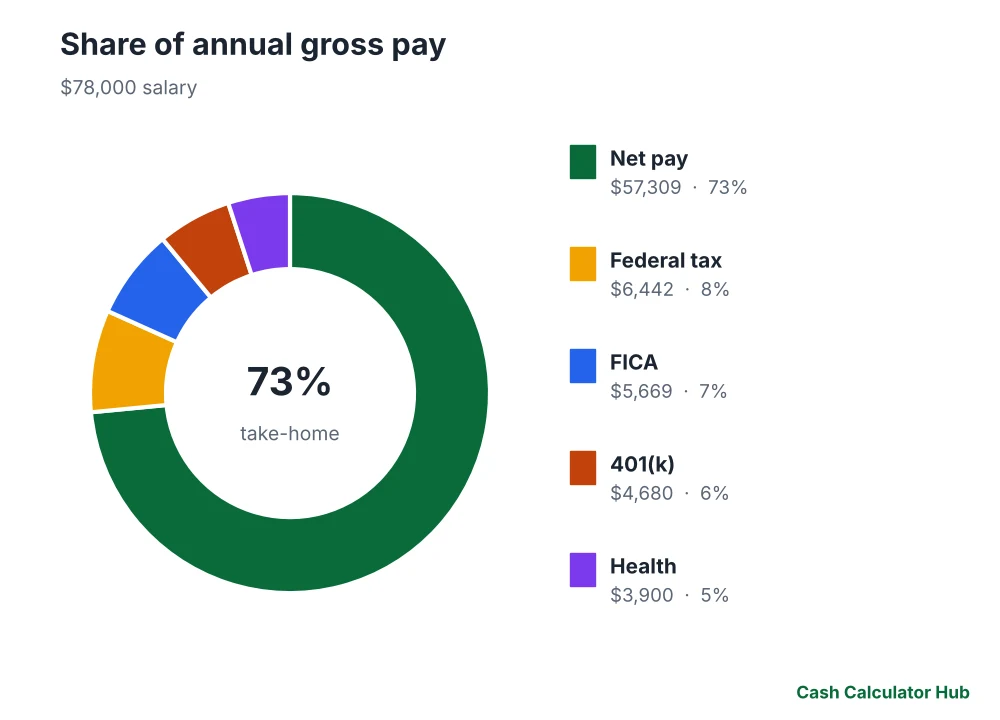
A $78,000 salary becomes $57,309 per year, or 73% of gross, in this example. The biggest pieces: federal tax $6,442, FICA $5,669, 401(k) $4,680 (which is your savings, not a loss) and premiums $3,900.
Tools
Use the take-home paycheck calculator and salary calculator to model your own check, and see hourly to salary if you are paid by the hour. More: tax tools.
Frequently asked questions
What is the difference between gross pay and net pay?
Gross pay is your total earnings before deductions. Net pay, or take-home, is what remains after taxes and deductions.
Why is my paycheck smaller than my salary divided by pay periods?
Income tax, FICA, retirement contributions and benefit premiums are subtracted.
What are pre-tax deductions?
Amounts taken out before income tax is calculated, such as traditional 401(k) contributions and health insurance premiums.
What does YTD mean on a pay stub?
Year-to-date: the running total of earnings, taxes and deductions for the calendar year.
Why does my first paycheck of the year look larger?
Some employers pay taxes progressively, or Social Security tax stops after the wage base for high earners, increasing later paychecks.
Sources and further reading
- IRS Tax Withholding Estimator
- IRS: Tax topics and forms
- U.S. Department of Labor: Wage and Hour Division
How the numbers were made: Every figure on this page was calculated from the formulas and assumptions stated above and rounded to the nearest dollar. Rates, limits and rules are for 2026 unless noted; confirm current figures with the sources listed before acting.
Keep reading
- How Much Is a $100,000 Salary After Taxes in 2026?
- Hourly to Salary: What Is $25 an Hour Per Year?
- 2026 Federal Tax Brackets and Standard Deduction, Explained With Examples
- FICA Taxes Explained: Social Security and Medicare Withholding in 2026
- W-2 vs 1099: How Much More You Must Charge to Match an Employee Salary
- Self-Employment Tax Explained: The 15.3% Tax and How to Estimate It
This guide is general information, not financial, tax or legal advice. Figures use stated assumptions and 2026 rules and will differ from your situation; check current rules and talk to a licensed professional before you decide. Full disclaimer.