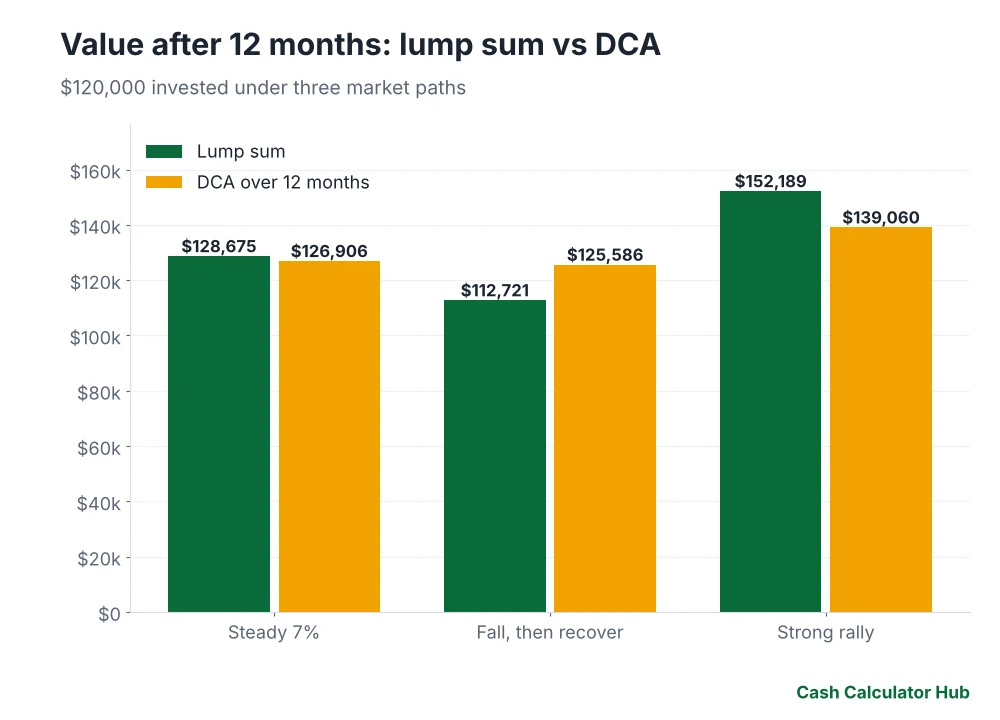
Quick answer: Investing a lump sum immediately has historically beaten spreading it over 12 months about two-thirds of the time, because markets rise more often than they fall. On $120,000 under steady 7% growth, the lump sum finishes about $1,769 ahead; if the market falls first, dollar-cost averaging wins by $12,865.
Say you inherit or save a large sum. You could invest it all today (lump sum) or invest equal portions each month for a year (dollar-cost averaging, DCA). Neither is right every time. The question is what you are trying to protect: expected return or regret.
The example invests $120,000 in a stock index fund. In the DCA version, $10,000 goes in each month and the cash waiting earns 4% in a savings account.
Key takeaways
- A lump sum invests more money for longer, so it wins whenever the market rises during the period.
- Studies of historical U.S. data found a lump sum beat 12-month DCA about two-thirds of the time.
- DCA lowers regret and volatility if the market falls right after you invest.
- If you invest from each paycheck, you are already doing DCA by necessity.
- In this example, the lump sum leads by $1,769 in a steady market and trails by $12,865 if markets fall then recover.
Three market paths for $120,000
Each path covers 12 months. The lump sum invests on day one. DCA invests $10,000 on the first of each month, and the uninvested cash earns 4% a year.
| Market path | Lump sum after 12 months | DCA after 12 months | Lump sum advantage |
|---|---|---|---|
| Steady (7% a year) | $128,675 | $126,906 | $1,769 |
| Fall then recover | $112,721 | $125,586 | $-12,865 |
| Strong rally (2% a month) | $152,189 | $139,060 | $13,129 |
Why the lump sum usually wins
Markets go up more often than they go down. On average, money invested earlier earns more than money waiting in cash, even cash earning 4%. DCA leaves, on average, about half the money in cash for half the year, so it trades expected return for smoother timing.
Why DCA can still be the right choice
- Regret. If the market falls 20% right after a lump sum, it can be hard to stay invested. DCA softens the blow.
- Uncertainty about valuations, which can lead people to sell at the wrong time.
- Behavior. People who would otherwise never invest the money may find DCA easier to start and stick with.

Compromises
- Shorter DCA. Invest over 3 to 6 months rather than 12.
- Half now, half later. Invest 50% today and the rest over six months.
- Match your plan to a goal. If the money is for a purchase in two years, it should not be in stocks regardless.
What about the paycheck?
When you invest each month from salary, there is no lump sum to compare against. Regular investing is the right approach for most people; the DCA-versus-lump-sum debate applies only when you already hold the money. See retirement contribution limits for where to invest regularly.
Taxes and accounts
In a tax-advantaged account, timing does not trigger taxes. In a taxable account, DCA creates multiple purchase lots at different prices, which affects the cost basis when you sell. Roth IRA and 401(k) limits restrict how fast you can invest in those accounts; see which account to fund first.
What the math does not cover
Past results do not guarantee the future. The market can fall for years, as in 2000 to 2002 or 2008. Diversify, hold an emergency fund and invest only money you will not need soon. See stocks versus bonds for sizing risk.
Model it yourself
Use the investment calculator for monthly contributions, the future value calculator for a single deposit and the average return calculator to check your results. More: investment calculators.
Frequently asked questions
Is dollar-cost averaging better than lump sum investing?
Not on average. A lump sum has beaten 12-month DCA roughly two-thirds of the time historically, but DCA reduces the risk of investing right before a drop.
What is dollar-cost averaging?
Investing a fixed amount at regular intervals, regardless of price. You buy more shares when prices are low and fewer when high.
Should I invest a windfall all at once?
If you can tolerate volatility and your time horizon is long, a lump sum has higher expected returns. If a drop would cause you to sell, a phased approach may suit you better.
How long should DCA take?
Three to twelve months is typical. Longer than a year increases the cost of being in cash.
Does DCA work in a 401(k)?
Yes, you naturally invest each paycheck. That is dollar-cost averaging by default.
Sources and further reading
How the numbers were made: Every figure on this page was calculated from the formulas and assumptions stated above and rounded to the nearest dollar. Rates, limits and rules are for 2026 unless noted; confirm current figures with the sources listed before acting.
Keep reading
- Compound Interest on $10,000: What It Becomes in 10, 20 and 30 Years
- ROI vs IRR vs CAGR: Which Return Number Should You Trust?
- How Long Does It Take to Save $1 Million?
- Capital Gains Tax Rates 2026: 0%, 15% and 20% Brackets Explained
- Stocks vs Bonds: How to Choose Your Asset Allocation
- Index Fund vs ETF vs Mutual Fund: Differences, Costs and Taxes
This guide is general information, not financial, tax or legal advice. Figures use stated assumptions and 2026 rules and will differ from your situation; check current rules and talk to a licensed professional before you decide. Full disclaimer.