Quick answer: A Roth conversion moves money from a traditional IRA or 401(k) to a Roth IRA and makes the converted amount taxable income that year. Converting $50,000 on top of $60,000 of other income costs about $10,350 in federal tax (an effective 20.7%); it pays off if your tax rate in retirement would be higher, and if you can pay the tax from outside the IRA.
Traditional accounts give you a deduction now and tax you later. Roth accounts do the opposite. A conversion lets you change your mind, paying tax now on money that would otherwise be taxed on withdrawal.
The result depends on your tax rate today compared with your rate later, and on a few rules that can add surprises.
Key takeaways
- Conversion adds to taxable income: $50,000 on top of $60,000 (single, after a $16,100 standard deduction) costs about $10,350 in federal tax.
- The effective rate on the conversion is 20.7%, because part of it fills the 12% bracket and the rest is taxed at 22%.
- Pay the tax from outside the IRA, or you lose part of the benefit.
- A conversion pays off when the rate you pay now is lower than the rate you would pay later.
- Each conversion has its own 5-year clock for penalty-free access to the converted principal before age 59½.
How the tax is calculated
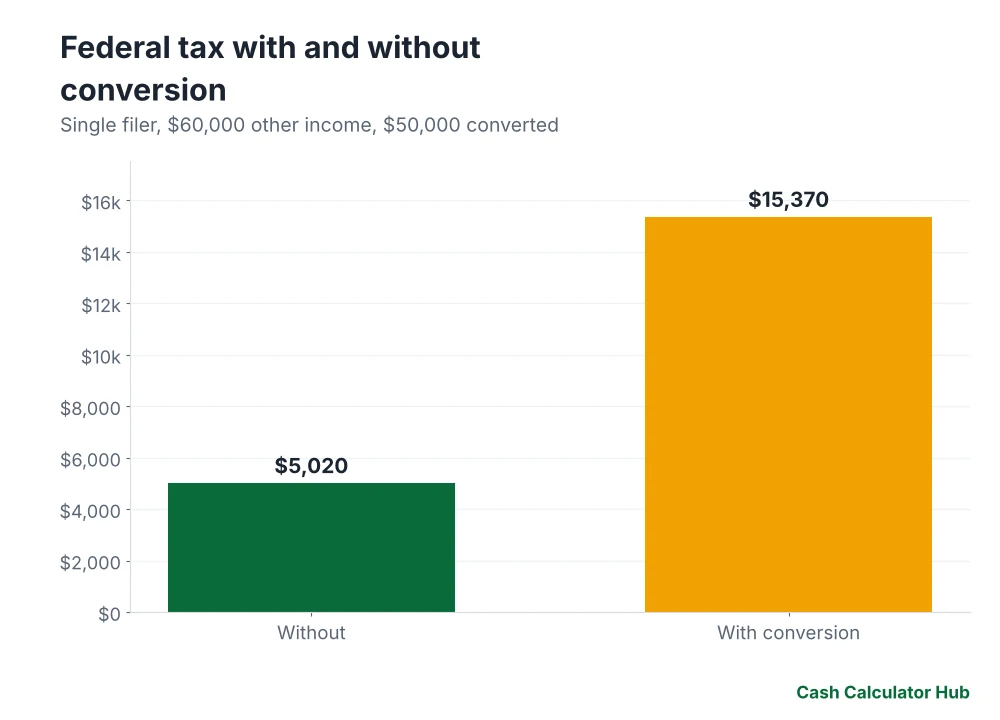
Taxable income before conversion: $60,000 − $16,100 standard deduction = $43,900. After converting $50,000: $93,900.
| Taxable income | Federal tax (2026 single brackets) | |
|---|---|---|
| Without conversion | $43,900 | $5,020 |
| With conversion | $93,900 | $15,370 |
| Cost of conversion | $10,350 |
The conversion fills the rest of the 12% bracket (up to $50,400) and then reaches into 22%. See the 2026 brackets explained.
The decision rule
A Roth conversion wins if your tax rate now is lower than the rate you would pay on the same money when withdrawn later. After the tax is paid, the Roth grows and is withdrawn tax-free. A traditional account grows the same but is taxed on withdrawal.
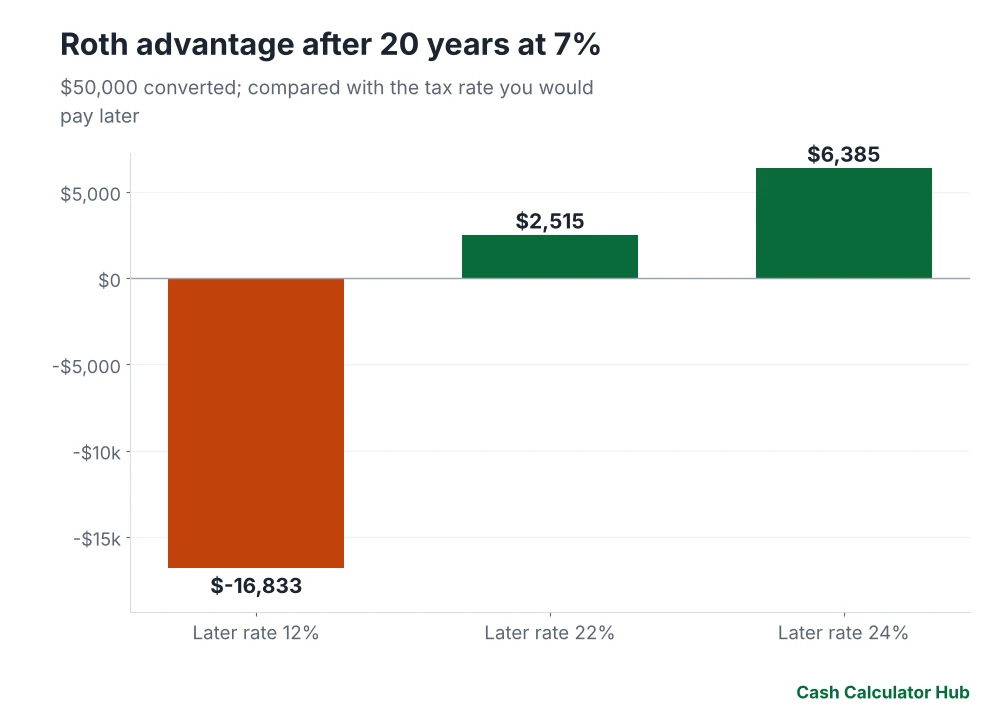
At 7% growth for 20 years, $50,000 becomes $193,484. The advantage of converting at an effective 20.7%, compared with different future rates:
| Tax rate you would pay later | Effective rate on the conversion | Value of the account after 20 years | Roth advantage |
|---|---|---|---|
| 12% | 20.7% | $193,484 | $-16,833 |
| 22% | 20.7% | $193,484 | $2,515 |
| 24% | 20.7% | $193,484 | $6,385 |
A negative number means that waiting would have been better. This simplified comparison assumes you pay the conversion tax from outside money.
Good times to convert
- Low-income years: between jobs, early retirement before Social Security and RMDs, or a sabbatical.
- Before required minimum distributions (age 73 or 75) force large taxable withdrawals; see RMDs.
- When you expect higher taxes later, or higher rates after current law changes.
- After a market dip, when the same shares convert at a lower value.
When it may not make sense
- You need the IRA money to pay the tax.
- The conversion would push you into a higher bracket or trigger other costs.
- You will be in a lower bracket in retirement.
- You may need the money within five years.
Side effects to check
- Medicare premiums. Income two years earlier sets IRMAA surcharges; see Medicare costs.
- Taxable Social Security. More income can make more benefits taxable; see taxation of benefits.
- Credits and deductions that phase out with income.
- State income tax.
- Net investment income tax for higher earners.
The five-year rules
- Each conversion has its own 5-year period before the converted principal can be withdrawn without a 10% penalty if you are under 59½.
- Earnings in a Roth IRA are tax-free only if the account has been open five years and you are 59½ or older (or meet another exception).
Partial conversions
Many people convert a bit each year, filling a target bracket. For example, with the 12% bracket top at $50,400 (single, taxable income), convert enough to reach that level each year. It spreads the cost and reduces risk.
Run your numbers
Use the Roth IRA calculator and IRA calculator to compare growth, and the income tax calculator to estimate the tax on a conversion. For the account choice, see Roth versus traditional. More: retirement tools.
Frequently asked questions
What is a Roth conversion?
Moving money from a traditional IRA or 401(k) into a Roth IRA. The converted amount is taxed as income in the year of conversion; qualified Roth withdrawals later are tax-free.
Is a Roth conversion worth it?
It is worth it when your current tax rate is lower than the one you expect later, and you can pay the tax from other funds.
Is there a limit on Roth conversions?
No income or amount limit applies to conversions. The tax cost is the practical limit.
How is a Roth conversion taxed?
As ordinary income at your marginal brackets, added to your other income for the year.
Can I undo a Roth conversion?
No. Recharacterizing a conversion was eliminated by the 2017 tax law, so plan carefully.
Sources and further reading
- IRS: Individual retirement arrangements (IRAs)
- IRS: Tax topics and forms
- Social Security Administration
How the numbers were made: Every figure on this page was calculated from the formulas and assumptions stated above and rounded to the nearest dollar. Rates, limits and rules are for 2026 unless noted; confirm current figures with the sources listed before acting.
Keep reading
- Roth vs Traditional 401(k) and IRA: How to Decide
- Required Minimum Distributions: Age 73 or 75, and How to Calculate Yours
- 2026 Federal Tax Brackets and Standard Deduction, Explained With Examples
- Backdoor Roth IRA Explained: Steps, the Pro-Rata Rule and Pitfalls
- Pension Lump Sum vs Monthly Payments: How to Compare the Offers
- How Much Should You Have Saved for Retirement by Age? Benchmarks for 30 to 67
This guide is general information, not financial, tax or legal advice. Figures use stated assumptions and 2026 rules and will differ from your situation; check current rules and talk to a licensed professional before you decide. Full disclaimer.