Quick answer: APR (annual percentage rate) is the yearly interest rate before compounding, while APY (annual percentage yield) includes compounding and shows what you actually earn or pay in a year. APY = (1 + APR/n)^n − 1. A 24% APR compounded monthly equals a 26.82% APY, while a savings account quoted at 4.00% APY earns exactly 4.00% in a year.
Banks quote loans in APR and savings in APY, and the difference can make a loan look cheaper or a savings account look better than it is. The key is to compare like with like: use APY for savings and for the true annual cost of borrowing.
Key takeaways
- APY = (1 + APR/n)^n − 1, where n is the number of compounding periods per year.
- More frequent compounding raises APY for the same APR.
- For loans, the APR also includes certain fees in the legal definition.
- Compare savings accounts by APY and loans by APR (and fees).
- The gap between APR and APY grows with the rate and frequency.
The conversion
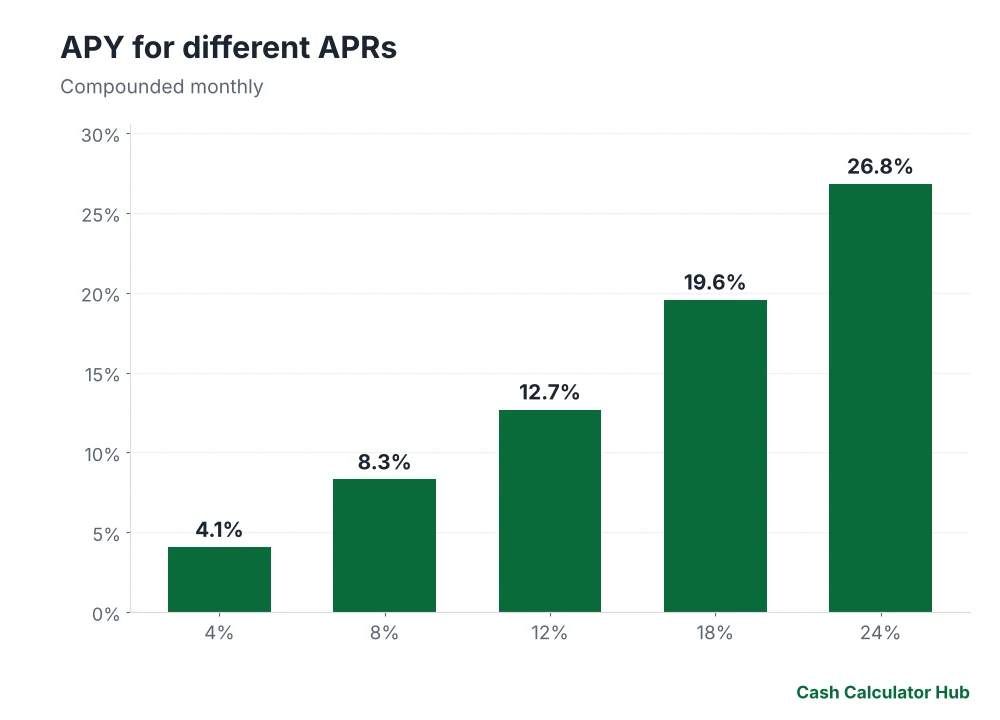
| APR | Compounded | APY |
|---|---|---|
| 4% | monthly | 4.07% |
| 8% | monthly | 8.30% |
| 12% | monthly | 12.68% |
| 18% | monthly | 19.56% |
| 24% | monthly | 26.82% |
| 29.99% | monthly | 34.48% |
| 24% | daily | 27.11% |
| 4% | yearly | 4.00% |
Savings example
$10,000 at 4.00% APR compounded monthly earns $407 in a year; a 4.07% APY is the same thing. At 4% simple annual compounding you would earn $400. The difference is small at low rates but grows with time and rate.
| Years | 4% APR monthly | 4% yearly compounding |
|---|---|---|
| 1 | $10,407 | $10,400 |
| 5 | $12,210 | $12,167 |
| 10 | $14,908 | $14,802 |
| 20 | $22,226 | $21,911 |
See high-yield savings and APY and compound interest on $10,000.
Borrowing example
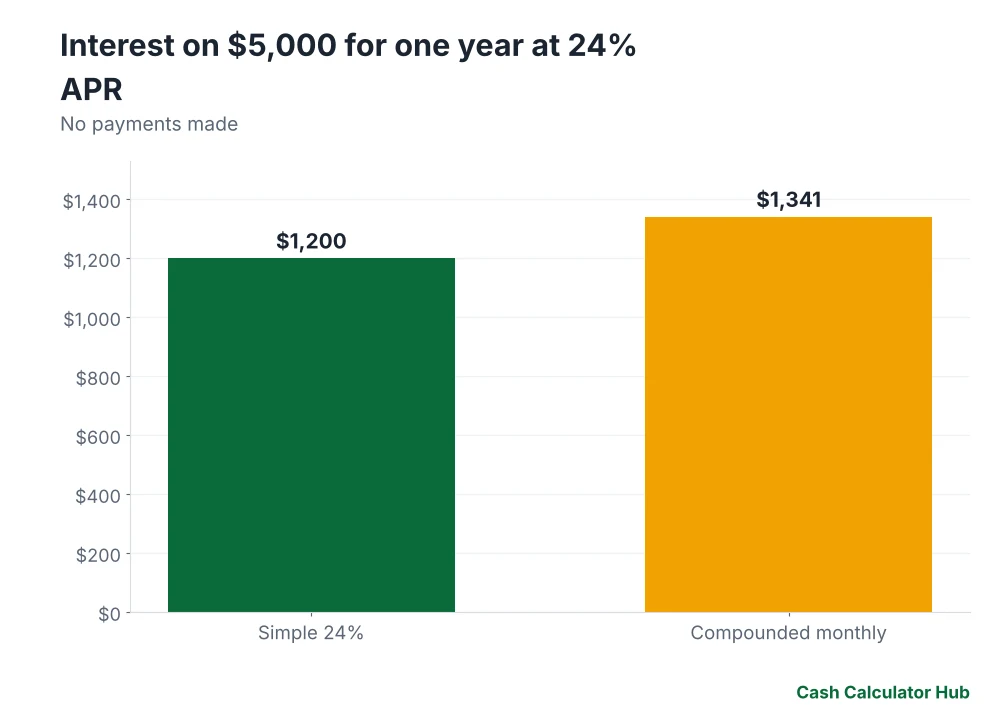
A credit card with a 24% APR charges interest daily or monthly on the balance. Carrying $5,000 for a year without payments would cost $1,341 in interest, not $1,200, because interest compounds. See how card interest is calculated.
Mortgage and car loans
For installment loans, the APR includes some fees and shows a more complete cost than the interest rate. Compare the APR across offers but also compare total interest. See mortgage points and auto loan refinancing.
Rule of thumb
- Savers: look for the highest APY.
- Borrowers: look for the lowest APR and fees, then compare the total cost.
Tools
Use the APR calculator, interest calculator and compound interest calculator. More: loan calculators.
Frequently asked questions
What is the difference between APR and APY?
APR is the annual rate without compounding; APY includes the effect of compounding.
Which is better, APR or APY?
For savings, a higher APY is better. For loans, a lower APR (and lower fees) is better.
How do I convert APR to APY?
APY = (1 + APR/n)^n − 1, where n is compounding periods per year.
Why is my credit card APY higher than its APR?
Because interest compounds, so you pay interest on interest.
Do loans advertise APR or APY?
Loans are advertised with APR; savings accounts with APY.
Sources and further reading
How the numbers were made: Every figure on this page was calculated from the formulas and assumptions stated above and rounded to the nearest dollar. Rates, limits and rules are for 2026 unless noted; confirm current figures with the sources listed before acting.
Keep reading
- Compound Interest on $10,000: What It Becomes in 10, 20 and 30 Years
- Savings Account vs CD: Which Earns More for Your Cash?
- How Long to Pay Off a Credit Card Making Only the Minimum?
- Credit Score Factors: What Moves Your Score and by How Much
- Balance Transfer Cards: Are They Worth the 3% to 5% Fee?
- Personal Loan vs Credit Card: Which Costs Less for a Big Expense?
This guide is general information, not financial, tax or legal advice. Figures use stated assumptions and 2026 rules and will differ from your situation; check current rules and talk to a licensed professional before you decide. Full disclaimer.