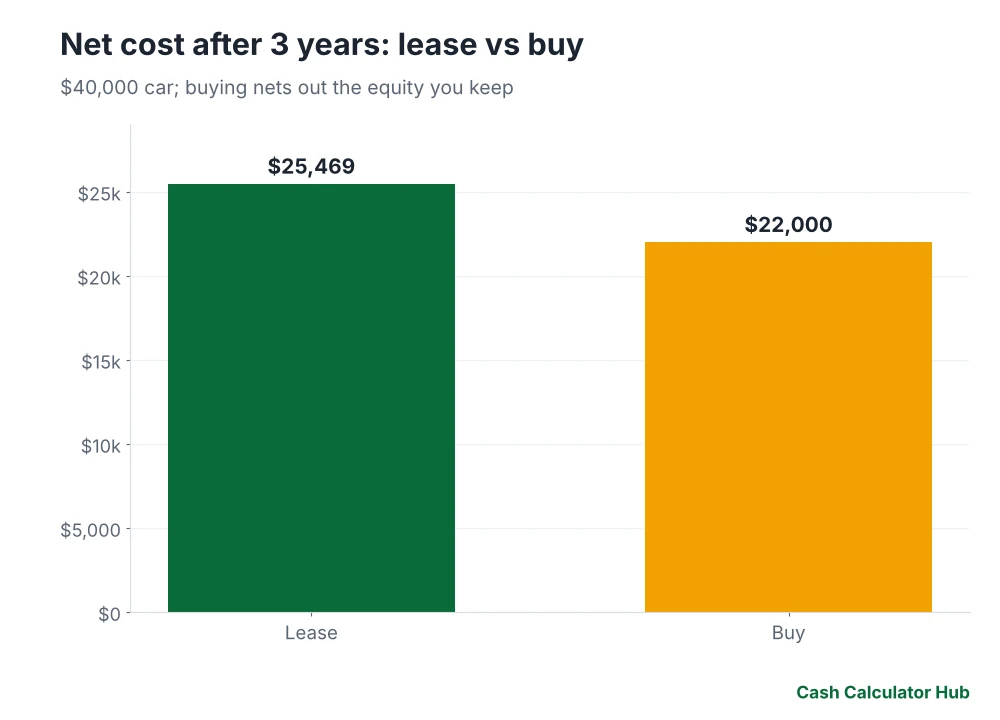
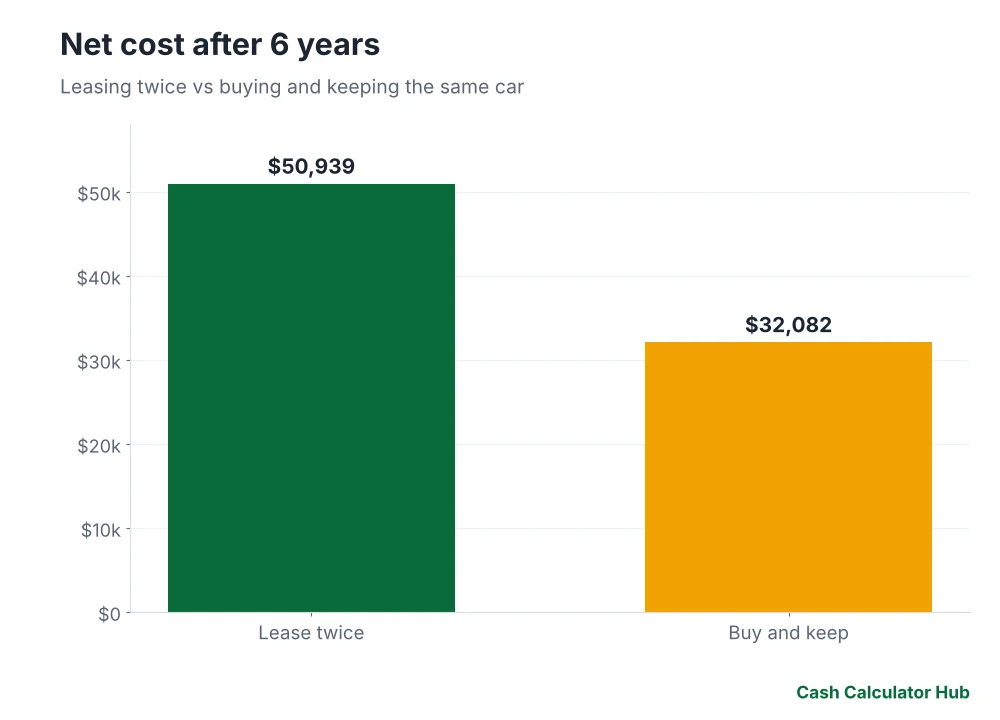
Quick answer: Leasing usually has a lower monthly payment but leaves you with no asset; buying costs more per month and builds equity. On a $40,000 car, three years of leasing costs about $25,469 versus $22,000 net for buying, but leasing twice for six years costs about $50,939 against $32,082 for buying and keeping the car.
The right answer depends on how long you keep cars and how much you drive. The lease payment looks attractive because you only pay for the part of the car’s value you use. But if you replace the car every three years, you pay for that depreciation again and again, and never own anything.
The example uses illustrative inputs: a $40,000 car, a 36-month lease at a 7.2% equivalent rate (money factor 0.003) with a 58% residual value, and a 60-month purchase loan at 7.5% with $4,000 down.
Key takeaways
- Lease payment: about $656 a month plus $2,500 due at signing; loan payment: $721 a month plus $4,000 down.
- After 3 years: net lease cost about $25,469; net buy cost about $22,000 counting the equity you keep.
- After 6 years: leasing twice costs about $50,939; buying and keeping costs about $32,082.
- Leasing fits drivers who want a new car every few years and stay under the mileage limit.
- Buying wins for people who keep cars 6 years or longer.
How a lease payment is built
Monthly lease payment = (price − residual value) ÷ months + (price + residual) × money factor.
- Residual value is the lender’s prediction of what the car will be worth at the end. Higher residual means a lower payment.
- Money factor is the interest rate divided by 2,400. A money factor of 0.003 is about 7.2% APR.
Here: ($40,000 − $23,200) ÷ 36 = $467 for depreciation, plus ($40,000 + $23,200) × 0.003 = $190 for finance charge, a total of $656 a month.
Three years: lease versus buy
| Lease | Buy (60-month loan) | |
|---|---|---|
| Due at start | $2,500 | $4,000 down |
| Monthly payment | $656 | $721 |
| Paid over 36 months | $25,469 | $29,969 |
| Car value at month 36 | none (returned) | about $24,000 |
| Loan balance at month 36 | none | $16,031 |
| Net cost | $25,469 | $22,000 |
The buyer’s net cost subtracts the equity: value minus loan balance. Lease costs exclude fees at turn-in, such as excess mileage (often 15 to 25 cents a mile) and wear charges.
Six years: where the gap opens
If you lease for three years and then lease again, you pay roughly the same $25,469 twice. If you buy and keep the car six years, the loan is paid off after year five and you drive a year payment-free:
| 6-year view | Lease twice | Buy and keep |
|---|---|---|
| Cash paid | $50,939 | $47,282 |
| Value of the car at the end | none | about $15,200 |
| Net cost | $50,939 | $32,082 |
| Per month | $707 | $446 |
When leasing makes sense
- You like new cars with warranty coverage and replace them every two to four years.
- You drive well under the mileage allowance (commonly 10,000 to 15,000 miles a year).
- You can deduct the cost for business use (talk to a tax professional).
- Residual values are high or the manufacturer subsidizes the lease.
When buying makes sense
- You keep cars for six years or more.
- You drive a lot or want to modify the car.
- You want the choice of selling or trading when you like.
- You value the lowest long-run cost over the lowest payment.
Lease traps
- Mileage overages. 3,000 extra miles at 25 cents is $750.
- Wear and tear charges at turn-in.
- Early termination. Ending a lease early can mean paying most of the remaining payments.
- Gap exposure. Most leases include gap coverage; check yours. See the gap insurance guide.
- Focus on the payment. Always negotiate the price of the car first; lower price reduces both the loan and the lease.
Compare with your own numbers
The auto lease calculator computes the payment from the price, residual and rate, and the auto loan calculator does the same for a purchase. For tax effects of a purchase and trade-in, see the trade-in guide. More: auto calculators.
Frequently asked questions
Is it cheaper to lease or buy a car?
Leasing has the lower monthly payment, but over long periods buying and keeping the car is usually cheaper because you stop making payments and keep an asset.
What is a good money factor?
A money factor of 0.0025 to 0.0035 corresponds to about 6% to 8.4% APR. Multiply the money factor by 2,400 to get the rate.
What happens at the end of a lease?
You return the car and pay any turn-in charges, lease a new one, or buy the car at the residual value stated in the contract.
Can I negotiate a lease?
Yes. Negotiate the price (capitalized cost), ask for the money factor and check the fees. These affect the payment more than the headline number.
Does leasing build equity?
No. You pay for the car’s depreciation during the term and own nothing at the end unless you buy it.
Sources and further reading
How the numbers were made: Every figure on this page was calculated from the formulas and assumptions stated above and rounded to the nearest dollar. Rates, limits and rules are for 2026 unless noted; confirm current figures with the sources listed before acting.
Keep reading
This guide is general information, not financial, tax or legal advice. Figures use stated assumptions and 2026 rules and will differ from your situation; check current rules and talk to a licensed professional before you decide. Full disclaimer.