Quick answer: Property tax is billed as a percentage of your home’s assessed value and typically adds $167 to $800 a month on a $400,000 home, depending on where you live. Lenders include it in your payment through escrow, so it directly changes how much house you can afford.
Property tax is the part of the monthly payment buyers underestimate most, because the rate depends on the county, the school district and sometimes the exact street. It is also the part that keeps rising after you buy, even on a fixed-rate loan.
This guide shows what it adds to the payment and how to check, estimate and, when justified, appeal it.
Key takeaways
- Effective property tax rates range from under 0.5% to over 2% of market value depending on state and locality.
- On a $400,000 home the tax runs from about $167 to $800 a month across that range.
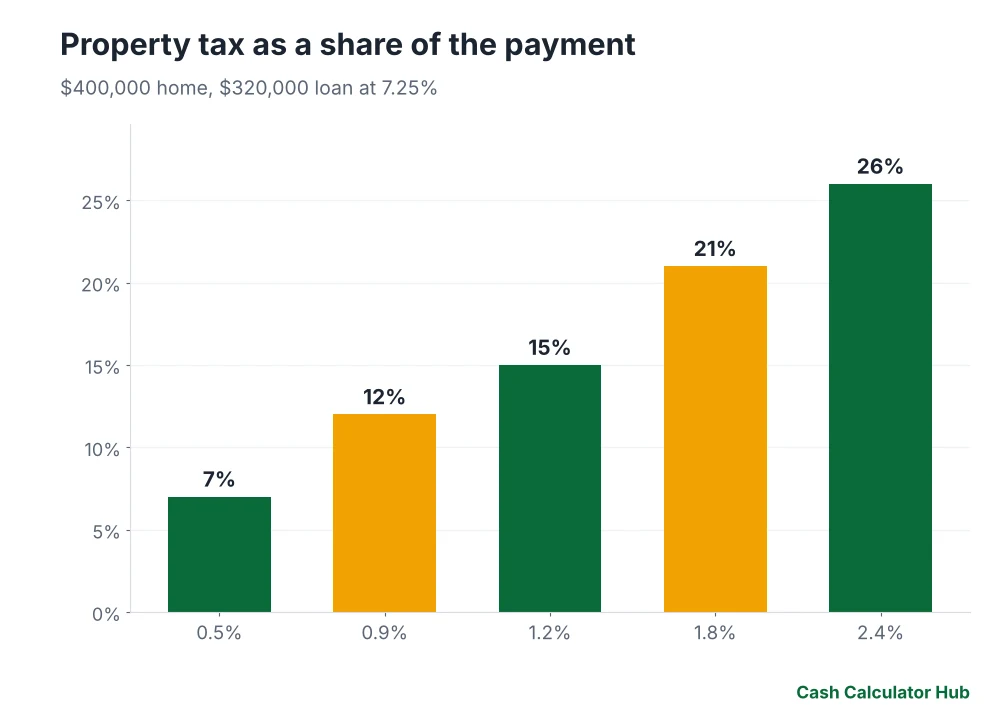
- Principal and interest on a $320,000 loan at 7.25% is $2,183; tax can add roughly 8% to 37% on top of that.
- The assessed value, not the price you paid, is what the tax rate applies to, and it can be reassessed after a sale.
- You can appeal an assessment you believe is too high, and many areas offer exemptions such as a homestead credit.
How property tax is calculated
Annual tax = assessed value × local tax rate (often written as a millage rate, where one mill is $1 per $1,000 of value). Assessed value may be the full market value or a fraction of it; the effective rate converts everything into a percentage of market value so you can compare places.
A county with a 1.2% effective rate charges $4,800 a year on a $400,000 house, or $400 a month.
What it adds to a $400,000 home payment
The table uses a $320,000 loan at 7.25% (principal and interest $2,183) and homeowners insurance of $117 a month, then varies only the property tax rate:
| Effective tax rate | Tax per year | Tax per month | Total monthly payment (PITI) |
|---|---|---|---|
| 0.5% | $2,000 | $167 | $2,466 |
| 0.9% | $3,600 | $300 | $2,600 |
| 1.2% | $4,800 | $400 | $2,700 |
| 1.8% | $7,200 | $600 | $2,900 |
| 2.4% | $9,600 | $800 | $3,100 |
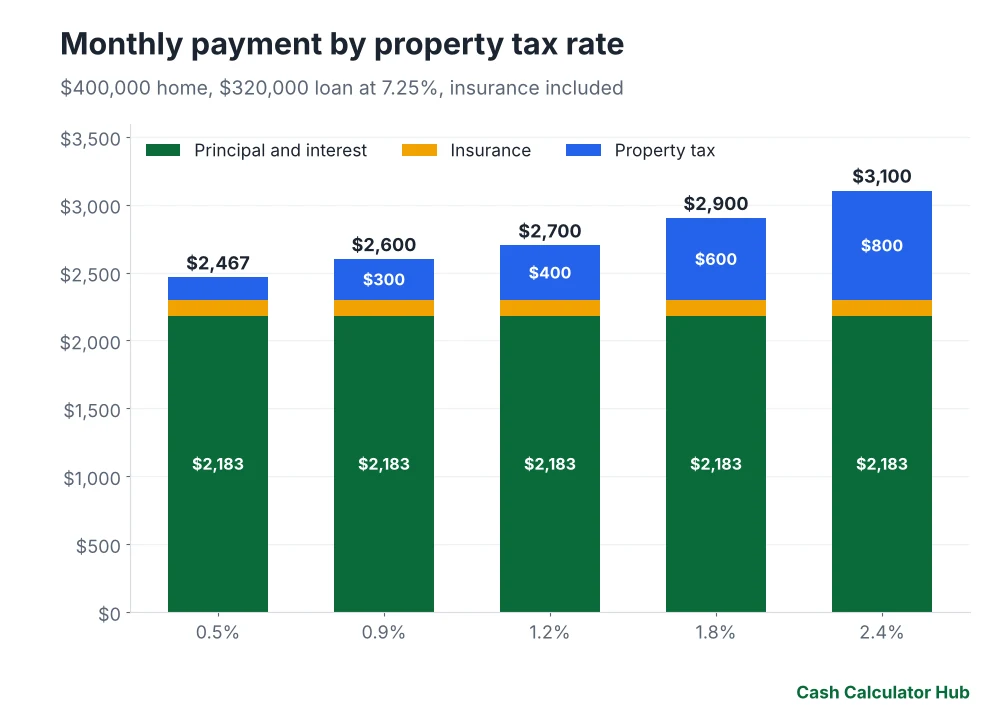
The spread between the lowest and highest row is more than $633 a month on the same house and the same mortgage. That is why two buyers with identical incomes can afford very different prices. Test your own numbers with the house affordability calculator.
Why it can rise after you buy
- Reassessment on sale. Some states, like California, reassess at the purchase price, while others let assessments rise slowly. A new buyer may pay far more than the seller did.
- Rising values. If market prices climb, the assessed value follows, subject to caps in some states.
- Rate changes. Schools, cities and counties vote on levies.
When taxes rise, the escrow portion of your payment adjusts at the annual review even though principal and interest do not. Read how escrow accounts work.
How to estimate before you buy
- Look up the property’s current tax bill on the county assessor’s website.
- Ask what the bill would be after reassessment at your purchase price.
- Check for the exemptions you would qualify for (homestead, senior, veteran).
- Add the monthly tax to your budget before you decide on a price.
What the tax does to your price range
A rule of thumb is that each additional percentage point of property tax rate reduces the home price you can afford by roughly 10% to 12% when you are limited by the 28% front-end ratio. Higher-tax areas often offer other advantages, such as stronger schools or no state income tax, so the comparison is not just about the rate. See how a $100K salary translates into a price.
Appealing an assessment
- Compare your assessed value with recent sales of similar nearby homes.
- Check the record for errors, such as extra bedrooms or square footage.
- File within the deadline, which is often only 30 to 60 days after the notice.
- Provide evidence: comparable sales, an independent appraisal or photos of defects.
Appeals succeed often enough that they are worth considering when the number looks high, but you may not win and some jurisdictions can raise a value on review.
Deducting property tax
Property taxes are part of the state and local tax (SALT) deduction for itemizers. For 2025 and 2026 the cap is about $40,000, phased down for very high incomes, so many homeowners can deduct more than they could before 2025. Whether itemizing beats the standard deduction depends on your mortgage interest, state income tax and charity. See the 2026 deduction amounts.
Run your own numbers
Start with the mortgage calculator and enter the tax rate for your county. Use the real estate calculator for ownership costs. More: mortgage calculators.
Frequently asked questions
What is a typical property tax rate?
Effective rates vary from under 0.5% to over 2% of market value. The national median is roughly 1%, but your county’s bill is what matters.
Does a mortgage lender collect property tax?
Usually yes, through an escrow account. Each month a portion of your payment is set aside and the servicer pays the tax bill when it is due.
Will my property tax go up after I buy a house?
It can. If the local assessor reassesses at the sale price or values rise, your bill may be higher than the seller’s.
Can I lower my property tax?
You can appeal an assessment you believe is too high and claim exemptions such as homestead or senior credits where available.
Is property tax deductible?
Yes, as part of the SALT deduction if you itemize. The cap on state and local taxes is about $40,000 for most filers in 2026.
Sources and further reading
How the numbers were made: Every figure on this page was calculated from the formulas and assumptions stated above and rounded to the nearest dollar. Rates, limits and rules are for 2026 unless noted; confirm current figures with the sources listed before acting.
Keep reading
- Mortgage Payment on a $400,000 House: Real Numbers
- How Much House Can I Afford on a $100K Salary?
- Mortgage Escrow Account Explained: Why Your Payment Changes
- How Your Credit Score Changes Your Mortgage Rate and Payment
- Cash-Out Refinance vs HELOC: Which Costs Less for $50,000?
- Home Equity: How It Builds, How Much You Can Borrow and When to Use It
This guide is general information, not financial, tax or legal advice. Figures use stated assumptions and 2026 rules and will differ from your situation; check current rules and talk to a licensed professional before you decide. Full disclaimer.