Quick answer: Do you need 20% down? No.
The 20% rule persists because it avoids private mortgage insurance and keeps your payment low. As a requirement it is a myth. The National Association of Realtors has reported for years that typical first-time buyers put down far less. What you need to decide is not “do I have 20%?” but “what does each level cost me, and what can I afford to hold in reserve?”
Minimums by loan type
- Conventional: as low as 3% with first-time-buyer programs, typically 5% on standard loans.
- FHA: 3.5% with a 580 credit score or higher.
- VA: 0% for eligible veterans and service members.
- USDA: 0% in eligible rural areas, with income limits.
Our comparison of FHA and conventional loans explains why the lowest down payment is not always the cheapest loan.
What each level costs on a $350,000 home
Assuming a 7% 30-year loan, with PMI or mortgage insurance estimated by down payment (illustrative; your actual PMI depends on your credit score, and the FHA row includes the 1.75% upfront premium financed into the loan):
| Down payment | Amount | Monthly P&I + insurance | Of which PMI/MIP |
|---|---|---|---|
| 3% | $10,500 | $2,513 | $255 |
| 3.5% (FHA) | $12,250 | $2,441 | $155 |
| 5% | $17,500 | $2,378 | $166 |
| 10% | $35,000 | $2,201 | $105 |
| 20% | $70,000 | $1,863 | $0 |
The biggest cliff is at 20%. Going from 10% to 20% down on this house takes the payment from $2,201 to $1,863, a drop of $338 a month. Part of that is the smaller loan; part is PMI disappearing.
Do not forget closing costs
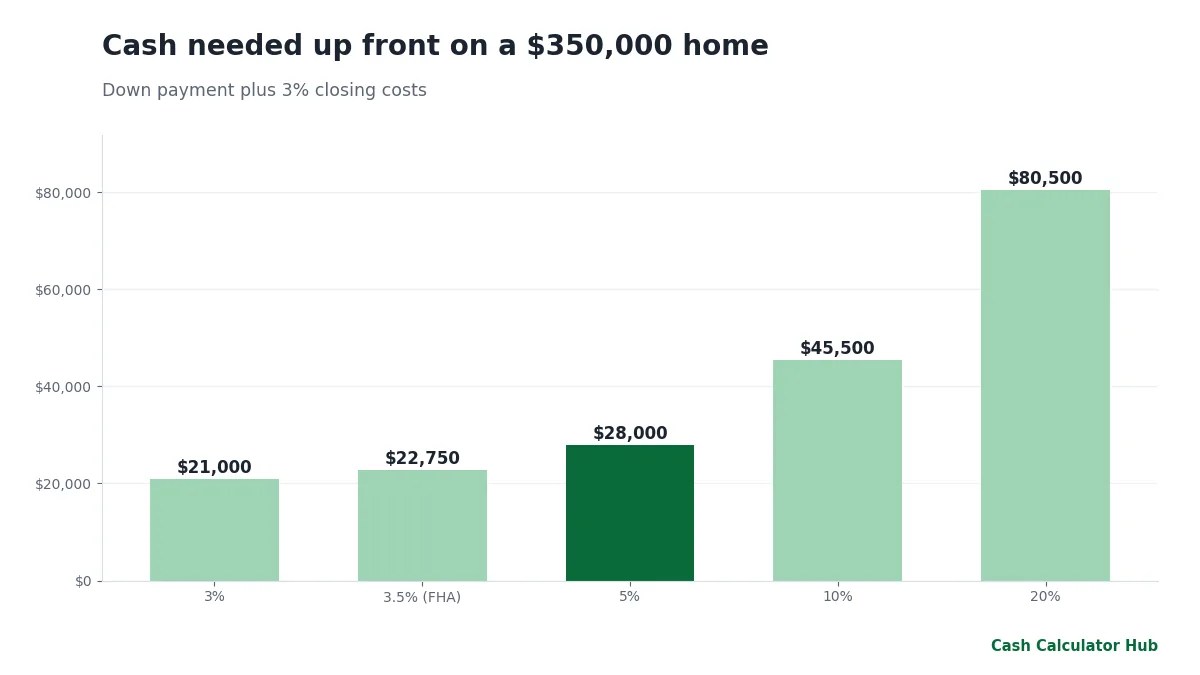
Closing costs run about 2% to 5% of the price. On a $350,000 home that is $7,000 to $17,500. Add the first year’s homeowners insurance and property tax escrow, moving costs, and a repair fund. A realistic cash target for 5% down is close to $31,000, not $17,500.
Is it smarter to wait until you have 20%?
Not automatically. Waiting has its own costs:
- Rent you pay while you save. Each year of renting is a year of equity you did not build.
- Rising prices and rates. If prices rise 3% a year, a $350,000 house costs $10,500 more in a year, which can swallow much of what you saved.
- PMI is temporary. On a conventional loan it ends when you reach 80% to 78% equity, whether from payments or price growth.
And buying too soon with too little cushion has costs too. If a $5,000 repair bill would force you onto a credit card at 22%, you are not ready, regardless of how small the down payment can be. A common guideline is to keep three to six months of expenses after closing.
How to save faster
- Calculate the full target with the down payment calculator, including closing costs.
- Automate a monthly transfer into a high-yield savings account. Compare account types in our guide to savings accounts vs CDs.
- Cut the biggest budget line first. Use the 50/30/20 rule to see where the money is going.
- Look for down payment assistance. State and local programs offer grants or low-interest second loans. Eligibility often depends on income and the home’s location.
- Do not drain retirement accounts without math. Early withdrawals from a 401(k) can carry taxes and penalties; first-time homebuyer rules for IRAs allow up to $10,000 penalty-free but not tax-free in every case.
The right question
Pick the down payment that keeps your monthly cost comfortable and leaves you with real reserves. Then check the whole plan in the mortgage calculator and the house affordability calculator. For the broader picture, see how much house you can afford on a $100K salary and the rest of the mortgage tools.
Three sample saving plans
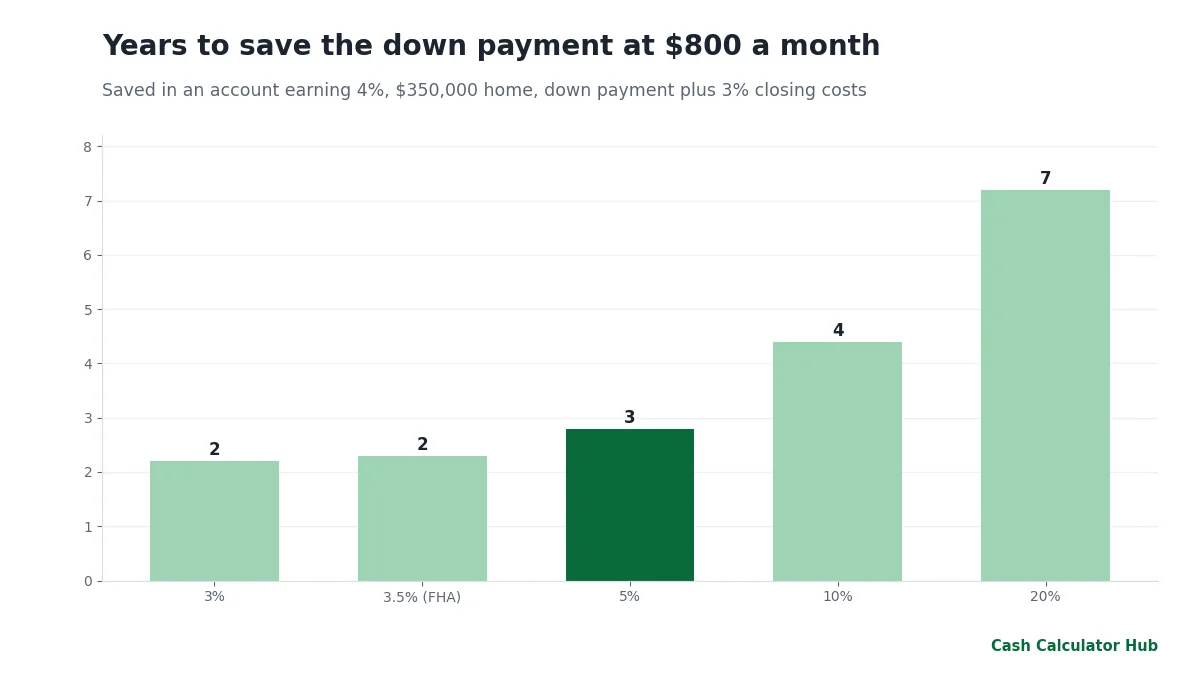
The 5% plan. Target on a $350,000 home: $28,000 (5% down plus 3% closing costs). Saving it in 24 months in an account earning 4% takes about $1,123 a month. That is a lot, so many people combine monthly saving with a gift, a bonus or a tax refund.
The slow-and-steady plan. At $500 a month, the same target takes about 4.3 years, which is long enough that prices and rates may move. Revisit the target every six months.
The assistance plan. State housing finance agencies and some employers and cities offer grants or low-interest second loans, often for first-time buyers or specific professions (teachers, nurses, first responders). Search your state’s housing finance agency and ask your lender which programs they work with. Programs usually have income caps and require homebuyer education, and some come with resale conditions.
A reality check before you commit
Ask yourself what happens in each of these cases after you close: a $4,000 repair, a three-month income gap, a 20% jump in your insurance premium. If the answer to any of them is “credit card,” you probably want a larger cushion before you buy, even if a lender would approve you today.
Can I buy a house with 0% down?
Yes, with VA or USDA loans if you qualify. Otherwise you need at least 3% to 3.5%.
Does a bigger down payment get me a lower interest rate?
Often, yes. Lenders price lower loan-to-value as lower risk, and the improvement is usually clearest at 20% and above.
Does gift money count toward a down payment?
Usually, with a gift letter and documentation. Rules differ by loan type.
How much should I have left after closing?
At least a few months of essential expenses, in an account you can reach easily.
Sources and further reading
How the numbers were made: Every figure on this page was calculated from the formulas and assumptions stated above and rounded. Rates, limits and rules are for 2026 unless noted; confirm current figures with the sources listed before acting.
Keep reading
- FHA vs Conventional Loan: Which Costs Less?
- Savings Account vs CD: Which Earns More for Your Cash?
- The 50/30/20 Budget Rule: How It Works, and How to Adjust It
- What Is PMI and How Do You Remove It? Costs and Timeline
- Closing Costs Explained: What You Pay and How to Lower It
- Mortgage Recast vs Refinance: Which Lowers Your Payment Better?
This guide is general information, not financial, tax or legal advice. Figures use stated assumptions and 2026 rules and will differ from your situation; check current rules and talk to a licensed professional before you decide. Full disclaimer.