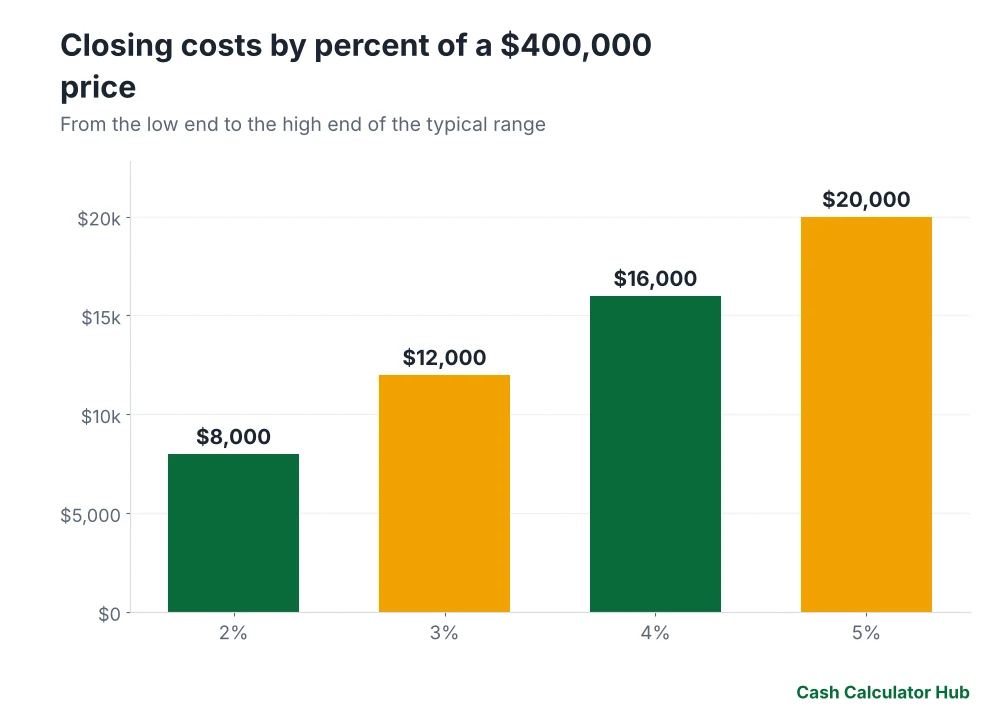
Quick answer: Buyer closing costs usually total 2% to 5% of the home price, or $8,000 to $20,000 on a $400,000 home. They include lender fees, title and settlement charges, government recording fees and prepaid items such as insurance and property taxes.
Closing costs surprise first-time buyers because they are separate from the down payment and arrive in the last few weeks. Knowing the categories lets you estimate them early and push back on the ones that can move.
The Loan Estimate and the Closing Disclosure, both required by federal rules, list every charge. Compare them line by line.
Key takeaways
- Plan on 2% to 5% of the price in closing costs, on top of the down payment.
- Some fees are fixed (taxes, recording); others vary by lender and provider (origination, title, appraisal).
- Prepaids, such as escrow setup, are not true fees: they are money you would owe anyway.
- You can shop for many services, ask for seller credits, or negotiate lender fees.
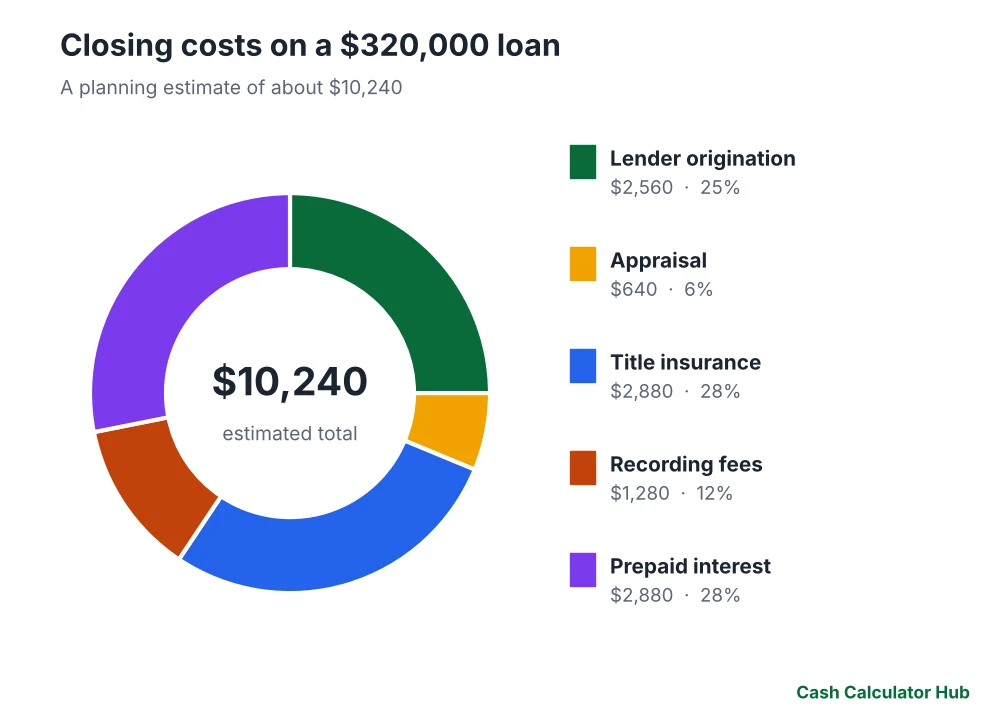
- On a $400,000 home with a $320,000 loan, an itemized planning estimate in this example comes to about $10,240.
How much to expect
| Home price | 2% | 3% | 5% |
|---|---|---|---|
| $300,000 | $6,000 | $9,000 | $15,000 |
| $400,000 | $8,000 | $12,000 | $20,000 |
| $500,000 | $10,000 | $15,000 | $25,000 |
Costs are higher in states with transfer taxes or where attorneys handle closings, and lower for no-fee lenders (who build costs into the rate). Compare offers using the Loan Estimate.
What the major fees are
| Fee | What it pays for | Shoppable? |
|---|---|---|
| Origination and underwriting | The lender’s work to process the loan | Negotiable |
| Appraisal | Opinion of value, ordered by the lender | Fixed by lender |
| Credit report and flood certificate | Required checks | Small, fixed |
| Title search and lender’s title insurance | Proves clean ownership, protects the lender | Often shoppable |
| Owner’s title insurance | Protects you | Optional but wise |
| Settlement or attorney fee | Closing agent or attorney | Often shoppable |
| Recording and transfer taxes | Government fees | Set by law |
| Prepaids and escrow deposits | Interest, insurance, taxes paid in advance | Based on timing |
An example on a $400,000 home
With 20% down the loan is $320,000. Using typical percentages of the loan amount:
| Category | Rate | Cost |
|---|---|---|
| Lender origination and underwriting | 0.8% | $2,560 |
| Appraisal, credit report, flood certification | 0.2% | $640 |
| Title insurance and settlement fees | 0.9% | $2,880 |
| Recording fees and transfer taxes | 0.4% | $1,280 |
| Prepaid interest, taxes and insurance (escrow setup) | 0.9% | $2,880 |
| Total | 3.2% | $10,240 |
Real bills vary widely. Use this as a planning range and request an official Loan Estimate within three business days of applying.
Seven ways to lower closing costs
- Compare at least three Loan Estimates. Origination fees and rates differ.
- Shop for title insurance and settlement services when the form says you can.
- Ask the seller for a credit. Concessions of 2% to 3% are common when the market is slow. Limits depend on the loan type and down payment.
- Negotiate or waive junk fees. Application, processing and administration fees can often be reduced.
- Close at the end of the month. You pay less prepaid interest because it is charged from the closing date to the end of that month.
- Look at lender credits, which trade a higher rate for lower costs. See the points guide for the break-even.
- Use down payment or closing assistance programs from state housing agencies, where eligible.
Can you roll closing costs into the loan?
On a refinance you can often roll costs into the balance, though it raises your loan size and interest. On a purchase, you cannot finance closing costs directly with most conventional loans, but seller credits or lender credits can cover them. FHA and VA loans have their own rules; see FHA versus conventional.
Budget for cash to close
Cash to close = down payment + closing costs + prepaids − seller credits − your earnest money deposit already paid. Build that number early and add a cushion, because items such as the appraisal may be due before closing. Also count first-year ownership costs, covered in the hidden costs guide.
Run the numbers
Use the down payment calculator to set a target, the real estate calculator to estimate total costs, and the mortgage calculator for the payment. More: mortgage tools.
Frequently asked questions
What are typical closing costs for a buyer?
Usually 2% to 5% of the purchase price, though some states and loan types run higher. Your Loan Estimate gives the actual figures.
Who pays closing costs, the buyer or the seller?
Both pay some. Buyers pay most loan and title charges; sellers typically pay agent commissions and their own transfer taxes. Seller credits to the buyer are negotiable.
Are closing costs tax deductible?
Most are not. Points on a purchase and some property taxes may be deductible for itemizers. Costs that add to your basis reduce taxable gain when you sell.
Can I negotiate closing costs?
Yes. Lender fees and sometimes title and settlement fees are negotiable, and a seller can offer credits.
When do I pay closing costs?
At closing, usually by wire or cashier’s check. The Closing Disclosure arrives at least three business days earlier so you can review it.
Sources and further reading
How the numbers were made: Every figure on this page was calculated from the formulas and assumptions stated above and rounded to the nearest dollar. Rates, limits and rules are for 2026 unless noted; confirm current figures with the sources listed before acting.
Keep reading
- How Much Down Payment Do You Really Need for a House?
- Mortgage Discount Points: When Is Paying for a Lower Rate Worth It?
- Mortgage Recast vs Refinance: Which Lowers Your Payment Better?
- ARM vs Fixed-Rate Mortgage: What a 5/1 ARM Really Costs
- What Is PMI and How Do You Remove It? Costs and Timeline
- 15-Year vs 30-Year Mortgage: Which Costs Less Overall?
This guide is general information, not financial, tax or legal advice. Figures use stated assumptions and 2026 rules and will differ from your situation; check current rules and talk to a licensed professional before you decide. Full disclaimer.