Quick answer: Paying down a student loan earns a guaranteed return equal to its interest rate; investing earns an uncertain return. On a $30,000 loan at 6.5% over 10 years, paying an extra $300 a month finishes the loan in 4 yr 7 mo and saves about $6,721 in interest. Investing $300 a month at 7% for 10 yr would give about $51,925 but at 5% only $46,585. Loans above about 6% to 7% usually favor paying off; low rates favor investing after the employer match.
It is a classic dilemma: extra cash can pay down debt or buy investments. The answer depends mostly on the loan’s interest rate, your tax situation, risk tolerance and whether you have already captured an employer match and built an emergency fund.
Key takeaways
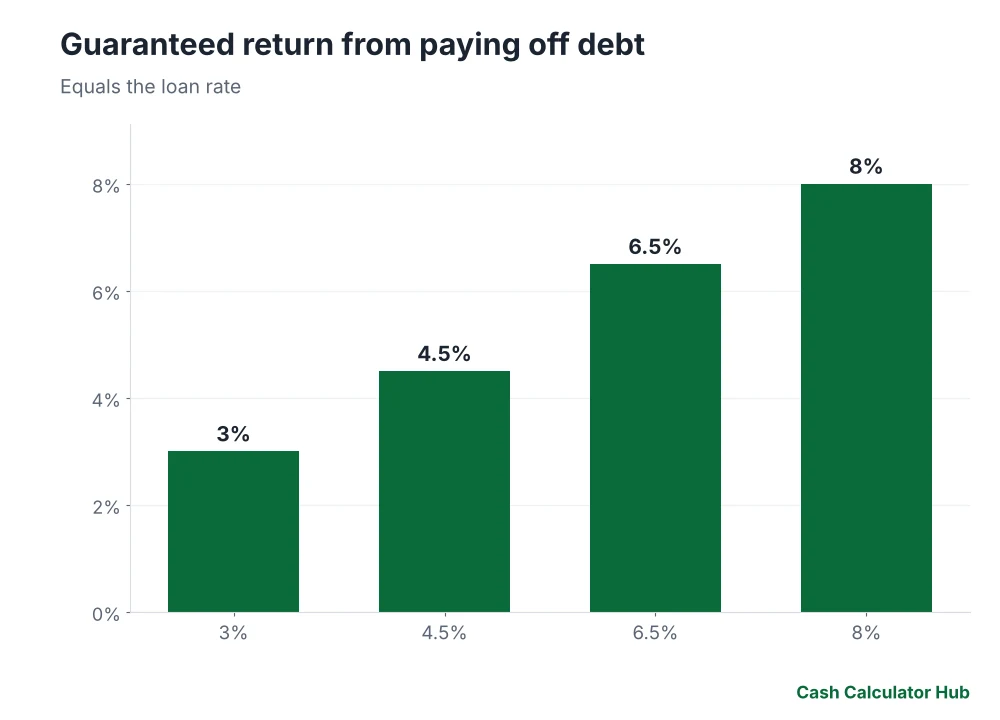
- Paying down a loan gives a guaranteed return equal to the interest rate (slightly higher if interest is not deductible).
- Stock returns are higher on average but uncertain; compare after taxes and risk.
- Rule of thumb: pay off loans above ~7%, invest when below ~4%, and blend in between.
- Always capture an employer 401(k) match first.
- Federal loans have protections that private loans lack; consider them before paying early.
The numbers
$30,000, 6.5%, 10-year term. Standard payment: $341.
| Standard | Extra $300 a month | |
|---|---|---|
| Payment | $341 | $641 |
| Payoff time | 10 yr | 4 yr 7 mo |
| Interest paid | $10,877 | $4,157 |
| Interest saved | $6,721 |
Invest instead
Investing $300 a month for 10 yr:
| Assumed return | Balance |
|---|---|
| 4% | $44,175 |
| 5% | $46,585 |
| 7% | $51,925 |
| 9% | $58,054 |
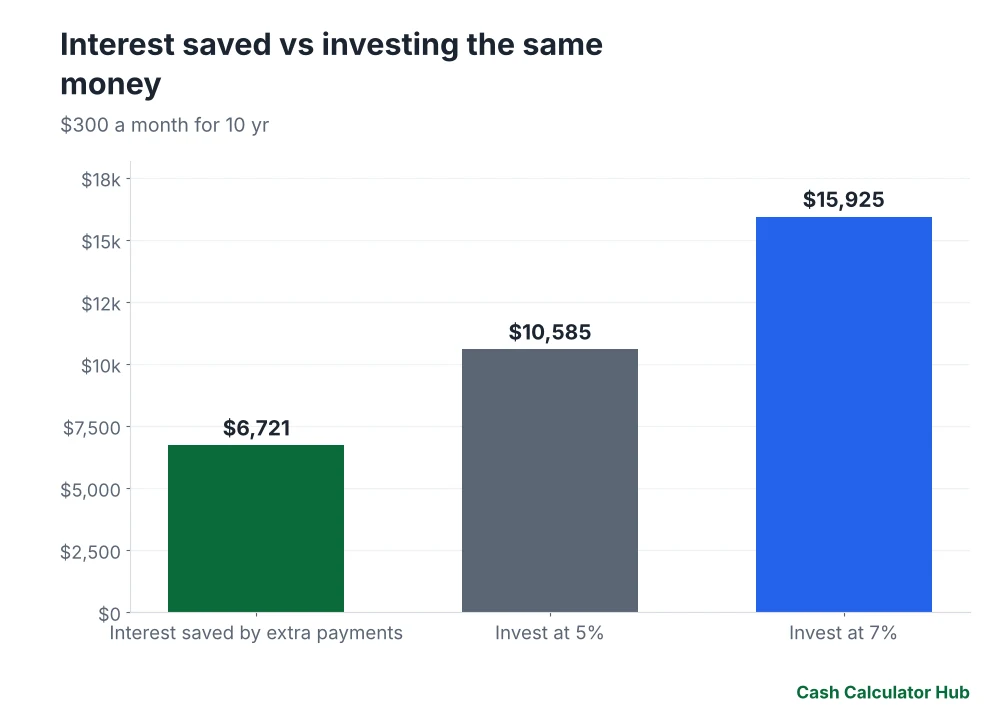
To compare fairly, add the loan interest saved to what you can do with the freed payment after payoff. Paying off early gives a risk-free 6.5%. A diversified stock portfolio has historically averaged about 7% above inflation less after fees and taxes, but with big swings. See average stock market return.
A decision framework
| Loan rate | Typical choice |
|---|---|
| Above 7% | Pay down aggressively (after match and starter emergency fund) |
| 4% to 7% | Split between extra payments and investing |
| Below 4% | Invest; keep making required payments |
Other considerations
- Employer match: always take it first. See 2026 limits.
- Interest deduction: up to $2,500 of student loan interest is deductible, phasing out at $85,000 to $100,000 for single filers ($175,000 to $205,000 joint).
- Federal protections: income-driven repayment, deferment and forgiveness programs are lost if you refinance to a private loan; see refinancing and repayment plans.
- Emergency fund: have one; see how much to save.
- Peace of mind: being debt-free has non-financial value.
Tools
Use the student loan calculator, repayment calculator and investment calculator. More: loan calculators.
Frequently asked questions
Should I pay off student loans early or invest?
If the loan rate is high (above about 6% to 7%), paying off is often better. For lower rates, investing, especially after the employer match, may earn more.
Is paying off a student loan a good return?
It is a guaranteed return equal to the loan’s interest rate.
Can I deduct student loan interest?
Up to $2,500, with income phase-outs of $85,000 to $100,000 single and $175,000 to $205,000 joint.
Should I refinance federal student loans?
Only after considering that you lose federal protections such as income-driven plans and forgiveness.
What should I do first with extra money?
Capture an employer match, build a starter emergency fund, pay off high-interest debt, then balance investing and loan payoff.
Sources and further reading
How the numbers were made: Every figure on this page was calculated from the formulas and assumptions stated above and rounded to the nearest dollar. Rates, limits and rules are for 2026 unless noted; confirm current figures with the sources listed before acting.
Keep reading
- Student Loan Repayment in 2026: What Changed and How to Run Your Numbers
- Debt Avalanche vs Snowball: A Four-Debt Example With Real Numbers
- Compound Interest on $10,000: What It Becomes in 10, 20 and 30 Years
- How Long to Pay Off $10,000 of Credit Card Debt? Timelines at $200 to $1,000 a Month
- Payday Loan APR: What a $15 per $100 Fee Really Costs
- Student Loan Refinancing: Savings, What You Give Up and When It Makes Sense
This guide is general information, not financial, tax or legal advice. Figures use stated assumptions and 2026 rules and will differ from your situation; check current rules and talk to a licensed professional before you decide. Full disclaimer.