
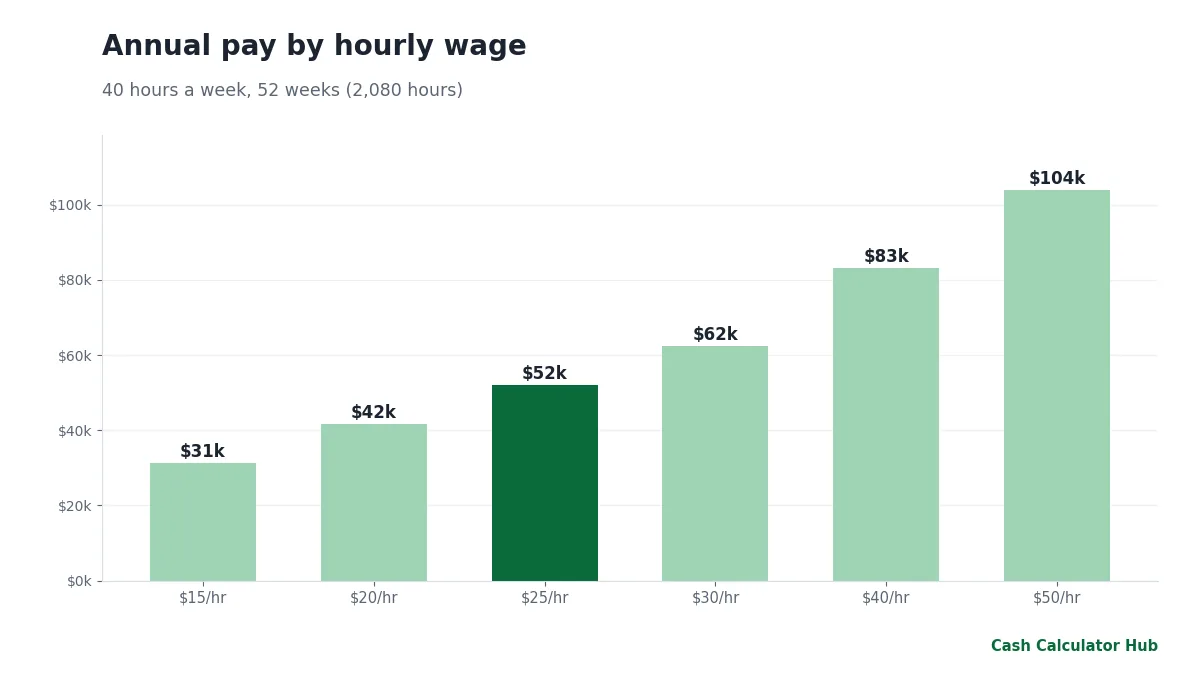
Quick answer: $25 an hour is $52,000 a year at 40 hours a week.
People ask this in two situations: they are comparing an hourly job with a salaried one, or they want to know what a raise really means. The arithmetic is simple. The assumptions are where the mistakes hide.
The formula
Annual pay = hourly rate × hours per week × weeks per year
At 40 hours and 52 weeks that is 2,080 hours. So $25 an hour is $25 × 2,080 = $52,000. To go the other way, divide a salary by 2,080: $65,000 ÷ 2,080 = $31.25 an hour.
Conversion table
| Hourly | Weekly | Monthly | Annual |
|---|---|---|---|
| $15 | $600 | $2,600 | $31,200 |
| $20 | $800 | $3,467 | $41,600 |
| $25 | $1,000 | $4,333 | $52,000 |
| $30 | $1,200 | $5,200 | $62,400 |
| $40 | $1,600 | $6,933 | $83,200 |
| $50 | $2,000 | $8,667 | $104,000 |
The unpaid time trap
An hourly worker only gets paid for hours worked. If you take two unpaid weeks, 80 hours, at $25 an hour you lose $2,000. A salaried employee with paid vacation and 10 paid holidays keeps pay for 2,080 hours while working about 1,900.
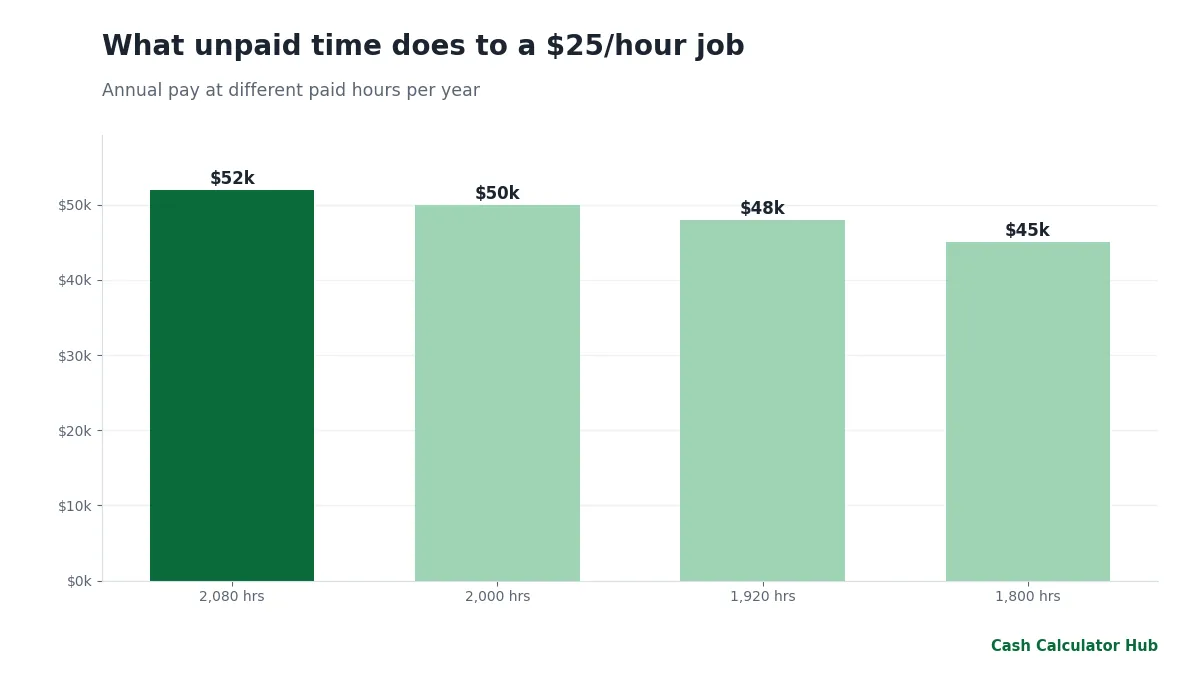
That is why comparing a $52,000 salary with a $25 hourly job is not apples-to-apples. If the hourly job offers no paid time off, the hourly rate should be higher to match. A rough guide: divide the salary by the hours you will actually work. A $52,000 salary with 3 weeks of vacation and 10 holidays means about 1,880 working hours, or about $27.66 an hour.
Overtime
Under federal rules, most non-exempt hourly workers earn 1.5 times pay beyond 40 hours in a week. At $25, overtime is $37.50. Ten overtime hours every week adds $19,500 a year. Salaried workers who are classified as exempt typically do not get it, so a salary needs to account for unpaid long hours.
After tax
Gross pay is not take-home pay. At $52,000 as a single filer in 2026, federal income tax is about $4,060 and FICA about $3,978, leaving around $43,962 before state tax. The $100,000 salary guide shows the same method at a higher income.
Compare the whole package
- Health insurance premiums you pay each month.
- Retirement match. A 4% match on $52,000 is $2,080 free money; see the 401(k) calculator.
- Paid time off and holidays.
- Commute and overhead costs.
- Stability and growth. A salaried path may raise earnings faster.
Use the calculators
The salary calculator converts between hourly, weekly, monthly and yearly, and adjusts for holidays and vacation days. The take-home paycheck calculator shows net pay per paycheck, and the percentage calculator helps compare raises. If you are moving cities for a better offer, see how much salary you need to keep your lifestyle. All tools: tax and salary calculators.
Hourly or salaried: which is better?
| Question | Hourly | Salaried |
|---|---|---|
| Overtime pay | Usually 1.5x over 40 hours | Often none if exempt |
| Paid time off | Varies; often limited | Often included |
| Income predictability | Hours can vary | Stable |
| Growth | Raises tied to rate | Raises and bonuses |
| Benefits | Sometimes fewer | Often fuller package |
Negotiating hourly pay
Know the market rate for your role and region, and ask for the rate that reflects the hours you will actually be paid. If benefits are weaker than a comparable salaried role, translate the difference into dollars per hour. A health plan that costs you $300 more a month is $1.73 an hour over 2,080 hours. Use the salary calculator to compare offers with different hours, holidays and vacation days, and see the cost-of-living guide if the jobs are in different cities.
How many working hours are in a year?
2,080 at 40 hours for 52 weeks. After 10 holidays and 15 vacation days it is about 1,880.
Is $25 an hour a good wage?
It is above the median hourly wage in many regions, but the cost of living changes the value a lot.
What is $20 an hour per year?
$41,600 at 2,080 hours.
Do I convert with 52 weeks or fewer?
Use 52 if you are paid every week of the year; use the hours you will actually be paid for if not.
Sources and further reading
- U.S. Department of Labor: Wage and Hour Division
- U.S. Department of Labor: Overtime pay
- BLS: Consumer Expenditure Surveys
How the numbers were made: Every figure on this page was calculated from the formulas and assumptions stated above and rounded. Rates, limits and rules are for 2026 unless noted; confirm current figures with the sources listed before acting.
Keep reading
- How Much Is a $100,000 Salary After Taxes in 2026?
- How Much Salary Do You Need to Move to a New City?
- Marriage Tax Penalty or Bonus: Who Pays More in 2026?
- Self-Employment Tax Explained: The 15.3% Tax and How to Estimate It
- Gross Margin vs Operating Margin vs Net Margin: What Each Tells You
- W-2 vs 1099: How Much More You Must Charge to Match an Employee Salary
This guide is general information, not financial, tax or legal advice. Figures use stated assumptions and 2026 rules and will differ from your situation; check current rules and talk to a licensed professional before you decide. Full disclaimer.