
Quick answer: A single filer earning $100,000 keeps about $79,180 a year before state tax ($6,598 a month).
“How much is $100,000 after taxes?” has no single answer because it depends on filing status, state, retirement savings and benefits. Here is the baseline (a single filer using the standard deduction, 2026 federal rules) and then what changes it.
The federal income tax
Start with $100,000, subtract the 2026 standard deduction of $16,100, and you have taxable income of $83,900. Tax is applied bracket by bracket:
| Bracket | Income in bracket | Tax |
|---|---|---|
| 10% up to $12,400 | $12,400 | $1,240 |
| 12% up to $50,400 | $38,000 | $4,560 |
| 22% up to $105,700 | $33,500 | $7,370 |
| Total | $13,170 |
Your marginal rate is 22% but your effective federal rate is only 13.2% of gross income. The 22% applies only to dollars above $50,400 of taxable income. More on this in how federal brackets work.
Payroll taxes (FICA)
Social Security takes 6.2% of wages up to the $184,500 base for 2026, and Medicare takes 1.45% of everything. On $100,000 that is $7,650. Your employer pays a matching amount, which you do not see.
Putting it together
| Annual | Monthly | |
|---|---|---|
| Gross | $100,000 | $8,333 |
| Federal income tax | -$13,170 | -$1,098 |
| FICA | -$7,650 | -$638 |
| Take-home before state tax | $79,180 | $6,598 |
State taxes change the number
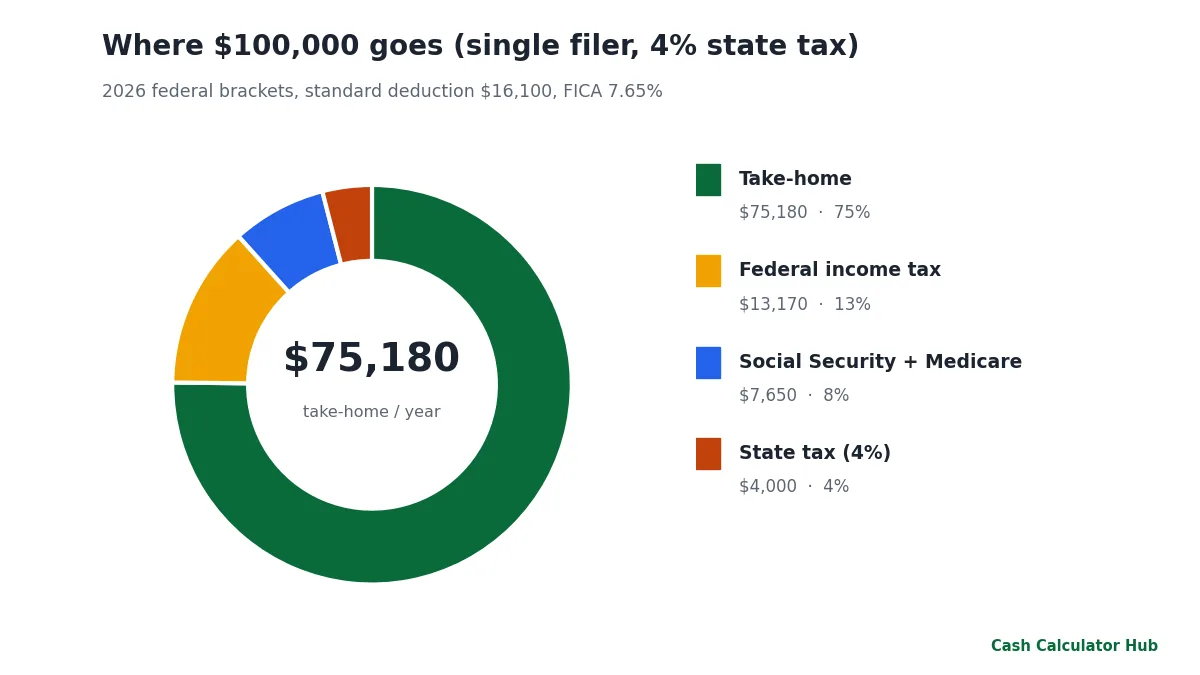
Nine states charge no wage income tax (including Texas, Florida and Washington). Others charge from about 3% to over 10%. At a flat illustrative 4%, you lose another $4,000; at 6% it is $6,000.
| State tax | Annual take-home | Monthly |
|---|---|---|
| 0% | $79,180 | $6,598 |
| 4% | $75,180 | $6,265 |
| 6% | $73,180 | $6,098 |
| 9% | $70,180 | $5,848 |
What a 401(k) does to your paycheck
Contributions to a traditional 401(k) come out of taxable wages. Put in 6% ($6,000):
- Federal income tax falls by about $1,320.
- Take-home falls by only $4,440, not $6,000.
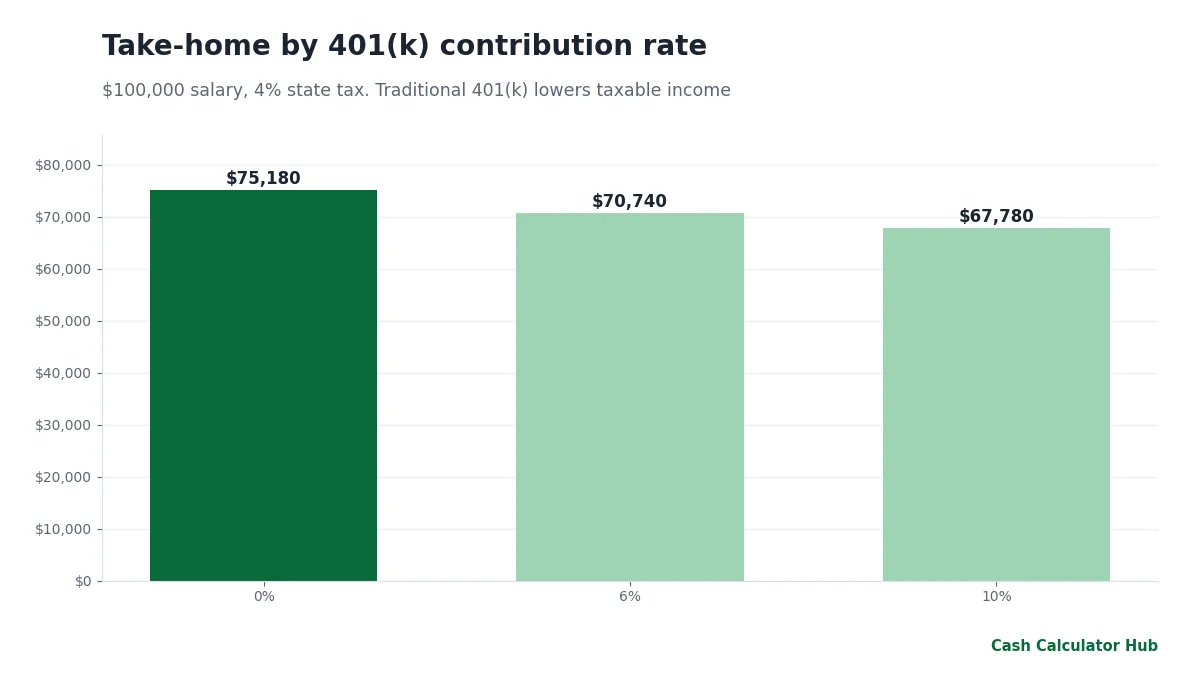
In other words, the government covers a part of your savings through lower taxes (22 cents per dollar at your marginal rate). Health insurance premiums and an HSA reduce taxable wages in the same way. Roth contributions do not, so your paycheck will be smaller. See Roth versus traditional.
Married, head of household and other situations
- Married filing jointly: the standard deduction is $32,200, and brackets are twice as wide. If your spouse has no income, $100,000 gives you a taxable income of $67,800 and a federal tax of about $7,640.
- Head of household: $24,150 standard deduction and wider brackets than single.
- Self-employed: you pay both halves of FICA (15.3% on 92.35% of net earnings), partly offset by a deduction. See the income tax calculator for this.
What this means for your budget
Take-home pay, not salary, is what you plan around. $6,265 a month after a 4% state tax is the number to feed into the 50/30/20 budget. If you are thinking about a mortgage on this income, read how much house you can afford on $100K.
Calculate yours exactly
The take-home paycheck calculator lets you add state tax, 401(k), insurance and other deductions per pay period. For a yearly tax estimate, use the income tax calculator, and the salary calculator to convert to hourly or weekly pay. More in tax and salary tools.
Why your paycheck may not match this
- W-4 withholding. Employers withhold based on your W-4. If you have two jobs or a working spouse, you may be under-withheld.
- Benefits. Health insurance premiums, HSA contributions and flexible spending accounts reduce taxable pay.
- Local taxes. Some cities add income tax.
- Pay frequency. A biweekly schedule has 26 paychecks, so two months have three.
Quick formula for a ballpark
Take-home ≈ gross − federal tax − 7.65% FICA − state tax − pre-tax deductions. For a single filer at $100,000 the federal part is about 13% of gross; for $75,000 it is about 9%. Use the take-home paycheck calculator with your own deductions to get the actual figure, and plan your budget around it, not around the headline salary.
How much is $100,000 a year per month after tax?
About $6,598 before state tax, and around $6,265 with a 4% state tax, for a single filer.
What is $100,000 a year per hour?
About $48 an hour gross for a 2,080-hour year.
Does bonus income get taxed more?
Withholding on bonuses is often 22% federal. The actual tax is settled on your return at your normal rates.
Is $100,000 a lot?
It depends on the cost of living where you are. The cost of living guide shows how much the same salary changes between cities.
Sources and further reading
How the numbers were made: Every figure on this page was calculated from the formulas and assumptions stated above and rounded. Rates, limits and rules are for 2026 unless noted; confirm current figures with the sources listed before acting.
Keep reading
- 2026 Federal Tax Brackets and Standard Deduction, Explained With Examples
- Roth vs Traditional 401(k) and IRA: How to Decide
- The 50/30/20 Budget Rule: How It Works, and How to Adjust It
- How Much House Can I Afford on a $100K Salary?
- 2026 401(k) and IRA Contribution Limits, Explained
- Hourly to Salary: What Is $25 an Hour Per Year?
This guide is general information, not financial, tax or legal advice. Figures use stated assumptions and 2026 rules and will differ from your situation; check current rules and talk to a licensed professional before you decide. Full disclaimer.