
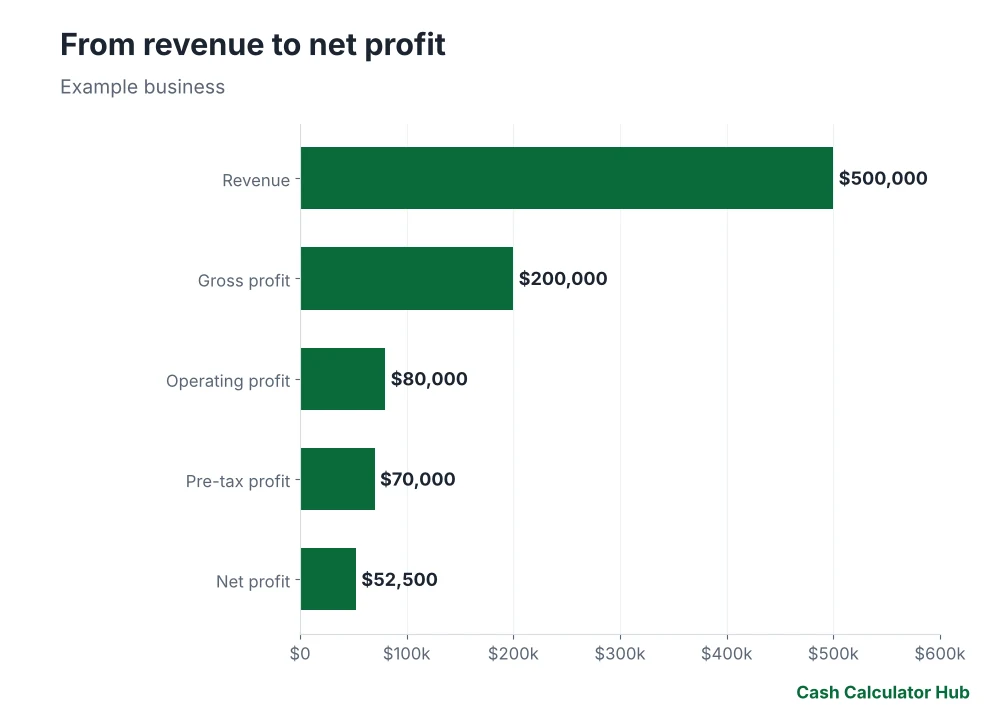
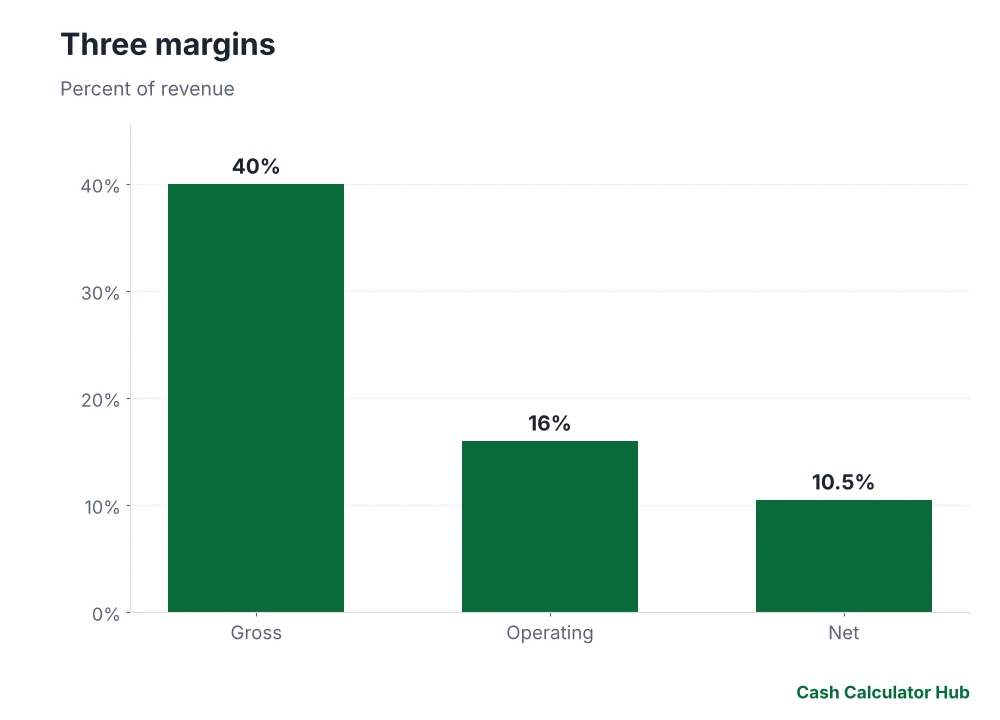
Quick answer: Gross margin = (revenue − cost of goods sold) ÷ revenue; operating margin = operating profit ÷ revenue; net margin = net profit ÷ revenue. For a business with $500,000 of revenue, $300,000 of cost of goods, $120,000 of operating expenses, $10,000 of interest and 25% tax, the margins are 40%, 16% and 10.5%.
“Margin” means different things depending on which costs you subtract. Knowing which one you are looking at keeps you from comparing apples with oranges. They also differ from markup; see the margin versus markup guide.
Key takeaways
- Gross margin shows pricing and production efficiency.
- Operating margin includes overhead and shows core business profitability.
- Net margin is the bottom line after interest and tax.
- Compare margins within an industry; benchmarks vary widely.
- Margin is a percentage of revenue; markup is a percentage of cost.
Income statement example
| Line | Amount | % of revenue |
|---|---|---|
| Revenue | $500,000 | 100% |
| Cost of goods sold | −$300,000 | 60% |
| Gross profit | $200,000 | 40% |
| Operating expenses | −$120,000 | 24% |
| Operating profit | $80,000 | 16% |
| Interest | −$10,000 | 2% |
| Pre-tax profit | $70,000 | 14% |
| Tax (25%) | −$17,500 | 3.5% |
| Net profit | $52,500 | 10.5% |
What each margin answers
| Margin | Formula | Question |
|---|---|---|
| Gross | (Revenue − COGS) ÷ Revenue | Do we price and produce profitably? |
| Operating | Operating profit ÷ Revenue | Does the core business make money after overhead? |
| Net | Net profit ÷ Revenue | What is left for owners? |
Margin vs markup
A product costing $60 sold at $100 has a margin of 40% and a markup of 66.7%. See margin vs markup and the margin calculator.
Improving margins
- Raise prices or shift mix toward higher-margin items.
- Negotiate supplier costs.
- Cut waste and reduce returns.
- Control overhead, scale fixed costs.
- Review interest costs and debt.
Each 1 point of gross margin on $500,000 of revenue is $5,000 of profit.
Related decisions
Margins feed break-even and cash flow.
Tools
Use the margin calculator, percentage calculator and ROI calculator. More: business and everyday tools.
Frequently asked questions
What is the difference between gross and net margin?
Gross margin only subtracts the cost of goods sold; net margin subtracts all expenses, interest and taxes.
What is a good profit margin?
It varies by industry; many small businesses target net margins of 10% or higher, while grocery stores operate on low single digits.
How do you calculate operating margin?
Operating profit divided by revenue.
Is margin the same as markup?
No. Margin is based on revenue; markup is based on cost.
How can I improve my profit margin?
Raise prices, lower costs, change the product mix or reduce overhead.
Sources and further reading
How the numbers were made: Every figure on this page was calculated from the formulas and assumptions stated above and rounded to the nearest dollar. Rates, limits and rules are for 2026 unless noted; confirm current figures with the sources listed before acting.
Keep reading
- Margin vs Markup: The Difference, the Formulas and a Conversion Table
- ROI vs IRR vs CAGR: Which Return Number Should You Trust?
- Hourly to Salary: What Is $25 an Hour Per Year?
- Payback Period and Discounted Payback: How Fast Does an Investment Return Your Money?
- Break-Even Analysis: How Many Units or How Much Revenue You Need to Cover Costs
- Successive Discounts: Why 20% Off Plus 10% Off Is Not 30% Off
This guide is general information, not financial, tax or legal advice. Figures use stated assumptions and 2026 rules and will differ from your situation; check current rules and talk to a licensed professional before you decide. Full disclaimer.