Quick answer: A contractor typically needs 15% to 30% more income than an employee to come out even. In a simple 2026 single-filer example, an $80,000 W-2 salary leaves about $65,110 after federal income tax and the employee’s 7.65% FICA; a 1099 worker needs about $86,023 (8% more) of net profit to take home the same, before health insurance, retirement match, paid time off and business expenses.
Employees and contractors can see the same hourly rate and get very different results. The reasons are the second half of payroll tax, benefits the employer pays and unpaid time off. This guide shows the tax piece with real numbers and lists the other costs.
Key takeaways
- W-2 $80,000: tax $8,770 + FICA $6,120 → take-home $65,110 (single, standard deduction, no state tax).
- 1099 needs about $86,023 for the same take-home, because it pays both halves of FICA.
- Benefits such as health insurance, retirement match and paid leave are on top of the tax gap.
- Classification depends on control and independence, not on what the contract says.
- The qualified business income deduction can narrow the gap.
Employee take-home
| Amount | |
|---|---|
| Salary | $80,000 |
| Federal income tax | −$8,770 |
| Social Security + Medicare (7.65%) | −$6,120 |
| Take-home | $65,110 |
What the contractor needs
A 1099 worker pays SE tax of 15.3% on 92.35% of profit, deducts half of it, then pays income tax.
| Net 1099 profit | SE tax | Income tax | Take-home |
|---|---|---|---|
| $80,000 | $11,304 | $7,527 | $61,170 |
| $90,000 | $12,717 | $9,571 | $67,712 |
| $86,023 | $12,155 | $8,758 | $65,110 |
| $100,000 | $14,130 | $11,616 | $74,255 |
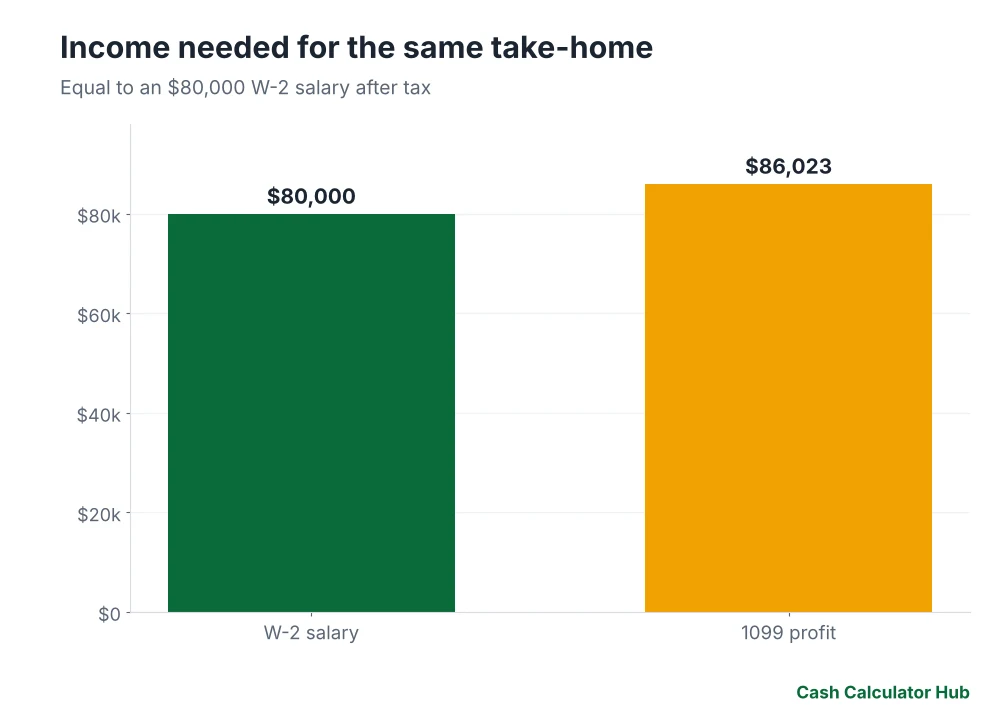
To match $65,110, the contractor needs about $86,023 of net profit: 7.5% more than the salary. This excludes the qualified business income deduction, which can reduce the gap for eligible filers.
What the employer also provides
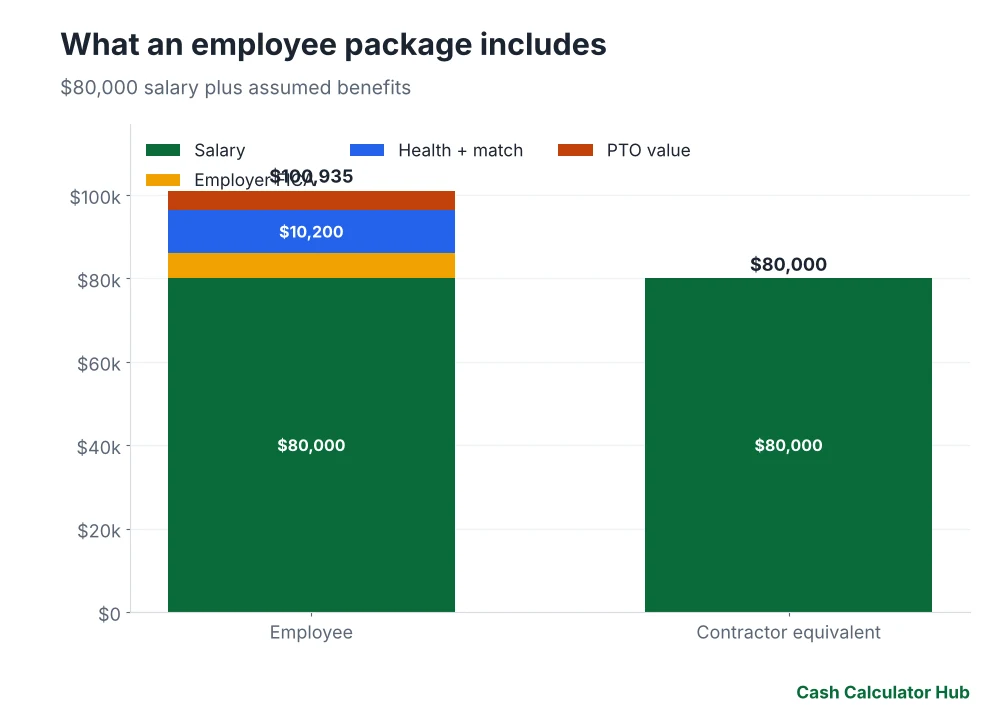
| Benefit | Typical annual value (assumed) |
|---|---|
| Health insurance, employer share | $7,000 |
| 401(k) match (4%) | $3,200 |
| Paid time off (3 weeks) | $4,615 |
| Employer’s half of FICA | $6,120 |
Add these and a contractor may need 25% to 40% more than the salary equivalent. Adjusting for unpaid downtime between projects raises it further.
Hourly rate conversion
$80,000 / 2,080 hours = $38.46 an hour as an employee. A contractor who bills 1,500 hours per year (allowing for downtime) would need about $65.95 an hour including a 15% allowance for benefits. See hourly to salary and setting a freelance rate.
Is the worker really a contractor?
Classification depends on behavioral control, financial control and the relationship. Misclassification can bring back taxes and penalties for employers; the IRS and Department of Labor provide guidance.
Tax differences
- Contractors deduct business expenses; employees cannot deduct unreimbursed expenses.
- Contractors pay quarterly estimates; see self-employment tax.
- Contractors can use Solo 401(k) or SEP; see plan comparison.
Tools
Use the salary calculator, paycheck calculator and income tax calculator. More: tax tools.
Frequently asked questions
How much more should a 1099 contractor charge than a W-2 employee?
Commonly 20% to 40% more once you include the extra payroll tax, benefits and unpaid downtime.
Do contractors pay more tax than employees?
They pay both halves of Social Security and Medicare tax, 15.3% versus 7.65%, though they can deduct business expenses.
What decides W-2 or 1099?
The degree of control the company has over how, when and where you work, financial independence and the nature of the relationship.
Do contractors get paid time off?
Not unless negotiated; you must price vacations and holidays into your rate.
Can contractors deduct health insurance?
Self-employed people may deduct health insurance premiums if they qualify.
Sources and further reading
How the numbers were made: Every figure on this page was calculated from the formulas and assumptions stated above and rounded to the nearest dollar. Rates, limits and rules are for 2026 unless noted; confirm current figures with the sources listed before acting.
Keep reading
- Hourly to Salary: What Is $25 an Hour Per Year?
- How Much Is a $100,000 Salary After Taxes in 2026?
- Self-Employment Tax Explained: The 15.3% Tax and How to Estimate It
- How to Read Your Paycheck: Gross Pay, Withholding and Net Pay Explained
- FICA Taxes Explained: Social Security and Medicare Withholding in 2026
- Capital Gains Tax Rates 2026: 0%, 15% and 20% Brackets Explained
This guide is general information, not financial, tax or legal advice. Figures use stated assumptions and 2026 rules and will differ from your situation; check current rules and talk to a licensed professional before you decide. Full disclaimer.