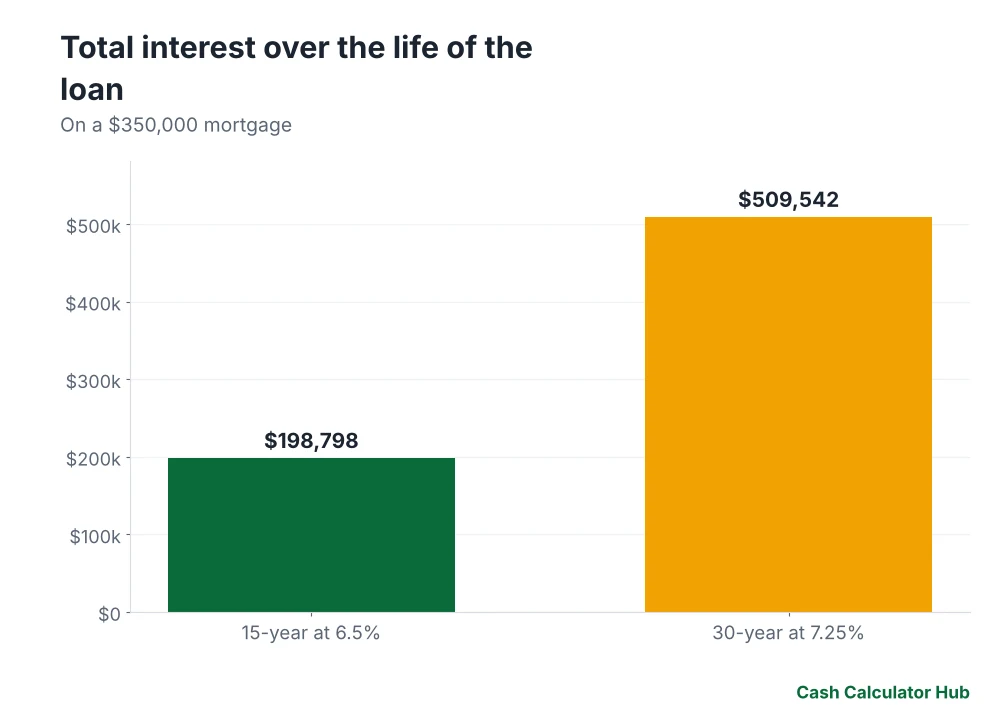
Quick answer: A 15-year mortgage costs far less in total interest, about $198,798 versus $509,542 on a $350,000 loan, but the monthly payment is $3,049 instead of $2,388. Choose it only if the higher payment fits comfortably in your budget without draining your savings.
The 15-year versus 30-year question is really a question about cash flow, risk and what else you would do with the money. The loan with the lower rate is not automatically the better one for you.
This guide uses a $350,000 loan, a 30-year rate of 7.25% and a 15-year rate of 6.5% (15-year loans usually price about half a point to three-quarters of a point lower). Swap in your own quotes with the mortgage calculator.
Key takeaways
- Monthly principal and interest: $2,388 on the 30-year, $3,049 on the 15-year.
- Total interest over the full term: $509,542 versus $198,798, a gap of $310,744.
- To keep the same 28% front-end ratio, the 15-year needs about $130,666 of gross income against $102,326 for the 30-year.
- Investing the payment difference only beats the 15-year if you earn about 9.5% a year or more, after taxes, every year.
- A 30-year loan with voluntary extra payments gives much of the savings and an escape hatch.
What each loan costs
| 30-year fixed | 15-year fixed | |
|---|---|---|
| Rate | 7.25% | 6.5% |
| Monthly principal and interest | $2,388 | $3,049 |
| Total paid over the term | $859,542 | $548,798 |
| Total interest | $509,542 | $198,798 |
| Gross income needed at 28% of income | $102,326 | $130,666 |
The 15-year payment is $661 higher each month, a 28% jump. In exchange you stop paying interest 15 years earlier and pay about 61% less of it overall. Taxes and insurance are the same under either loan, so they do not change the comparison.
Why the 15-year builds equity so much faster
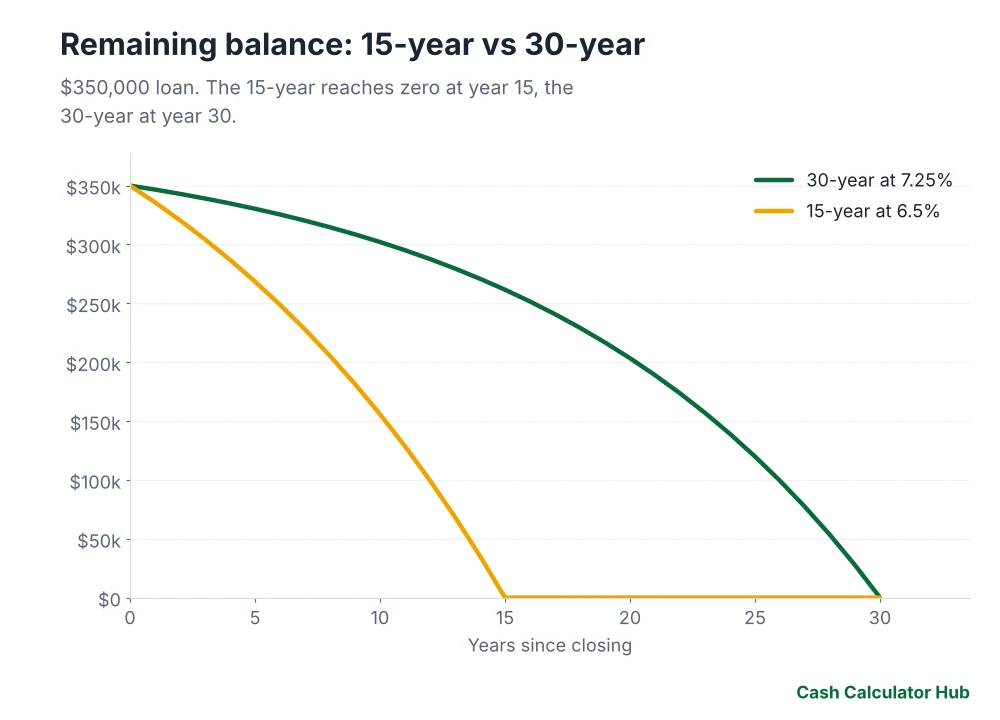
With the 30-year loan, almost all of the early payments go to interest. After 5 years you still owe $330,326, only $19,674 less than you borrowed. On the 15-year loan the balance after 5 years is $268,510. At 7.5 years the shorter loan has a balance of $216,723; the 30-year would still be at $317,478.
That faster equity matters if you might sell, refinance or borrow against the home, and it protects you if prices stall. See the extra payments guide for how equity compounds.
The invest-the-difference argument
A common claim is that you should take the 30-year loan and invest the $661 you save each month. Run the numbers: after 15 years the 30-year loan still has a balance of $261,553. The monthly difference would need to grow to that amount to break even, which takes a return of about 9.5% a year, after tax, every year, with no skipped months.
At 6% that investment grows to $192,306; at 8% it reaches $228,821. Stock returns have averaged more than 9% over long periods, so the plan can win, but the result is uncertain while the loan payoff is guaranteed. People also tend to spend the savings rather than invest them.
A middle path: 30-year loan, 15-year habits
You can take the 30-year loan for the flexibility and pay extra toward principal when cash allows. Paying the 15-year amount of $3,049 on the 7.25% loan clears it in about 16.4 years, and you can drop back to $2,388 if a job loss or a new baby changes your budget. The cost is the rate gap of 0.75 points, which is the price of the option to pay less.
How to choose
- Check the 28/36 limits first. If the 15-year payment pushes your debt-to-income ratio past about 36%, you are stretching. See what lenders allow.
- Build the safety net. You should still have 3 to 6 months of expenses after closing. A fast payoff means little if a layoff forces you onto credit cards.
- Get the match first. If a 401(k) match is available, capture it before paying down a 7% mortgage faster.
- Consider your age. Someone who wants no mortgage at 70 has a strong reason to pick 15 years; a 30-year-old with rising income has more reasons for flexibility.
- Price both options. Rates for the two terms differ by lender, so request quotes for each.
Who usually fits each loan
| Choose the 15-year if | Choose the 30-year if |
|---|---|
| Your income is stable and well above the qualifying level | You want the lowest required payment |
| You want to be mortgage-free before retirement | You will invest the savings or use them for a business or education |
| You already have an emergency fund and retirement on track | Your income varies or you expect big costs soon |
| Interest savings matter more than liquidity | You can pay extra voluntarily and want the choice |
Run your own numbers
Enter the price, down payment and each rate in the mortgage calculator, test the payoff date with the mortgage payoff calculator and see the schedule in the amortization calculator. For a payment that includes taxes and insurance, read what a $400,000 house really costs per month. More tools: mortgage calculators.
Frequently asked questions
Is a 15-year mortgage worth it?
It is worth it when the higher payment fits comfortably and you already have savings. On $350,000 it saves about $310,744 of interest but needs about $661 more per month.
Can I pay off a 30-year loan in 15 years?
Yes, if your loan has no prepayment penalty. Paying about $3,049 a month on the 7.25% loan clears it in roughly 16 years. Confirm the extra goes to principal.
Do 15-year loans have lower rates?
Usually by about 0.5 to 0.75 percentage points, because the lender’s money is at risk for a shorter time. Compare quotes for both terms.
Does a shorter loan help me qualify?
No. It makes qualifying harder because the monthly payment is higher and lenders count it in your debt-to-income ratio.
Should I refinance a 30-year into a 15-year?
Only if the new rate is lower or similar and you can afford the payment. Count closing costs and run a break-even calculation; see the refinance break-even guide.
Sources and further reading
How the numbers were made: Every figure on this page was calculated from the formulas and assumptions stated above and rounded to the nearest dollar. Rates, limits and rules are for 2026 unless noted; confirm current figures with the sources listed before acting.
Keep reading
- Pay Off Your Mortgage Early: What Extra Payments Really Save
- Mortgage Payment on a $400,000 House: Real Numbers
- Debt-to-Income Ratio for a Mortgage: What Lenders Allow
- ARM vs Fixed-Rate Mortgage: What a 5/1 ARM Really Costs
- Mortgage Recast vs Refinance: Which Lowers Your Payment Better?
- Closing Costs Explained: What You Pay and How to Lower It
This guide is general information, not financial, tax or legal advice. Figures use stated assumptions and 2026 rules and will differ from your situation; check current rules and talk to a licensed professional before you decide. Full disclaimer.