Quick answer: An extra $250 a month on a $300,000 loan at 6.75% saves about $128,000 in interest and cuts about 8 years.
There is a feeling that paying off a mortgage early is the “responsible” move. Sometimes it is. Sometimes it is a way to earn 6.75% on money that could earn more in your 401(k) match, or to drain your emergency fund. The right answer depends on arithmetic, so let us do the arithmetic.
The baseline
Take a $300,000 loan at 6.75% for 30 years. The required payment is $1,946. If you only ever pay that, you pay $400,486 in interest, which is 133% of the amount you borrowed.
What extra monthly payments do
Extra money goes straight to principal, and a lower balance means less interest next month, which means more of the following payment goes to principal. The effect snowballs.
| Extra per month | Payoff time | Interest saved | New total interest |
|---|---|---|---|
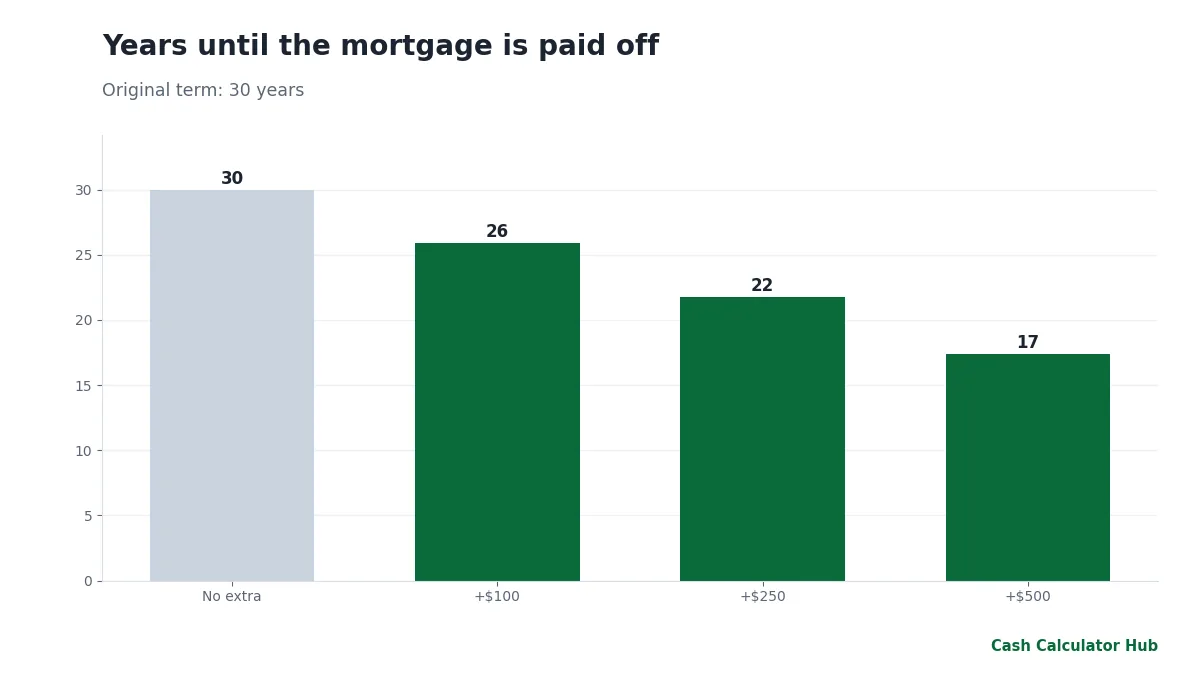
| $100 | 25 yrs 11 mo | $65,076 | $335,409 |
| $250 | 21 yrs 9 mo | $127,685 | $272,801 |
| $500 | 17 yrs 5 mo | $189,871 | $210,615 |
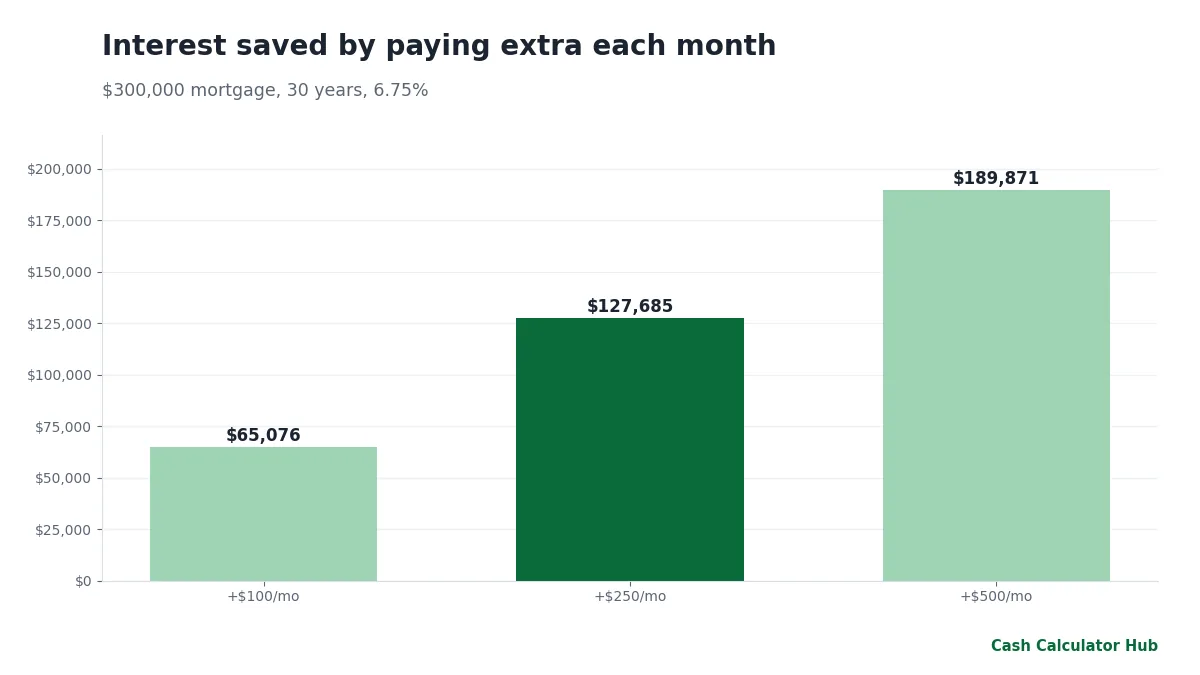
Notice what $250 a month buys you: about 8.2 years off the loan and $127,685 kept in your pocket. Total extra money you paid in during that time is roughly $65,250, so you got back more in avoided interest than you contributed.
The “one extra payment a year” shortcut
Instead of a fixed monthly add-on, some people make 13 payments a year (or pay half the payment every two weeks, which works out to the same thing). On this loan that is about $162 extra per month. It shortens the payoff to roughly 24.0 years and saves around $94,638. Confirm that your servicer applies the extra to principal rather than holding it, and that they do not charge a biweekly program fee. You can do the same yourself for free by adding an extra month’s payment annually.
When extra payments make sense
- Your rate is high and you are not capturing a bigger return elsewhere. A guaranteed 6.75% return from not paying interest is competitive with bonds and savings accounts.
- You already have an emergency fund. Home equity is hard to access. If you lose your income, you cannot spend your equity at the grocery store.
- You are within sight of retirement and want housing costs off your fixed income.
- You hate debt. That is a legitimate reason. Peace of mind has value, so long as you do it with your eyes open.
When it does not
- You carry credit card debt. Paying 22% interest on a card while shaving 6.75% mortgage interest is backwards. Use the avalanche or snowball method first.
- You are not getting your full employer match. A 50% to 100% instant return beats everything. See the 401(k) calculator.
- Your rate is low (say 3% to 4% from a past refinance). Cash in savings or investments probably earns more than that.
- You would be house-rich and cash-poor. If a job loss would force a sale, build liquidity first.
Lump sums versus monthly extras
If you get an annual bonus or a tax refund, timing matters because interest compounds on the balance. The earlier a one-time prepayment lands, the more interest it eliminates. The same $10,000 delivered in year 1 saves several times what it would save in year 20, which is why a windfall in the first few years of a loan is the best moment to use one. If your money is limited, front-load it.
Prepayment details to check
Most conventional mortgages today have no prepayment penalty, but check your note. Make sure extra payments are labeled “principal only,” or they may be applied to next month’s interest and due date instead. If you are considering refinancing instead of prepaying, compare both in our refinance break-even guide.
Try your own numbers
Plug your balance, rate and remaining term into the mortgage payoff calculator and add extra monthly, yearly and one-time amounts. If you would rather see the whole schedule, the amortization calculator shows each payment. The full set is in the mortgage category.
Extra payments matter more when your rate is higher
Because the savings come from avoided interest, the same $250 a month does very different work at different rates. On a $300,000, 30-year loan:
| Mortgage rate | Interest saved with +$250/mo |
|---|---|
| 3.5% | $49,683 |
| 5.0% | $81,156 |
| 6.75% | $127,685 |
| 8.0% | $168,161 |
At 3.5% you save $49,683. At 8% the same habit saves $168,161. This is why people who locked in cheap pandemic-era loans are usually better off investing, while borrowers at today’s rates have a stronger case for prepaying.
How to set it up so it actually works
- Ask your servicer how to designate extra money as principal only. Some have a separate field online; others need a note on a check.
- Automate it. A standing extra payment that leaves your account the same day as your regular one is easier to keep than a monthly decision.
- Check the next statement. The principal balance should drop by more than the scheduled amount.
- Consider a recast if you make a big lump sum. For a fee (often a few hundred dollars) the lender re-calculates your payment on the lower balance, which lowers your monthly bill without refinancing.
Is it better to pay extra on the mortgage or invest?
Compare your mortgage rate with the after-tax return you expect from investing. Stocks have historically returned more than 6.75% over long periods but with risk; paying down the loan is a guaranteed return equal to your rate.
Do extra payments lower my monthly payment?
No. They shorten the term unless you ask for a recast, which re-amortizes the balance and lowers the payment. Not every lender offers a recast.
Does paying extra principal help with PMI?
Yes. Once your balance reaches 80% of the original value you can request PMI cancellation, and it ends automatically at 78%.
What about lump sums, like a bonus?
A one-time $10,000 payment early in the loan saves far more than the same $10,000 late in the loan, because it eliminates many years of compounding interest.
Sources and further reading
How the numbers were made: Every figure on this page was calculated from the formulas and assumptions stated above and rounded. Rates, limits and rules are for 2026 unless noted; confirm current figures with the sources listed before acting.
Keep reading
- Debt Avalanche vs Snowball: A Four-Debt Example With Real Numbers
- Mortgage Refinance Break-Even Point: Is It Worth It?
- How Much House Can I Afford on a $100K Salary?
- Mortgage Payment on a $400,000 House: Real Numbers
- How Much Do You Need to Retire? A Practical Way to Find Your Number
- 15-Year vs 30-Year Mortgage: Which Costs Less Overall?
This guide is general information, not financial, tax or legal advice. Figures use stated assumptions and 2026 rules and will differ from your situation; check current rules and talk to a licensed professional before you decide. Full disclaimer.