Quick answer: A discount point costs 1% of the loan and typically lowers the rate by about 0.25 percentage points. On a $350,000 loan, one point costs $3,500 and saves about $59 a month, so it pays for itself in about 4.9 years. If you will keep the loan longer than that, points are worth it.
Lenders offer a menu: pay more at closing, get a lower rate. The pitch is easy to say yes to and hard to evaluate in the moment. The only thing you need is a break-even calculation and an honest guess about how long you will keep the loan.
The example uses a $350,000 30-year loan with a base rate of 7.25%. Each point is 1% of the loan amount.
Key takeaways
- One point on $350,000 costs $3,500; two points cost $7,000.
- Monthly savings are about $59 for one point and $118 for two.
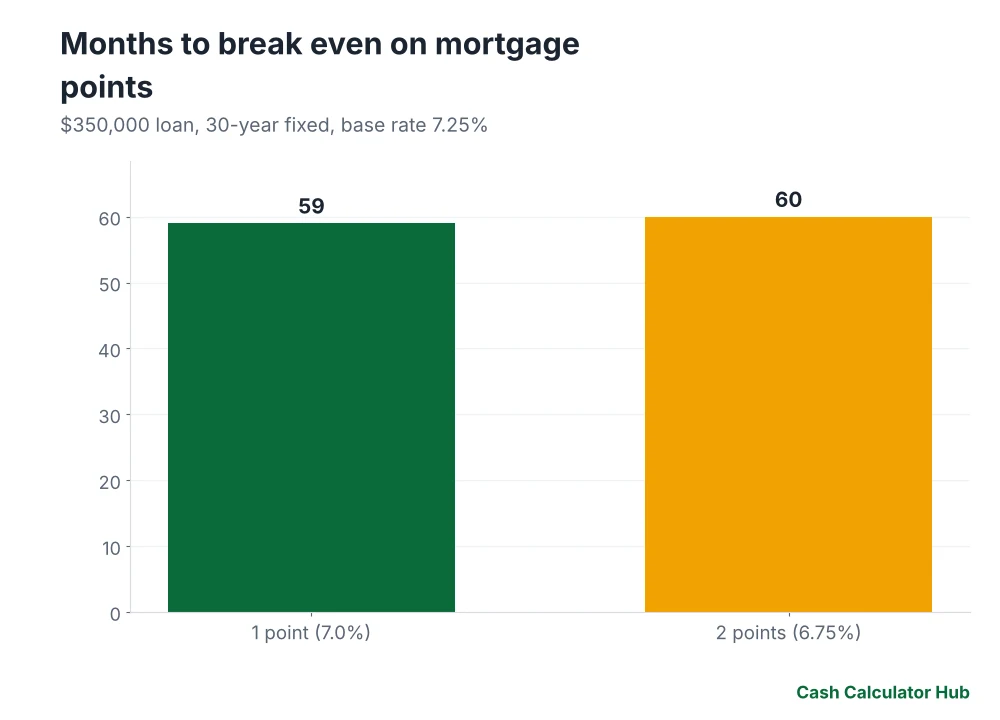
- Break-even is 4.9 years for one point and 5.0 years for two.
- If you sell or refinance before break-even, points lose money.
- Points are different from lender credits, which do the opposite: a higher rate in exchange for lower closing costs.
The break-even formula
Break-even months = cost of points ÷ monthly payment savings. Compare that number with how long you realistically expect to hold the loan. The average homeowner moves or refinances well before 30 years, so the 30-year payoff is rarely the right test.
| Option | Rate | Upfront cost | Monthly payment | Monthly savings | Break-even |
|---|---|---|---|---|---|
| No points | 7.25% | $0 | $2,388 | n/a | n/a |
| 1 point | 7.0% | $3,500 | $2,329 | $59 | 59 months (4.9 yrs) |
| 2 points | 6.75% | $7,000 | $2,270 | $118 | 60 months (5.0 yrs) |
What you net by how long you stay
| Years in the loan | Net gain, 1 point | Net gain, 2 points |
|---|---|---|
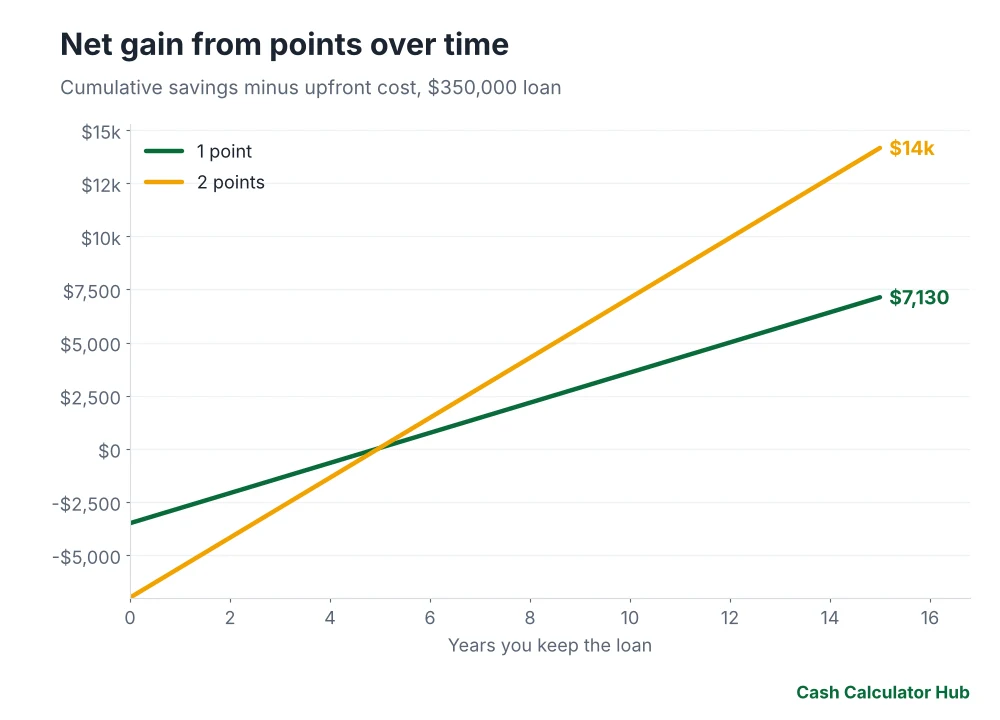
| 3 | $-1,374 | $-2,769 |
| 5 | $43 | $51 |
| 7 | $1,461 | $2,872 |
| 10 | $3,587 | $7,103 |
| 30 | $17,761 | $35,309 |
A negative number means you would have been better off paying no points. Notice that the second point takes longer to pay back than the first, because the savings per dollar spent shrink as the rate falls.
Three reasons the math can be worse than it looks
- Refinancing resets the clock. If rates drop and you refinance in three years, you lose the points you paid. Read the refinance break-even guide before you buy points on a loan you may replace.
- The money has another use. $3,500 could go toward a bigger down payment to avoid PMI, or into an emergency fund. See how PMI works.
- Tax treatment varies. Points paid to buy a primary residence may be deductible in the year paid if you itemize, but the rules have conditions. Ask a tax professional.
Lender credits: the opposite trade
A lender credit lowers your closing costs in exchange for a higher rate. That can make sense if you expect to sell or refinance within a couple of years, or if cash at closing is tight. It is the same break-even calculation reversed: how many months until the extra interest outweighs the credit.
When points make sense
- You plan to stay in the home and keep this loan for at least 7 to 10 years.
- You have already reached 20% down and an emergency fund.
- The seller or builder is paying the points, which changes the math completely. See how closing costs work.
When to skip them
- You think you may move in under five years.
- You expect rates to fall and plan to refinance.
- Paying points would shrink your down payment below 20% or your cash reserves below three months.
How to compare quotes properly
Ask each lender for the same loan at three pricing levels and request the Loan Estimate. Compare APR only when the lenders charge similar points. A lower APR with high points tells you the loan is cheaper only if you keep it for the full term. Run each scenario in the mortgage calculator and the APR calculator.
Run your own numbers
Enter your loan amount at each rate, subtract the payments and divide the points cost by the difference. The refinance calculator does the same thing for a new loan. More tools: mortgage calculators.
Frequently asked questions
How much does one mortgage point lower the rate?
About 0.25 percentage points is the usual rule of thumb, but it varies by lender and market. Ask for the exact pricing on your loan.
Are mortgage points tax deductible?
Points on a loan to buy your main home can often be deducted in the year paid if you itemize and meet IRS conditions. Points on a refinance are generally deducted over the life of the loan.
Is it better to pay points or make a bigger down payment?
If a bigger down payment gets you to 20% and avoids PMI, that usually beats buying down the rate. Otherwise compare the break-even periods.
What is a good break-even period for points?
Many people look for a break-even of five to seven years or less, and only if they are confident they will keep the loan that long.
Can the seller pay for my points?
Yes, as a seller concession within the limits of your loan type. This is a negotiation tool, particularly when the seller wants to avoid cutting the price.
Sources and further reading
How the numbers were made: Every figure on this page was calculated from the formulas and assumptions stated above and rounded to the nearest dollar. Rates, limits and rules are for 2026 unless noted; confirm current figures with the sources listed before acting.
Keep reading
- Mortgage Refinance Break-Even Point: Is It Worth It?
- Closing Costs Explained: What You Pay and How to Lower It
- Mortgage Payment on a $400,000 House: Real Numbers
- Mortgage Recast vs Refinance: Which Lowers Your Payment Better?
- ARM vs Fixed-Rate Mortgage: What a 5/1 ARM Really Costs
- What Is PMI and How Do You Remove It? Costs and Timeline
This guide is general information, not financial, tax or legal advice. Figures use stated assumptions and 2026 rules and will differ from your situation; check current rules and talk to a licensed professional before you decide. Full disclaimer.