
Quick answer: A spouse can receive up to 50% of the worker’s full retirement benefit (primary insurance amount) if that is more than their own, and a surviving spouse can receive up to 100% of what the deceased was getting. With a worker benefit of $2,800 and a spouse’s own benefit of $700, the spousal top-up at full retirement age is $700, bringing the spouse to $1,400.
For married couples, Social Security has benefits that depend on a partner’s record, not just your own. They matter most when one spouse earned far more than the other, or had a shorter career. They also affect when the higher earner should claim.
The figures below use the full retirement age (FRA) of 67 for people born in 1960 or later.
Key takeaways
- The spousal benefit is up to 50% of the worker’s primary insurance amount (PIA) at the spouse’s full retirement age.
- If the spouse claims earlier, the spousal benefit is reduced, to about 32.5% of the worker’s PIA at age 62.
- The worker must have filed for benefits before a spouse can collect on their record, with an exception for divorced spouses.
- A survivor can receive up to 100% of the worker’s benefit; claiming survivor benefits at 60 yields about 71.5%.
- The higher earner’s claiming age sets the survivor benefit, so delaying can protect the surviving spouse.
How the spousal benefit works
A spouse gets the greater of their own benefit or the spousal benefit. The spousal benefit tops up your own benefit so the total equals 50% of the worker’s PIA (at your full retirement age).
Example: the worker’s PIA is $2,800; the spouse’s own PIA is $700.
| Amount | |
|---|---|
| Spousal benefit at FRA (50% of $2,800) | $1,400 |
| Spouse’s own benefit | $700 |
| Extra spousal top-up | $700 |
| Spouse’s total | $1,400 |
The spouse gets their own benefit first, and the top-up covers the difference. If the spouse’s own benefit is 50% or more of the worker’s, there is no spousal benefit.
Claiming early reduces it
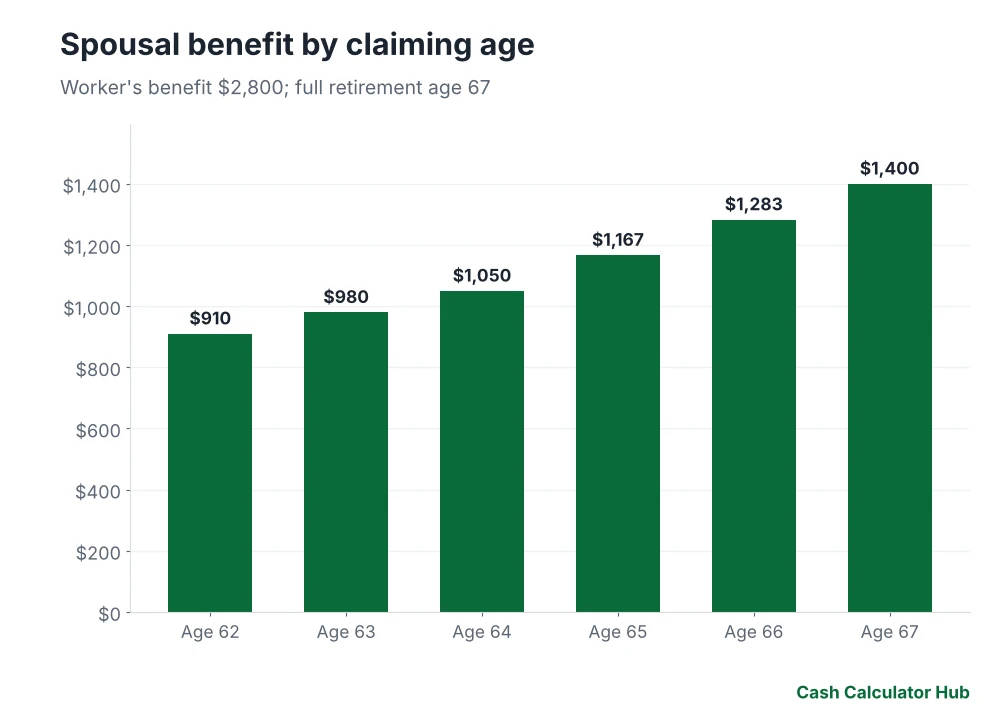
The spousal benefit is reduced for each month before full retirement age. It does not grow after FRA (unlike your own benefit, which earns delayed credits).
| Spouse claims at | Maximum spousal benefit as share of worker’s PIA | On a $2,800 PIA |
|---|---|---|
| 62 | 32.5% | $910 |
| 63 | 35.0% | $980 |
| 64 | 37.5% | $1,050 |
| 65 | 41.7% | $1,167 |
| 66 | 45.8% | $1,283 |
| 67 | 50.0% | $1,400 |
Eligibility basics
- You must be at least 62, or any age if you care for a child under 16 or disabled.
- The worker must have applied for retirement benefits (a divorced spouse can collect if the ex has been eligible for two years).
- Divorced spouses qualify if the marriage lasted at least 10 years and they are currently unmarried.
- Remarriage generally ends eligibility on an ex-spouse’s record, except after 60 for survivor benefits.
Survivor benefits
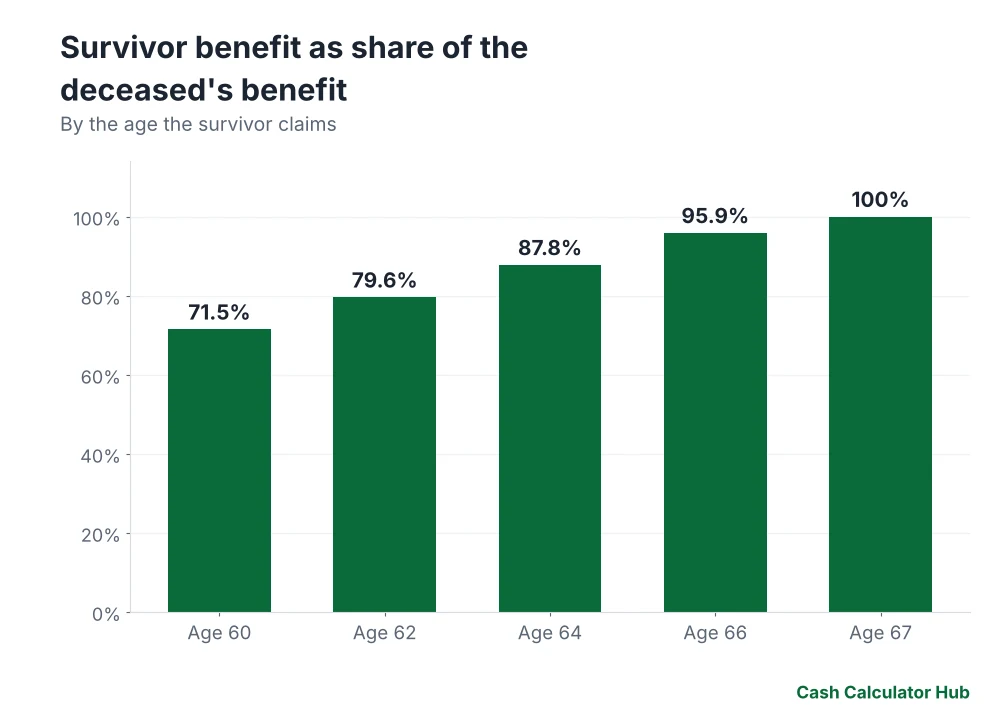
When a worker dies, the surviving spouse can receive the worker’s benefit amount (up to 100%), instead of their own if it is higher. The widow(er) can start as early as 60 (50 if disabled), with a reduction:
| Survivor claims at | Share of the deceased’s benefit |
|---|---|
| 60 | 71.5% |
| 62 | 79.6% |
| 64 | 87.8% |
| 66 | 95.9% |
| 67 | 100.0% |
If the worker claimed early and was receiving a reduced benefit, the survivor benefit is based on that reduced amount, subject to a floor of 82.5% of the PIA. That is a reason for the higher earner to delay: the larger benefit continues for the survivor’s life.
Strategy for couples
- The higher earner delays to 70 if possible; this raises their own and the survivor’s benefit. See 62 versus 67 versus 70.
- The lower earner may claim earlier, providing income while the larger benefit grows.
- Switch strategies between own and spousal/survivor benefit: a surviving spouse can start the survivor benefit at 60 and switch to their own at 70 if that is larger.
- Divorced spouses should check their rights; claiming on an ex’s record does not reduce the ex’s benefit.
The family maximum and other rules
Total benefits payable to a worker’s family have a cap, generally 150% to 180% of the worker’s PIA. The earnings test and the government pension offset or windfall elimination rules may also apply, depending on your work history. The Social Security Fairness Act of 2025 repealed the WEP and GPO; see the SSA site for current guidance.
Taxes
Benefits can be taxable if your income is above certain thresholds; see how Social Security is taxed.
Plan it
Use the Social Security calculator to compare claiming ages and the retirement calculator for household income. For the full planning picture, see how much you need to retire. More: retirement tools.
Frequently asked questions
How much is the spousal benefit?
Up to 50% of the worker’s full retirement benefit if the spouse claims at their own full retirement age, reduced if claimed earlier.
Can I get my own and my spouse’s benefit?
You receive your own benefit first, and if the spousal benefit is higher, you receive a top-up so the total equals the spousal amount.
Do divorced spouses get benefits?
Yes, if the marriage lasted 10 years or more and the former spouse is unmarried. The ex’s benefits are not reduced.
How much do survivors get?
Up to 100% of the deceased worker’s benefit at the survivor’s full retirement age, and about 71.5% if claimed at 60.
Does the spousal benefit increase if I wait past full retirement age?
No. Delayed credits apply to your own benefit but not to spousal benefits.
Sources and further reading
How the numbers were made: Every figure on this page was calculated from the formulas and assumptions stated above and rounded to the nearest dollar. Rates, limits and rules are for 2026 unless noted; confirm current figures with the sources listed before acting.
Keep reading
- Social Security at 62 vs 67 vs 70: When Does Waiting Pay Off?
- How Much Do You Need to Retire? A Practical Way to Find Your Number
- Required Minimum Distributions: Age 73 or 75, and How to Calculate Yours
- Pension Lump Sum vs Monthly Payments: How to Compare the Offers
- How Much Should You Have Saved for Retirement by Age? Benchmarks for 30 to 67
- Backdoor Roth IRA Explained: Steps, the Pro-Rata Rule and Pitfalls
This guide is general information, not financial, tax or legal advice. Figures use stated assumptions and 2026 rules and will differ from your situation; check current rules and talk to a licensed professional before you decide. Full disclaimer.