
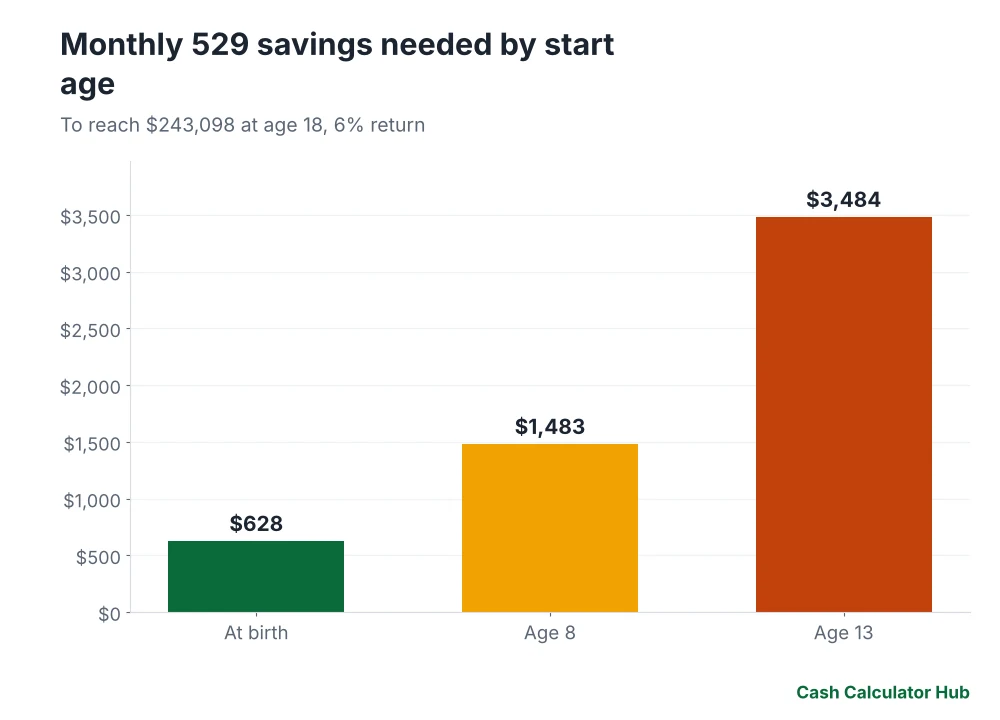
Quick answer: A 529 plan is a tax-advantaged education savings account where growth and withdrawals for qualified education expenses are free of federal income tax. To cover $120,000 in today’s dollars of college costs (about $243,098 after 18 years at 4% cost inflation), saving at a 6% return takes about $628 a month from birth, $1,483 from age 8, or $3,484 from age 13.
College costs rise faster than general inflation in many years, and the earlier you start, the more compounding does the work. A 529 plan is the most common tool for this, because earnings grow federally tax-free when used for qualified education.
The model assumes four years of college that cost $120,000 in today’s dollars, 4% yearly cost inflation, a 6% investment return and savings contributed monthly until age 18.
Key takeaways
- Target in future dollars: about $243,098 at age 18 for what costs $120,000 today.
- Monthly savings needed: $628 from birth, $1,483 from age 8, $3,484 from age 13.
- Qualified withdrawals are free of federal income tax; many states also give a tax deduction or credit for contributions.
- Unused funds can be changed to another beneficiary, used for K-12 tuition up to a cap, or partly rolled into a Roth IRA for the beneficiary.
- Savings in a 529 count as parent assets in financial aid formulas, with a small effect on aid.
How much to save, by starting age
| Start when | Years to save | Monthly amount | Total contributed |
|---|---|---|---|
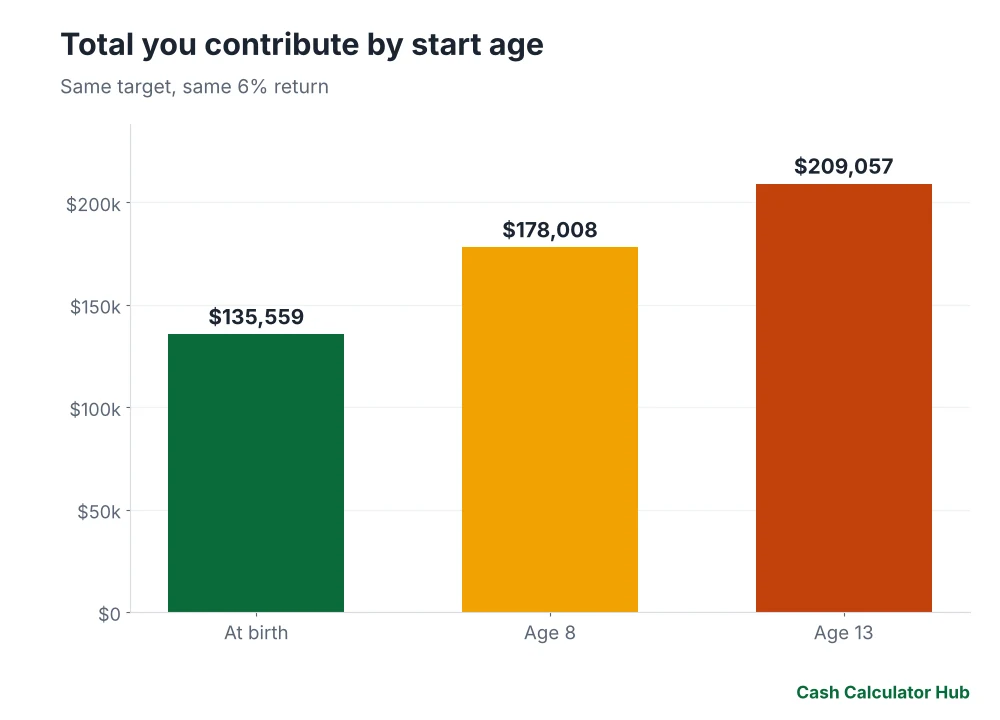
| At birth | 18 years | $628 | $135,559 |
| Age 8 | 10 years | $1,483 | $178,008 |
| Age 13 | 5 years | $3,484 | $209,057 |
Starting at birth, you contribute about $135,559 over 18 years and compounding supplies the rest of the $243,098. Starting at 13, you contribute $209,057 and need a much larger share of the target from your own savings. The monthly amount at 13 is about 5.6 times the amount at birth.
You do not have to save the whole cost. Scholarships, current income, public in-state tuition and student loans fill the gap. Setting a goal for one-third to one-half of expected costs is common.
How the tax rules work
- Contributions are made with after-tax money and are not deductible federally. Many states offer a deduction or credit.
- Growth is tax-deferred.
- Qualified withdrawals for tuition, fees, books, supplies and certain room and board are federal-tax-free.
- Nonqualified withdrawals have earnings taxed as ordinary income plus a 10% penalty on the earnings.
- Gifts. Contributions count as gifts: up to $19,000 per donor per beneficiary a year in 2026 without gift-tax filing, and you can front-load five years at once ($95,000) using the five-year election.
What if the child does not go to college?
- Change the beneficiary to a sibling, cousin or yourself.
- Pay for other education, such as trade school or graduate programs.
- Roll into a Roth IRA. After the account has been open 15 years, up to $35,000 over a lifetime can be rolled into the beneficiary’s Roth IRA, subject to annual Roth contribution limits.
- Withdraw and pay tax on earnings and the penalty if nothing else works.
K-12 and student loans
Some withdrawals for K-12 tuition and for repaying student loans (with a lifetime cap) are allowed. K-12 caps have changed in recent years, so check current limits.
Choosing a plan
- Check your state’s plan for deductions. In some states they apply only to the home-state plan.
- Compare fees. Low-cost index portfolios are typically 0.1% to 0.3%. See how fees compound.
- Pick an age-based portfolio that shifts toward bonds as college nears, or build your own.
- Automate monthly contributions.
529 versus other options
| Option | Pros | Cons |
|---|---|---|
| 529 plan | Tax-free growth for education, high limits | Penalty on non-education use |
| Roth IRA | Flexible, contributions accessible | Low annual limit; competes with retirement |
| Taxable brokerage | Total flexibility | No tax advantages |
| Coverdell ESA | Tax-free for education | $2,000 annual limit |
Do not sacrifice retirement for college savings. You can borrow for college; you cannot borrow for retirement. See which account to fund first.
Run it yourself
Use the future value calculator and savings calculator to set a monthly amount. The investment calculator lets you test different returns. For loans later, see student loan repayment. More: savings and investing tools.
Frequently asked questions
How much should I save in a 529 plan?
Many families aim for one-third to one-half of expected costs. Use a monthly savings calculation based on your child’s age and the type of school.
Are 529 contributions tax deductible?
Not federally. Many states offer a deduction or credit for contributions, often only to the home-state plan.
What happens to leftover 529 money?
You can change the beneficiary, use it for other qualified education, or roll up to $35,000 into the beneficiary’s Roth IRA under certain conditions. Otherwise earnings face tax and a 10% penalty.
Can I use a 529 for K-12 tuition?
Yes, up to an annual cap that has been changing. Check the current limit and your state’s treatment.
Does a 529 affect financial aid?
A parent-owned 529 is counted as a parent asset at a low rate, so the effect on aid is usually small.
Sources and further reading
How the numbers were made: Every figure on this page was calculated from the formulas and assumptions stated above and rounded to the nearest dollar. Rates, limits and rules are for 2026 unless noted; confirm current figures with the sources listed before acting.
Keep reading
- Compound Interest on $10,000: What It Becomes in 10, 20 and 30 Years
- Student Loan Repayment in 2026: What Changed and How to Run Your Numbers
- How Long Does It Take to Save $1 Million?
- Stocks vs Bonds: How to Choose Your Asset Allocation
- Index Fund vs ETF vs Mutual Fund: Differences, Costs and Taxes
- Dollar-Cost Averaging vs Lump Sum: Which Is Better for $120,000?
This guide is general information, not financial, tax or legal advice. Figures use stated assumptions and 2026 rules and will differ from your situation; check current rules and talk to a licensed professional before you decide. Full disclaimer.