
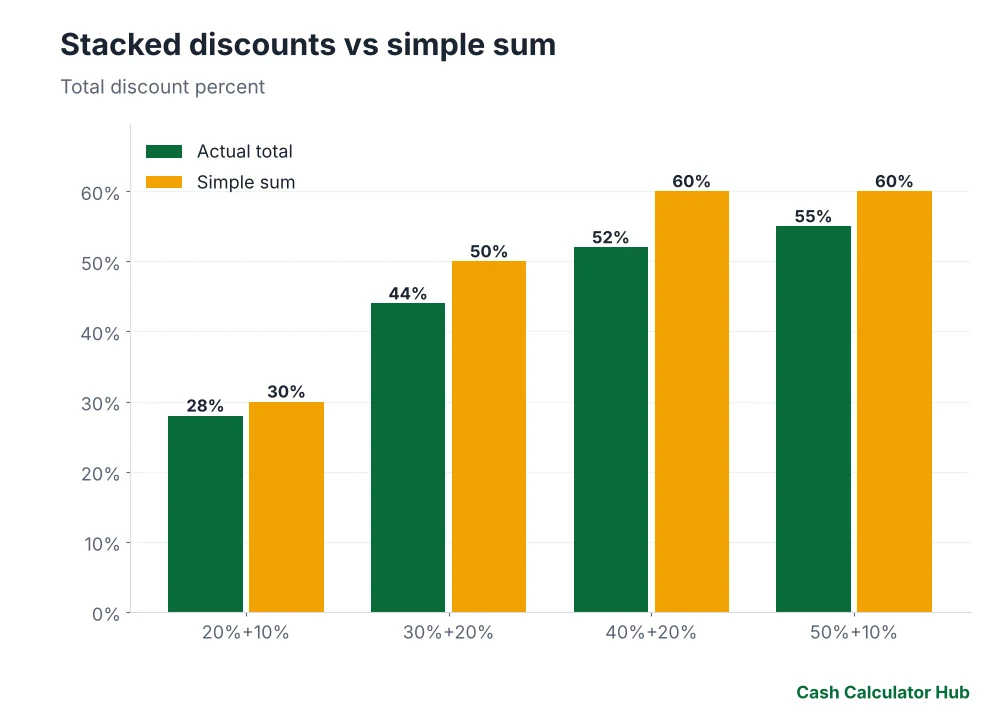
Quick answer: Successive discounts multiply rather than add. 20% off followed by an extra 10% off leaves 0.80 × 0.90 = 72% of the price, a total discount of 28%, not 30%. On a $200 item the final price is $144, not $140.
Stores often advertise “extra 10% off” on top of a sale. Because each discount applies to the already reduced price, the combined discount is smaller than the sum. The formula is simple and saves you from overestimating deals.
Key takeaways
- Total discount = 1 − (1 − d1)(1 − d2)…
- The order does not matter: 20% then 10% equals 10% then 20%.
- Combined discount is always less than the sum of the percentages.
- Compare final prices rather than headline percentages.
- Coupons that apply to the original price differ from those applied to the sale price.
The formula
Final price = original × (1 − d1) × (1 − d2).
Example: $200 with 20% then 10% off: 200 × 0.80 × 0.90 = $144.
Common stacks on a $200 item
| First discount | Extra discount | Total discount | Final price | If simply added |
|---|---|---|---|---|
| 20% | 10% | 28.0% | $144 | $140 |
| 30% | 20% | 44.0% | $112 | $100 |
| 40% | 20% | 52.0% | $96 | $80 |
| 50% | 10% | 55.0% | $90 | $80 |
Why the order does not matter
Multiplication is commutative: 0.80 × 0.90 = 0.90 × 0.80. What matters is whether a coupon applies to the original price (then you add) or to the sale price (then you multiply).
| Coupon type | Calculation on $200 | Final |
|---|---|---|
| 20% off + 10% coupon on original | 200 − 40 − 20 | $140 |
| 20% off + 10% coupon on sale price | 200 × 0.80 × 0.90 | $144 |
Comparing deals
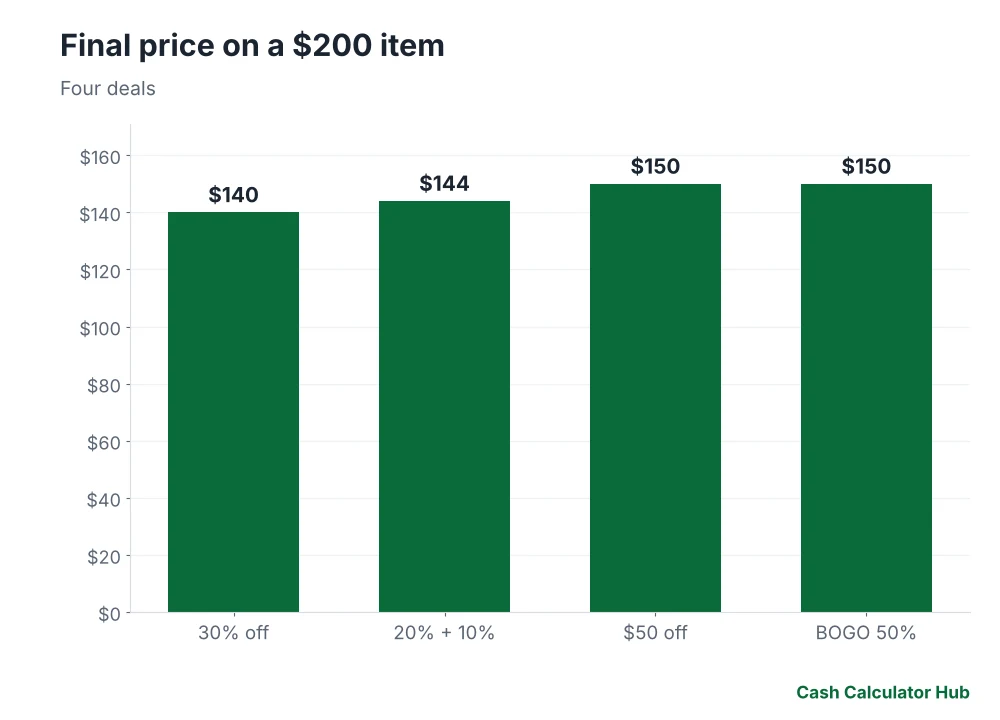
Which is better: 30% off, or 20% off plus 10% extra?
| Deal | Final price on $200 |
|---|---|
| 30% off | $140 |
| 20% + 10% | $144 |
| $50 off $200 | $150 |
| Buy one, get one 50% off (two $100 items) | $150 for two, $75 each (25% off) |
Adding tax
Sales tax usually applies after discounts. A $144 price with 7% tax is $154.08. See sales tax by state and VAT vs sales tax.
Also useful
The reverse: if the final price is $144 after 28% total discount, the original is $144 ÷ 0.72 = $200. See percent change formulas.
Tools
Use the discount calculator, percentage calculator and sales tax calculator. More: business and everyday tools.
Frequently asked questions
Is 20% off plus 10% off the same as 30% off?
No. The total is 28% because the second discount applies to the reduced price.
How do I calculate successive discounts?
Multiply the remaining fractions: (1 − d1) × (1 − d2), then subtract from 1.
Does the order of discounts matter?
Not for percentage discounts, but it matters for fixed-dollar coupons.
How do I find the original price?
Divide the final price by the product of the remaining fractions.
Are discounts applied before sales tax?
Usually yes; tax is calculated on the discounted price.
Sources and further reading
- FTC: Consumer advice on money and credit
- U.S. Small Business Administration
- IRS: Tax topics and forms
How the numbers were made: Every figure on this page was calculated from the formulas and assumptions stated above and rounded to the nearest dollar. Rates, limits and rules are for 2026 unless noted; confirm current figures with the sources listed before acting.
Keep reading
- Margin vs Markup: The Difference, the Formulas and a Conversion Table
- Sales Tax by State: Base Rates, No-Tax States and How to Calculate Total Tax
- What Was $100 Worth in 2000? Inflation, Calculated
- Payback Period and Discounted Payback: How Fast Does an Investment Return Your Money?
- Break-Even Analysis: How Many Units or How Much Revenue You Need to Cover Costs
- Gross Margin vs Operating Margin vs Net Margin: What Each Tells You
This guide is general information, not financial, tax or legal advice. Figures use stated assumptions and 2026 rules and will differ from your situation; check current rules and talk to a licensed professional before you decide. Full disclaimer.