
Quick answer: Start with spending, subtract Social Security, multiply the gap by 25.
“You need $1 million” and “you need $2 million” are both answers to a question nobody asked. The right number depends on how much you will spend and how much of that Social Security or a pension already covers.
The method
- Estimate yearly spending in retirement in today’s dollars. A first guess is 70% to 80% of your current spending, but housing paid off and healthcare costs can move it either way.
- Subtract guaranteed income: Social Security, pensions, annuities. Use your SSA statement and the Social Security calculator.
- Multiply the gap by 25. That is the classic nest egg for a 4% starting withdrawal rate.
Four examples
| Yearly spending | Social Security + pension | Gap | Nest egg (×25) |
|---|---|---|---|
| $50,000 | $30,000 | $20,000 | $500,000 |
| $60,000 | $30,000 | $30,000 | $750,000 |
| $70,000 | $30,000 | $40,000 | $1,000,000 |
| $90,000 | $30,000 | $60,000 | $1,500,000 |
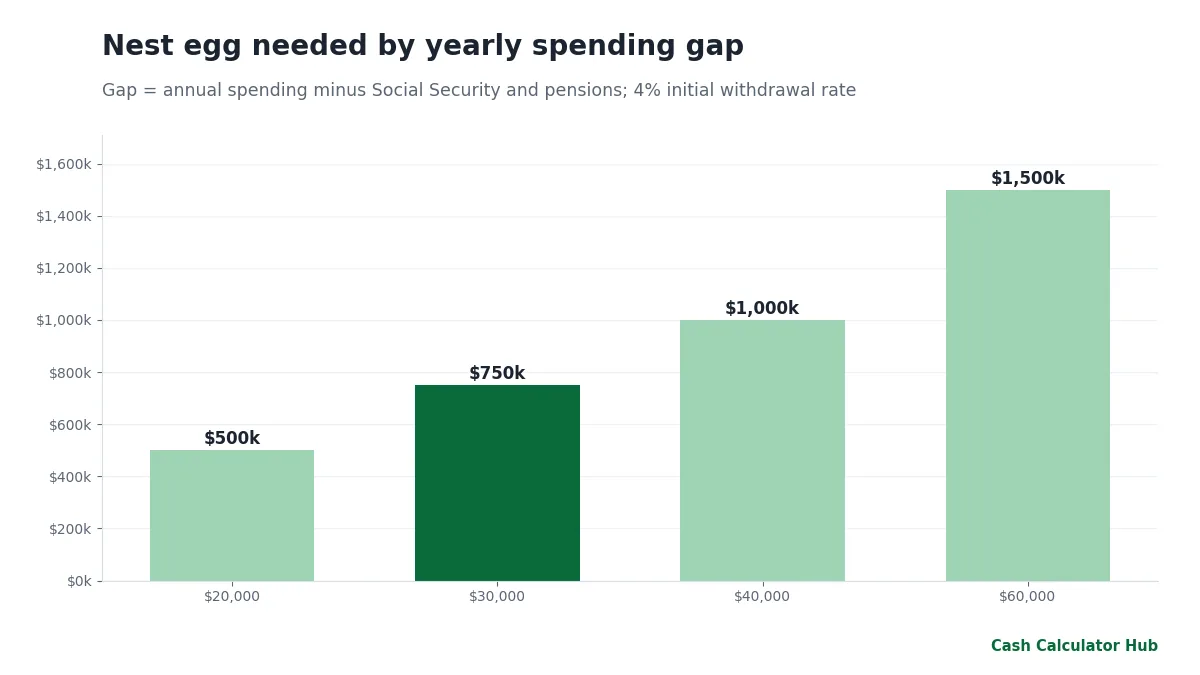
A couple spending $60,000 with $30,000 of Social Security needs about $750,000, not $1 million or $2 million. That is why the generic answers can mislead in both directions.
Where the 4% rule comes from
William Bengen’s 1994 research, followed by the 1998 “Trinity study”, found that withdrawing 4% of your starting balance in year one and adjusting for inflation each year would have lasted at least 30 years across historical US market periods. It is a starting guideline, not a law. It assumed a stock-and-bond portfolio and a 30-year retirement.
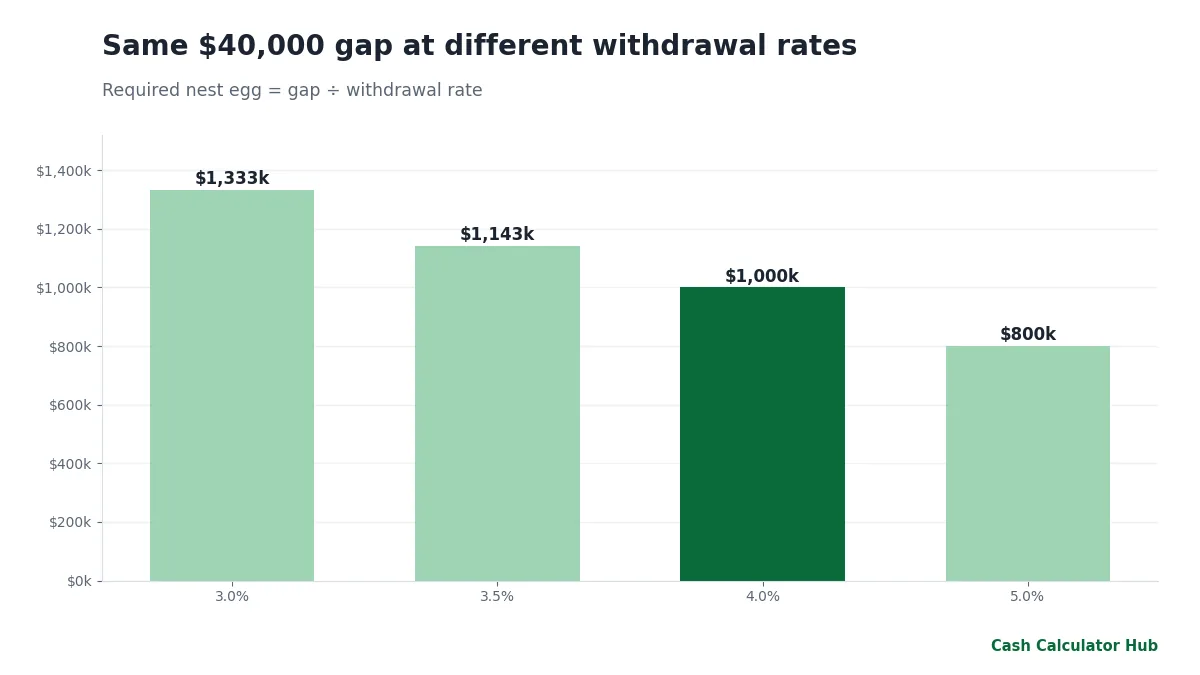
Reasons to use a lower rate: retiring early (40-year horizon), high stock valuations, or a desire for near-certainty. Reasons to use a higher one: flexibility to cut spending after bad markets, a shorter horizon, or large guaranteed income.
Inflation changes the target
A nest egg need is stated in today’s dollars. If you are 30 years from retirement and spend $60,000 today, at 3% inflation you will need about $145,636 a year then. That is why a calculator that inflates expenses matters; the retirement calculator does that, then shows how much to save each month.
Healthcare and the things people forget
- Medicare begins at 65. Before that, coverage can be costly. Premiums, deductibles and out-of-pocket costs continue afterward, plus possible long-term care.
- Taxes. Traditional 401(k) and IRA withdrawals are taxed, so the “gap” may need to be higher before tax. Roth withdrawals are not.
- The first years. Bad markets early in retirement matter most (sequence risk). Keeping one to two years of expenses in cash helps.
- Spending patterns. Many people spend more early (travel) and less later, with healthcare costs rising at the end.
How much to save each month
If your number is $750,000 and you are 35, you have about 30 years. At 7%, you would need $615 a month (see the savings table for $1 million and scale). Check your own plan with the 401(k) calculator, including your match. Choose account types with the Roth versus traditional guide.
Pension or lump sum?
If you have a pension, the pension calculator estimates the payout and compares a lump-sum offer, and the annuity payout calculator shows how long a balance lasts at a given payment. See more in retirement tools.
Stress-test your number
- Inflation. Rerun your plan at 4% inflation. If it fails, build more cushion or plan to adjust.
- Returns. Rerun at a lower return, such as 5%. This shows how much your plan depends on strong markets.
- Longevity. Plan to age 95. A couple at 65 has a meaningful chance that at least one of them lives past 90.
- Early bad markets. Imagine a 25% drop in your first two years of retirement. Do you have cash or flexibility to avoid selling stocks at the bottom?
Levers you control
- Work a little longer. Each extra year adds savings, delays withdrawals and raises Social Security.
- Spend flexibly. Trimming withdrawals after bad years makes a given nest egg last much longer.
- Part-time income. Even $1,000 a month in early retirement reduces the amount you need to withdraw.
- Housing. Downsizing or paying off a mortgage changes the target substantially. See paying off a mortgage early.
Is $1 million enough to retire?
At a 4% rate that is $40,000 a year before taxes. With $30,000 from Social Security, it supports $70,000 of spending. It depends entirely on your costs.
How much should I have saved by 40, 50 and 60?
A common benchmark is about 3x salary by 40, 6x by 50 and 8x by 60 (Fidelity guidelines). Treat them as signposts, not rules.
Does the 4% rule still work?
It is a reasonable starting point. Many planners adapt it, spending less after market drops.
Should I count my home?
Only if you plan to sell or downsize. Otherwise it is housing, not spendable assets.
Sources and further reading
How the numbers were made: Every figure on this page was calculated from the formulas and assumptions stated above and rounded. Rates, limits and rules are for 2026 unless noted; confirm current figures with the sources listed before acting.
Keep reading
- How Long Does It Take to Save $1 Million?
- Roth vs Traditional 401(k) and IRA: How to Decide
- Pay Off Your Mortgage Early: What Extra Payments Really Save
- Social Security at 62 vs 67 vs 70: When Does Waiting Pay Off?
- What Was $100 Worth in 2000? Inflation, Calculated
- The 4% Rule: Safe Withdrawal Rates From 3% to 5%, With Real Numbers
This guide is general information, not financial, tax or legal advice. Figures use stated assumptions and 2026 rules and will differ from your situation; check current rules and talk to a licensed professional before you decide. Full disclaimer.