
Quick answer: Yes, up to 85% of Social Security benefits can be taxable at the federal level, depending on your “provisional income” (adjusted gross income + tax-exempt interest + half of your benefits). For a single filer, benefits begin to be taxable above $25,000 of provisional income and up to 85% above $34,000; for married couples filing jointly the thresholds are $32,000 and $44,000.
Many retirees are surprised to learn their benefits can be taxed. The rules are not indexed to inflation, so more people owe tax on benefits each year. The tax is on the benefit, but it is not a flat 85%: the percentage of the benefit that is included in income is up to 85%, and it is then taxed at your ordinary rate.
Key takeaways
- Provisional income = adjusted gross income + tax-exempt interest + 50% of Social Security benefits.
- Single thresholds: $25,000 and $34,000. Married filing jointly: $32,000 and $44,000.
- Between thresholds, up to 50% of benefits are taxable; above the second threshold, up to 85%.
- The thresholds have not been adjusted for inflation since they were set in 1984 and 1993.
- Some states also tax benefits; most do not.
The formula
- Add your adjusted gross income (excluding Social Security), tax-exempt interest and 50% of your Social Security benefits. This is your provisional income.
- Compare it with the thresholds.
| Filing status | 0% taxable below | Up to 50% taxable | Up to 85% taxable above |
|---|---|---|---|
| Single, head of household | $25,000 | $25,000–$34,000 | $34,000 |
| Married filing jointly | $32,000 | $32,000–$44,000 | $44,000 |
| Married filing separately (living together) | $0 | Up to 85% from the first dollar |
Example: a $30,000 benefit, single filer
Half the benefit ($15,000) counts toward provisional income. As other income rises:
| Other income | Provisional income | Taxable benefit | Share of benefit taxable |
|---|---|---|---|
| $0 | $15,000 | $0 | 0% |
| $10,000 | $25,000 | $0 | 0% |
| $20,000 | $35,000 | $5,350 | 18% |
| $30,000 | $45,000 | $13,850 | 46% |
| $40,000 | $55,000 | $22,350 | 74% |
| $60,000 | $75,000 | $25,500 | 85% |
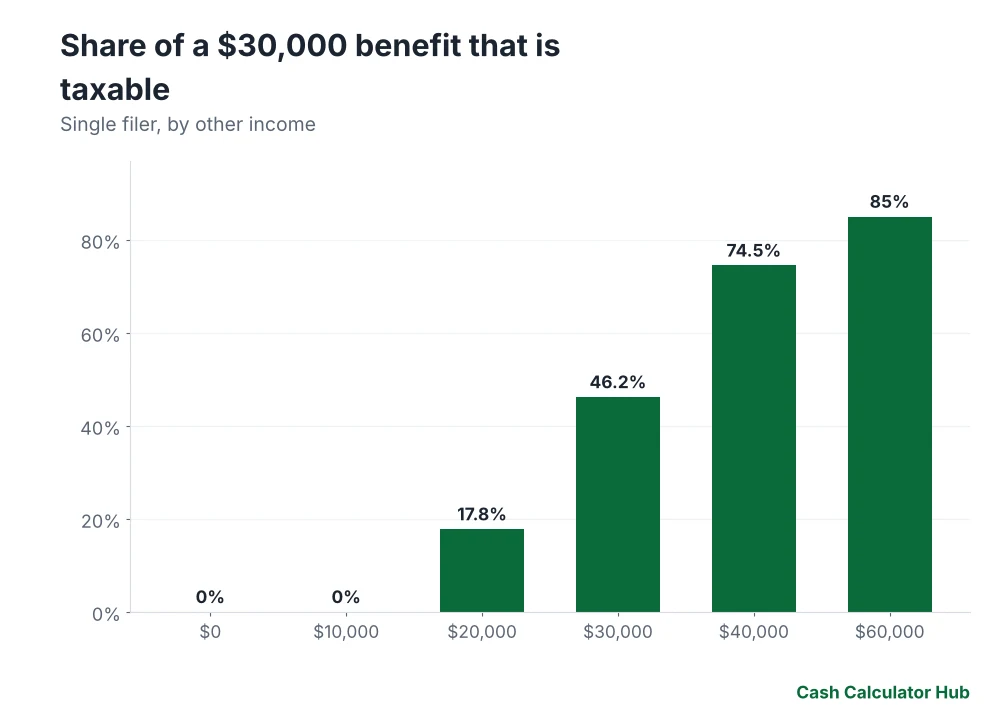
Notice how fast the taxable share rises once other income is $20,000 or more. The tax on that included amount is at your normal bracket; see 2026 tax brackets.
The “tax torpedo”
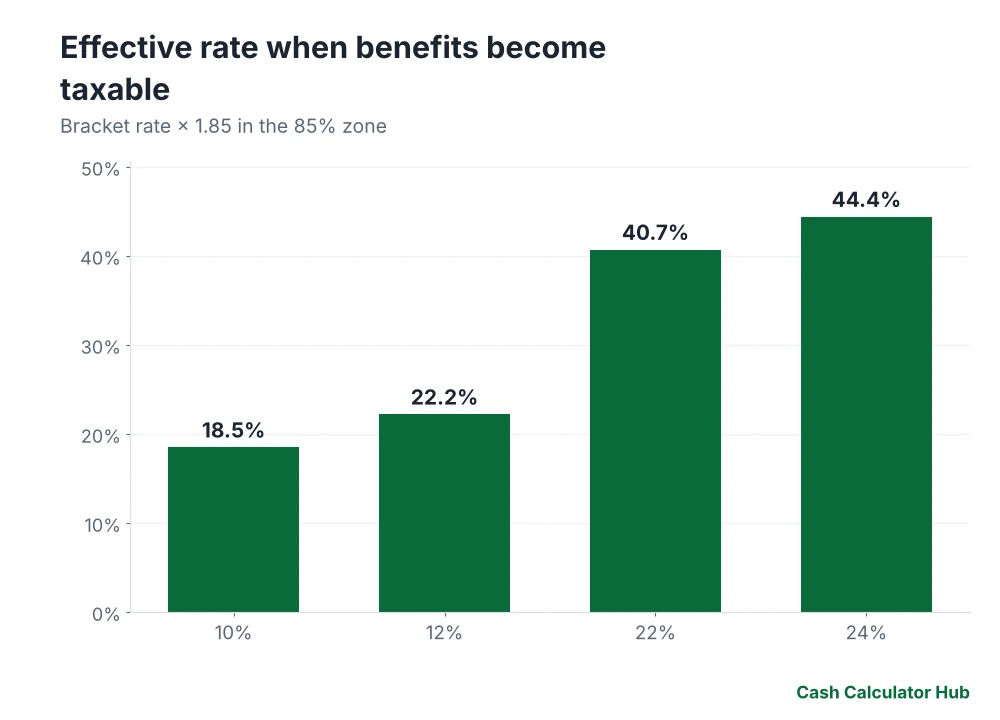
In the range where each extra dollar of income makes another 85 cents of benefits taxable, your effective marginal rate can be up to 85% higher than the bracket suggests (for example, 12% × 1.85 = 22.2%). That affects IRA withdrawals, Roth conversions and capital gains.
Ways to reduce taxes on benefits
- Use Roth money. Roth withdrawals are not part of provisional income. See Roth conversions and plan them before claiming.
- Manage withdrawals. Take enough from IRAs to fill low brackets but avoid unneeded spikes. Required minimum distributions can raise income; see RMDs.
- Qualified charitable distributions from an IRA after age 70½ count as non-taxable and can satisfy RMDs.
- Delay claiming to lower the need for IRA withdrawals in the early years.
- Withhold tax by filing Form W-4V, voluntary withholding of 7%, 10%, 12% or 22%, or make estimated payments.
Examples in other situations
- Low income: a single retiree with $15,000 of benefits and $5,000 of other income has provisional income of $12,500, well below $25,000, so none is taxable.
- Couple: married couple with $50,000 of benefits and $30,000 other income has provisional income of $55,000, above $44,000, so up to 85% is taxable.
State taxes
Most states do not tax Social Security. A handful do, some with exemptions based on age or income. Check your state’s revenue department.
Plan ahead
Check how this affects your claiming decision in 62 versus 67 versus 70 and the income plan in how much you need to retire. Use the Social Security calculator and income tax calculator for estimates. More: retirement tools.
Frequently asked questions
Is Social Security income taxable?
Up to 85% can be included in taxable income, depending on provisional income. Many low-income retirees owe no federal tax on benefits.
At what income is Social Security taxed?
For a single filer, when provisional income exceeds $25,000. For married couples filing jointly, when it exceeds $32,000.
What is provisional income?
Adjusted gross income plus tax-exempt interest plus half of your Social Security benefits.
Do all states tax Social Security?
No. Most states do not, though a few tax benefits partly or fully.
How can I withhold tax from my benefits?
File Form W-4V with the SSA to have 7%, 10%, 12% or 22% withheld, or make quarterly estimated payments.
Sources and further reading
How the numbers were made: Every figure on this page was calculated from the formulas and assumptions stated above and rounded to the nearest dollar. Rates, limits and rules are for 2026 unless noted; confirm current figures with the sources listed before acting.
Keep reading
- Social Security at 62 vs 67 vs 70: When Does Waiting Pay Off?
- Required Minimum Distributions: Age 73 or 75, and How to Calculate Yours
- 2026 Federal Tax Brackets and Standard Deduction, Explained With Examples
- FIRE Explained: How Your Savings Rate Sets the Years Until Financial Independence
- 401(k) Rollover Options When You Leave a Job: What to Do With Your Old Plan
- Solo 401(k) vs SEP IRA: Which Retirement Plan Is Better for the Self-Employed?
This guide is general information, not financial, tax or legal advice. Figures use stated assumptions and 2026 rules and will differ from your situation; check current rules and talk to a licensed professional before you decide. Full disclaimer.