
Quick answer: In U.S. sit-down restaurants a tip of 15% to 20% of the pre-tax bill is customary; on an $80 bill that is $12 to $16. Mental shortcut: move the decimal for 10% ($8) and double it for 20% ($16). Split bills by dividing the total including tip by the number of people, or by item if orders differ a lot.
Tipping norms vary by country and service. In the United States, servers rely on tips because the federal minimum cash wage for tipped employees is low, so tipping is part of the cost of dining out. The math is easy once you have a shortcut.
Key takeaways
- Restaurants: 15% to 20% before tax is common; 20% or more for excellent service.
- Shortcut: 10% = move the decimal; 20% = double it.
- Tip on the pre-tax amount, or on the total if you prefer; the difference is small.
- Delivery, rideshare, salons and other services have their own norms.
- Tipping customs differ abroad; check local practice.
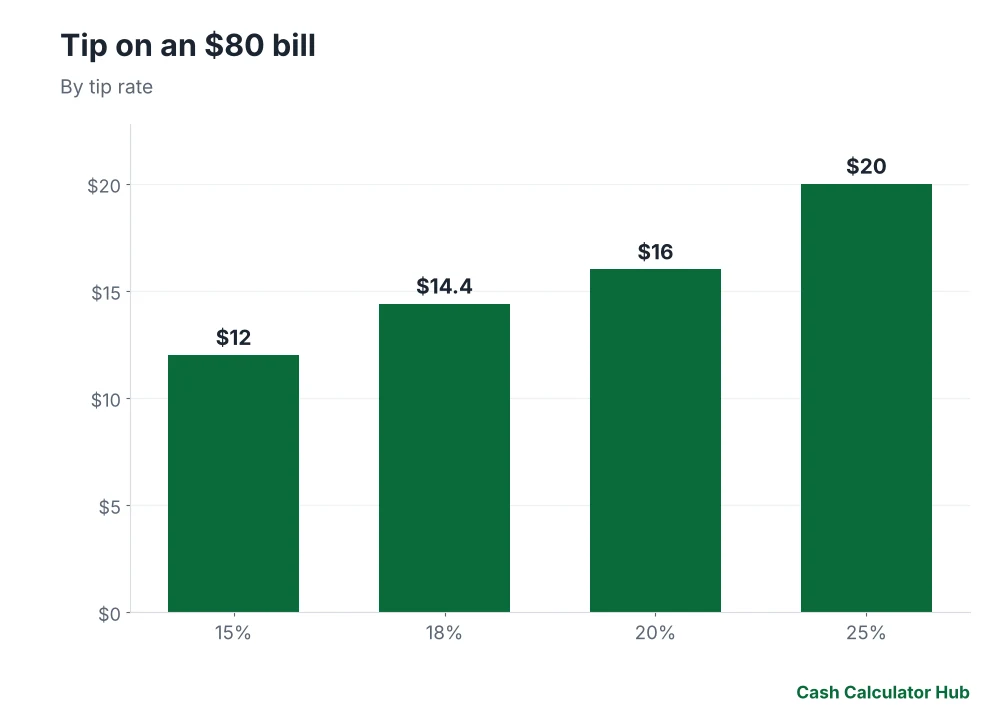
Tip table on an $80 bill
| Tip rate | Tip | Total |
|---|---|---|
| 15% | $12.00 | $92.00 |
| 18% | $14.40 | $94.40 |
| 20% | $16.00 | $96.00 |
| 25% | $20.00 | $100.00 |
Quick mental math
- Move the decimal left one place for 10%: $80 → $8.
- Double it for 20%: $16.
- For 15%, add half of the 10% to the 10%: $8 + $4 = $12.
- For 18%, take 20% and subtract a little.
Tipping on tax
If the bill is $80 before 8% tax, the tax is $6.40 and the total is $86.40. A 20% tip on the pre-tax amount is $16.00; on the total it is $17.28. The difference is $1.28.
Splitting a bill
Even split: (bill + tip) ÷ people. Four people, $80 bill and 20% tip: $24.00 each.
By item: compute each person’s food share plus a share of tax and tip.
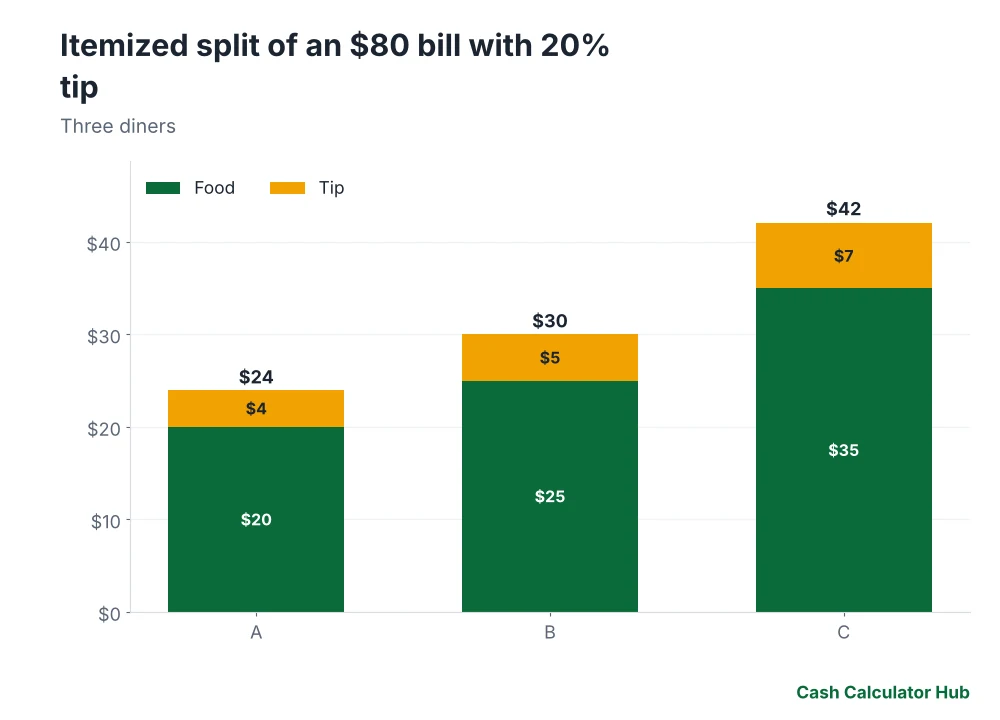
Example: three diners with orders of $20, $25 and $35 (total $80) and a 20% tip:
| Diner | Food | Tip (20%) | Total |
|---|---|---|---|
| A | $20 | $4 | $24 |
| B | $25 | $5 | $30 |
| C | $35 | $7 | $42 |
| Total | $80 | $16 | $96 |
Other services (typical U.S. norms)
| Service | Common tip |
|---|---|
| Food delivery | 15%–20% or $3–$5 minimum |
| Rideshare/taxi | 15%–20% |
| Hair/salon | 15%–20% |
| Coffee counter | optional; $1 or round up |
| Hotel housekeeping | $3–$5 per night |
These are customary ranges, not rules.
Annual cost of tipping
Dining out four times a month at an $80 bill with a 20% tip is $768 a year in tips alone. See your restaurant budget in average household spending and grocery budget.
Tools
Use the percentage calculator and sales tax calculator. See percentage formulas. More: business and everyday tools.
Frequently asked questions
How much should I tip at a restaurant?
15% to 20% of the pre-tax bill is customary in the U.S., more for exceptional service.
Should I tip on the pre-tax or post-tax amount?
Either is acceptable; tipping on the pre-tax amount is common.
How do I calculate a 20% tip quickly?
Move the decimal left one place to get 10%, then double it.
How do I split a bill with different orders?
Calculate each person’s items, add a proportional share of tax and tip.
Is tipping required?
It is not legally required but is customary in many U.S. service settings because servers’ base wages are low.
Sources and further reading
- U.S. Department of Labor: Wage and Hour Division
- IRS: Tax topics and forms
- U.S. Department of Labor: Overtime pay
How the numbers were made: Every figure on this page was calculated from the formulas and assumptions stated above and rounded to the nearest dollar. Rates, limits and rules are for 2026 unless noted; confirm current figures with the sources listed before acting.
Keep reading
- Sales Tax by State: Base Rates, No-Tax States and How to Calculate Total Tax
- The 50/30/20 Budget Rule: How It Works, and How to Adjust It
- Margin vs Markup: The Difference, the Formulas and a Conversion Table
- The True Cost of an Employee: Why a $70,000 Salary Costs About $90,000
- How to Set a Freelance Hourly Rate: From Income Goal to Billable Hours
- Time Value of Money: Present Value, Future Value and NPV Explained With Examples
This guide is general information, not financial, tax or legal advice. Figures use stated assumptions and 2026 rules and will differ from your situation; check current rules and talk to a licensed professional before you decide. Full disclaimer.