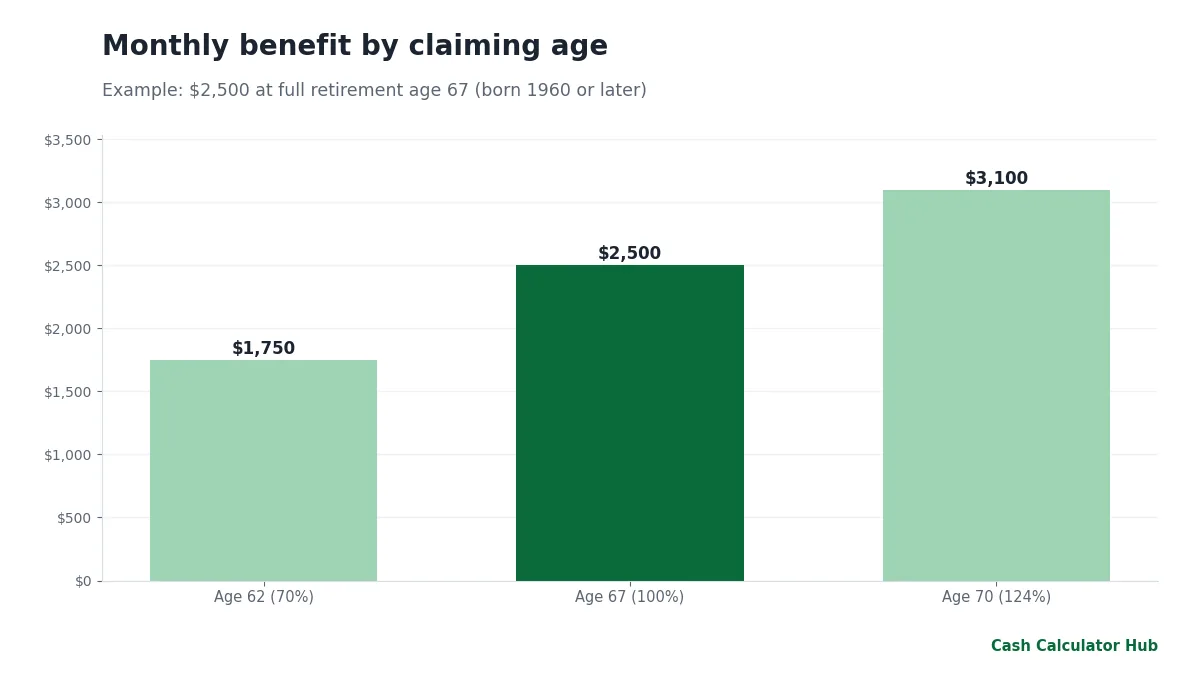
Quick answer: On a $2,500 full benefit, claiming at 62 pays $1,750, at 67 $2,500 and at 70 $3,100.
This is one of the few retirement decisions you cannot reverse after a year, and it affects a check you will receive for life. So it deserves some actual math.
How the age changes the check
Your full retirement age (FRA) is 67 if you were born in 1960 or later. You can claim as early as 62 or delay to 70.
- Claim at 62: about a 30% permanent reduction.
- Claim at FRA (67): 100% of your primary insurance amount.
- Delay to 70: 8% more per year past FRA, so about 124%.
On a $2,500 full benefit:
| Claim age | % of full benefit | Monthly | Annual |
|---|---|---|---|
| 62 | 70% | $1,750 | $21,000 |
| 67 | 100% | $2,500 | $30,000 |
| 70 | 124% | $3,100 | $37,200 |
(Benefits for people born before 1960 follow a slightly different schedule. Check your own SSA statement at ssa.gov.)
The break-even ages
Waiting means collecting nothing for a while in return for a bigger check. Where does the extra catch up?
- 67 versus 62: break-even at age 79.
- 70 versus 67: break-even at age 83.
- 70 versus 62: break-even around age 81.
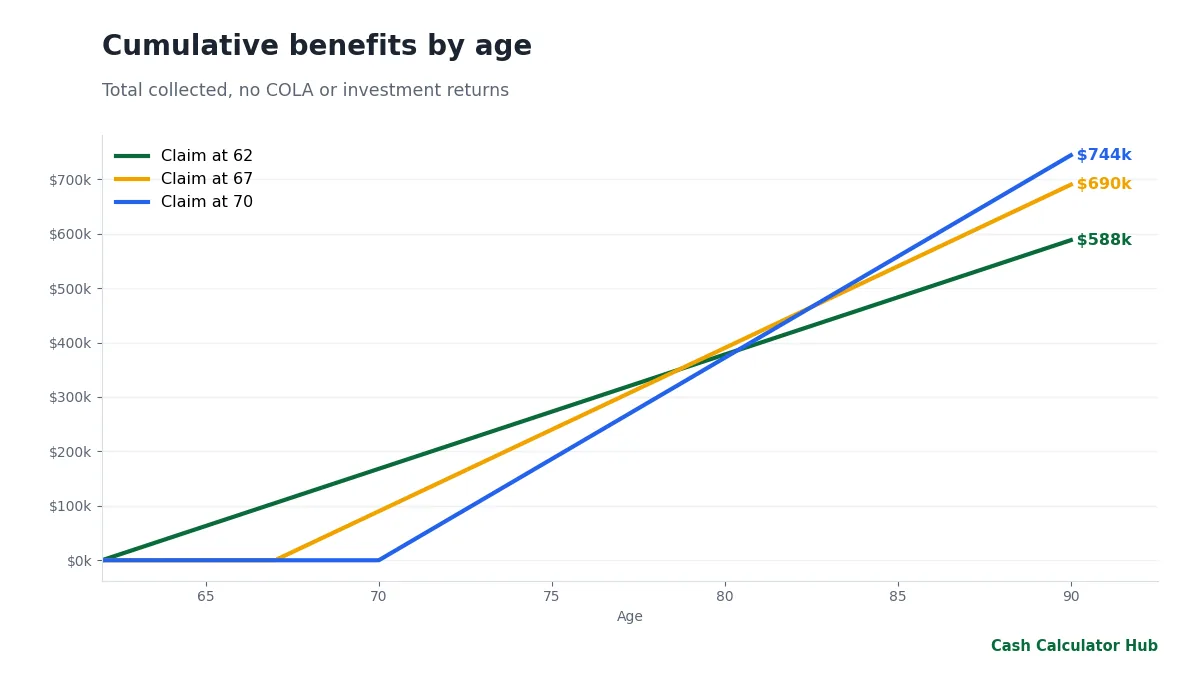
These ignore cost-of-living increases (which help the larger check more in dollars) and investment returns on money you collect early. A 2.8% COLA applied for 2026 shows that annual adjustments can be meaningful.
Who should claim early
- You need the income. If the alternative is high-interest debt or being unable to cover basics, claim.
- Poor health or short life expectancy in your family and your own history.
- A lower earner in a couple who is not the one the survivor benefit depends on.
- You will keep working and the earnings test would reduce checks anyway before FRA. Benefits withheld under the test are recalculated later, but it often surprises people.
Who should wait
- You expect to live past your early 80s. Social Security is inflation-adjusted longevity insurance that is hard to replace.
- The higher earner in a married couple. The survivor gets the larger of two benefits, so delaying protects the surviving spouse for life.
- You can cover expenses from savings or work in the meantime.
Taxes on your benefits
Up to 85% of benefits can be taxable depending on “combined income,” which includes half of your benefits. The thresholds ($25,000 and $34,000 for single filers, $32,000 and $44,000 for joint) are not indexed to inflation, so more retirees are affected over time. Roth withdrawals do not count toward combined income, one more reason to read the Roth versus traditional guide.
How to run your own numbers
- Get your earnings record and estimated benefits from ssa.gov.
- Enter them in the Social Security calculator to compare 62, 67 and 70.
- Check what your retirement income looks like with the retirement calculator.
- Read how much you need to retire for the nest egg that fills the gap.
- Remember required distributions: RMD rules can raise taxable income at 73 or 75.
More tools: retirement calculators.
Couples: the survivor benefit changes the math
When one spouse dies, the survivor keeps the larger of the two benefits. That means the higher earner’s claiming age effectively sets the minimum income for whoever lives longer. In a couple where one spouse earned much more, delaying that spouse’s claim to 70 can protect the survivor for decades, even if the break-even age looks long for the higher earner alone. The lower earner might claim earlier to bring in cash while the higher earner waits.
The earnings test
If you claim before full retirement age and keep working, benefits are reduced when your earnings exceed an annual limit (about $24,000 to $25,000 a year in recent years; check the current figure). Withheld benefits are not lost; your monthly amount is recalculated at full retirement age. After FRA, there is no earnings test.
How to decide
Estimate your expenses, list other income, and ask what the benefit would need to cover. Then compare the monthly differences with your health and family history. If you are on the fence, delaying for even one or two years has a real payoff for the surviving spouse, and you can use the retirement calculator to see how the choice changes how long your savings last.
What is the best age to take Social Security?
There is no single age. For many healthy people with other income, delaying to 70 maximizes lifetime income; for others, claiming earlier is safer.
Can I change my mind after claiming?
Within 12 months you can withdraw the application and repay benefits. After that you can suspend at FRA, with limits.
Do spouses get benefits?
A spouse can receive up to 50% of the worker’s full benefit, and survivors receive up to 100% of the deceased’s benefit.
Will Social Security run out?
The trust fund is projected to be short in the 2030s, after which incoming taxes would pay roughly three-quarters of scheduled benefits unless Congress acts. It is not projected to disappear.
Sources and further reading
How the numbers were made: Every figure on this page was calculated from the formulas and assumptions stated above and rounded. Rates, limits and rules are for 2026 unless noted; confirm current figures with the sources listed before acting.
Keep reading
- Roth vs Traditional 401(k) and IRA: How to Decide
- How Much Do You Need to Retire? A Practical Way to Find Your Number
- Required Minimum Distributions: Age 73 or 75, and How to Calculate Yours
- The 4% Rule: Safe Withdrawal Rates From 3% to 5%, With Real Numbers
- CPI Explained: How Inflation Is Measured and What the Number Misses
- How Much Should You Have Saved for Retirement by Age? Benchmarks for 30 to 67
This guide is general information, not financial, tax or legal advice. Figures use stated assumptions and 2026 rules and will differ from your situation; check current rules and talk to a licensed professional before you decide. Full disclaimer.