Quick answer: An index fund tracks a market index at low cost; it can be packaged as an ETF (traded like a stock all day) or an index mutual fund (priced once a day). An actively managed mutual fund tries to beat the market and typically costs more. On $100,000 over 30 years at a 7% gross return, a 0.03% fund ends near $754,849 and a 1.00% fund near $574,349.
People often compare these three as if they were the same kind of thing. They are not. “Index” describes what the fund holds and how it is run. “ETF” and “mutual fund” describe how the fund is packaged and bought.
So you can own an index ETF, an index mutual fund or an actively managed mutual fund (or ETF). The practical differences are cost, how you trade, how much you need to start and how taxes work.
Key takeaways
- An index fund passively tracks a market index and usually has very low fees.
- ETFs trade throughout the day like stocks; mutual funds trade once a day at the closing net asset value (NAV).
- Fees compound: a 1% fee instead of 0.03% can cost tens of thousands over decades.
- ETFs are often more tax-efficient in taxable accounts; in a 401(k) or IRA the difference does not matter.
- Choose by cost, diversification and what your account allows, not by label.
The three at a glance
| Index fund (mutual fund version) | ETF | Actively managed mutual fund | |
|---|---|---|---|
| Goal | Match an index | Usually match an index | Beat an index |
| Typical expense ratio | 0.02% to 0.20% | 0.03% to 0.25% (index) | 0.50% to 1.25% |
| How you buy | At the end-of-day price through the provider or broker | During market hours like a stock | End-of-day price |
| Minimum investment | Often $1 to $3,000 | One share (or fractional shares) | Varies, often $1,000 to $3,000 |
| Fractional or automatic investing | Easy | Depends on broker | Easy |
| Tax efficiency in taxable accounts | Good | Often best | Lower; more trading |
| Trading costs | None at most brokers | Commissions are rare, but bid-ask spreads apply | None at most brokers |
Fees in dollars
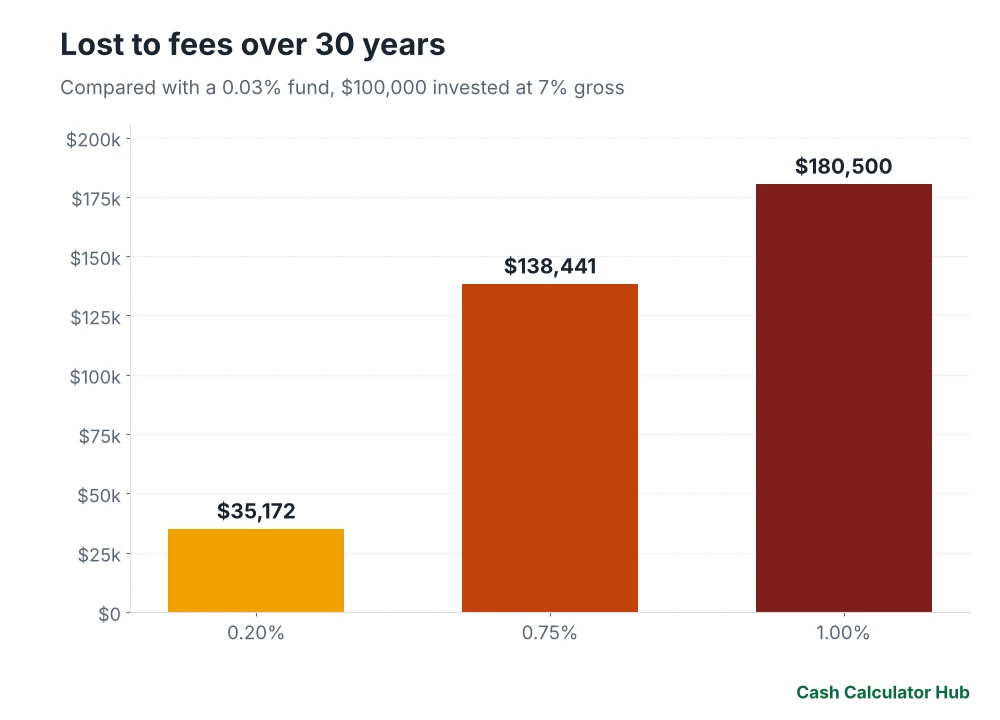
A $100,000 investment growing at a 7% gross return for 30 years under four different fees:
| Expense ratio | Net return | Value after 30 years | Lost to fees |
|---|---|---|---|
| 0.03% | 6.97% | $754,849 | $0 |
| 0.20% | 6.80% | $719,677 | $35,172 |
| 0.75% | 6.25% | $616,408 | $138,441 |
| 1.00% | 6.00% | $574,349 | $180,500 |
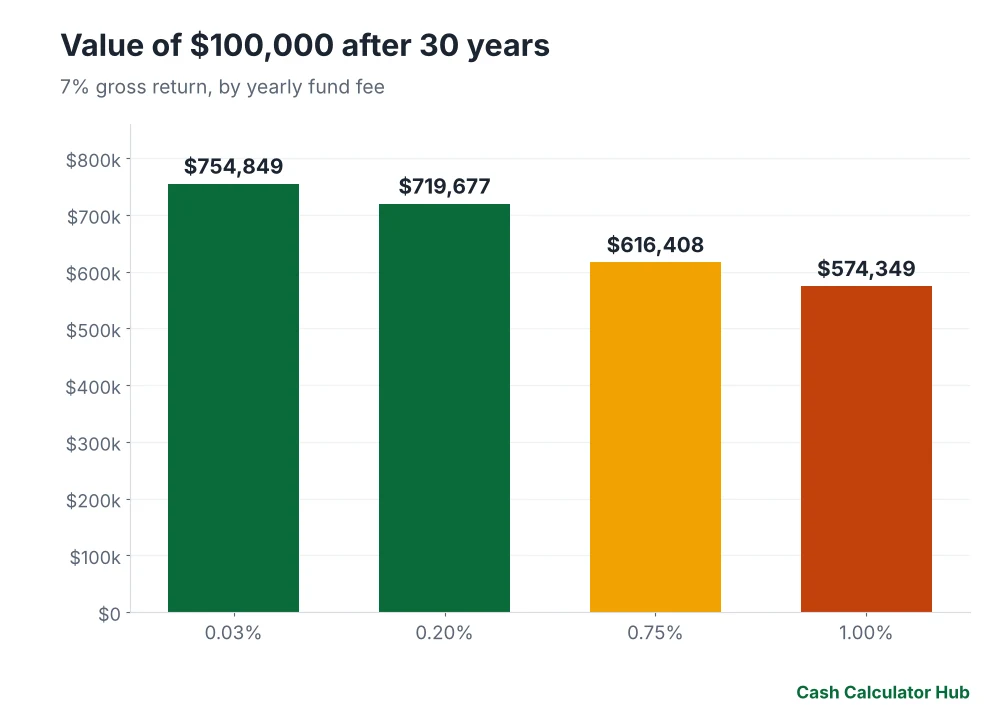
Fees are the one number you can control. Investor.gov and many studies note that, on average, lower-cost funds have tended to outperform higher-cost ones after fees. For the full effect read how expense ratios cost you six figures.
How taxes differ
In a taxable account, mutual funds can distribute capital gains when the manager sells holdings or when shareholders redeem. ETFs use a creation-and-redemption process that usually avoids passing out gains, so they tend to be more tax-efficient. Index mutual funds also have low turnover, which limits distributions. In a 401(k), IRA or Roth account, taxes are deferred or exempt, so tax efficiency is irrelevant.
What to choose
- In a 401(k): pick the lowest-cost index fund offered; options are limited to what your plan provides.
- In an IRA or taxable brokerage account: a broad index ETF or index mutual fund both work. ETFs are convenient and tax-efficient; mutual funds are convenient for automatic investments of exact dollar amounts.
- If you want active management: compare the cost against its record after fees over 10+ years and what you would own anyway.
What to check before buying
- Expense ratio. Lower is better, all else equal.
- What the index holds. Total market, S&P 500, international, bonds.
- Tracking error and fund size. Large, established funds tend to track well.
- Bid-ask spread for ETFs. It matters for thinly traded ones.
- Account fit. Some brokers have free in-house funds.
Common mistakes
- Buying several funds that hold the same stocks and calling it diversification.
- Chasing last year’s best performer.
- Paying a sales load (front-end or back-end) when no-load index funds exist.
- Trading in and out; the biggest cost is behavior.
Next steps
Estimate how fees and returns affect your goal with the mutual fund calculator, the investment calculator and the compound interest calculator. For a mix of stocks and bonds, see asset allocation. More: investment tools.
Frequently asked questions
Is an ETF better than an index fund?
They are not opposites. An ETF can track an index. The best choice depends on costs, how you want to trade and the account you use.
Are index funds safe?
They are diversified but not risk-free; they rise and fall with the market they track. They are not insured like bank deposits.
What is an expense ratio?
The yearly fee charged by a fund, expressed as a percentage of your investment. A 0.05% ratio costs $5 a year per $10,000.
Do ETFs have minimums?
Usually you can buy one share, and many brokers allow fractional shares, so the minimum can be a few dollars.
Why are mutual funds still popular?
They are common in 401(k) plans and make automatic investing of exact dollar amounts easy.
Sources and further reading
How the numbers were made: Every figure on this page was calculated from the formulas and assumptions stated above and rounded to the nearest dollar. Rates, limits and rules are for 2026 unless noted; confirm current figures with the sources listed before acting.
Keep reading
- How Expense Ratios Quietly Cost You Six Figures
- Compound Interest on $10,000: What It Becomes in 10, 20 and 30 Years
- ROI vs IRR vs CAGR: Which Return Number Should You Trust?
- Stocks vs Bonds: How to Choose Your Asset Allocation
- Dollar-Cost Averaging vs Lump Sum: Which Is Better for $120,000?
- High-Yield Savings Accounts: APY, Insurance Limits and What You Really Earn
This guide is general information, not financial, tax or legal advice. Figures use stated assumptions and 2026 rules and will differ from your situation; check current rules and talk to a licensed professional before you decide. Full disclaimer.