
Quick answer: Commission = sales × commission rate. On $60,000 of sales, straight commission at 8% pays $4,800; a tiered plan paying 5% on the first $20,000, 8% on the next $20,000 and 12% above that pays $5,000; a plan with a $3,000 base plus 3% pays $4,800. The best structure depends on how much your sales vary.
Commission aligns pay with results, but different structures shift risk between employee and employer. Before taking a sales job, convert each plan into earnings at several sales levels, including a bad month.
Key takeaways
- Straight commission: sales × rate; highest risk and upside.
- Tiered commission: higher rates at higher sales levels.
- Base plus commission: stable pay with smaller upside.
- Compare plans at low, average and high sales levels.
- Check for caps, clawbacks, draws and how overtime and minimum wage rules apply.
Three plans compared
Plans: (A) 8% straight; (B) tiered: 5% on the first $20,000, 8% on the next $20,000, 12% above $40,000; (C) $3,000 base plus 3%.
| Monthly sales | A: 8% straight | B: tiered | C: base + 3% |
|---|---|---|---|
| $20,000 | $1,600 | $1,000 | $3,600 |
| $40,000 | $3,200 | $2,600 | $4,200 |
| $60,000 | $4,800 | $5,000 | $4,800 |
| $90,000 | $7,200 | $8,600 | $5,700 |
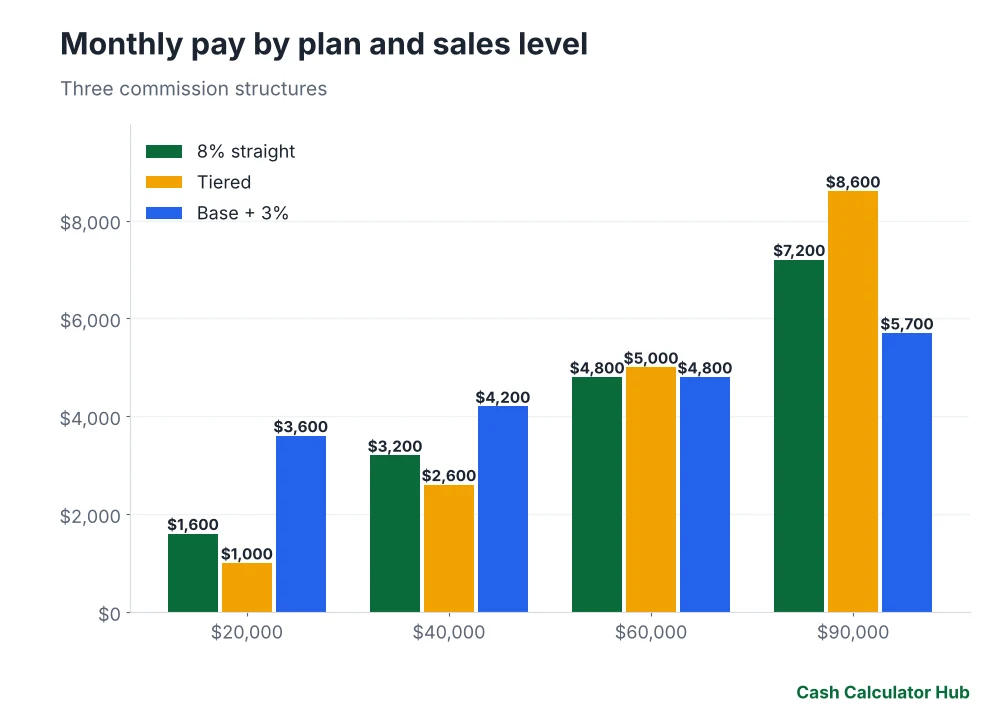
Plan C pays most in weak months and plan B in strong months; straight commission (A) never comes out on top in this example.
Break-even between plans
Plan C beats A when $3,000 + 0.03S > 0.08S, so S < $60,000. Above $60,000 of monthly sales, straight commission pays more.
Common structures
- Draw against commission: advance paid, later recouped from commission.
- Residual commission: ongoing payments on recurring revenue.
- Gross margin commission: a percentage of profit, not revenue.
- Bonus and accelerators: extra pay for hitting quota.
Taxes and withholding
Commission is supplemental wages: employers often withhold 22% flat. See bonus withholding. Self-employed sales agents pay self-employment tax.
Annual pay estimate
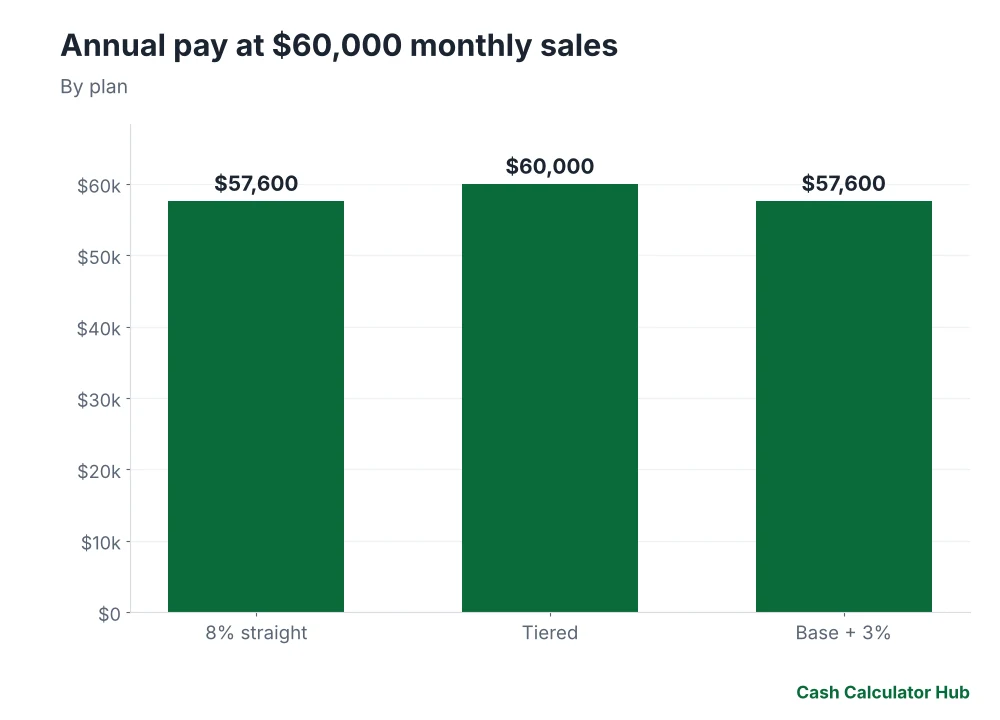
At average sales of $60,000 a month:
| Plan | Annual pay |
|---|---|
| A | $57,600 |
| B | $60,000 |
| C | $57,600 |
Compare with a salary using hourly to salary.
Questions to ask
- Is commission paid on revenue, profit or collected cash?
- Are there caps or clawbacks for returns and cancellations?
- What is the quota and how is it adjusted?
- When is commission paid?
Tools
Use the commission calculator, salary calculator and take-home paycheck calculator. More: business and everyday tools.
Frequently asked questions
How is commission calculated?
Multiply sales by the commission rate. Tiered plans apply different rates to different portions of sales.
What is the difference between straight and base-plus commission?
Straight commission pays only a percentage of sales; base-plus adds a fixed salary or draw.
What is a commission draw?
An advance against future commissions that is later repaid from earned commissions.
Is commission taxed differently?
It is ordinary income; employers often withhold 22% federal tax on supplemental wages.
Which commission structure is best?
It depends on your sales volume and risk tolerance; compare earnings at low, typical and high sales.
Sources and further reading
- U.S. Department of Labor: Wage and Hour Division
- IRS: Tax topics and forms
- U.S. Small Business Administration
How the numbers were made: Every figure on this page was calculated from the formulas and assumptions stated above and rounded to the nearest dollar. Rates, limits and rules are for 2026 unless noted; confirm current figures with the sources listed before acting.
Keep reading
- Hourly to Salary: What Is $25 an Hour Per Year?
- How Much Is a $100,000 Salary After Taxes in 2026?
- Margin vs Markup: The Difference, the Formulas and a Conversion Table
- The True Cost of an Employee: Why a $70,000 Salary Costs About $90,000
- How to Set a Freelance Hourly Rate: From Income Goal to Billable Hours
- Time Value of Money: Present Value, Future Value and NPV Explained With Examples
This guide is general information, not financial, tax or legal advice. Figures use stated assumptions and 2026 rules and will differ from your situation; check current rules and talk to a licensed professional before you decide. Full disclaimer.