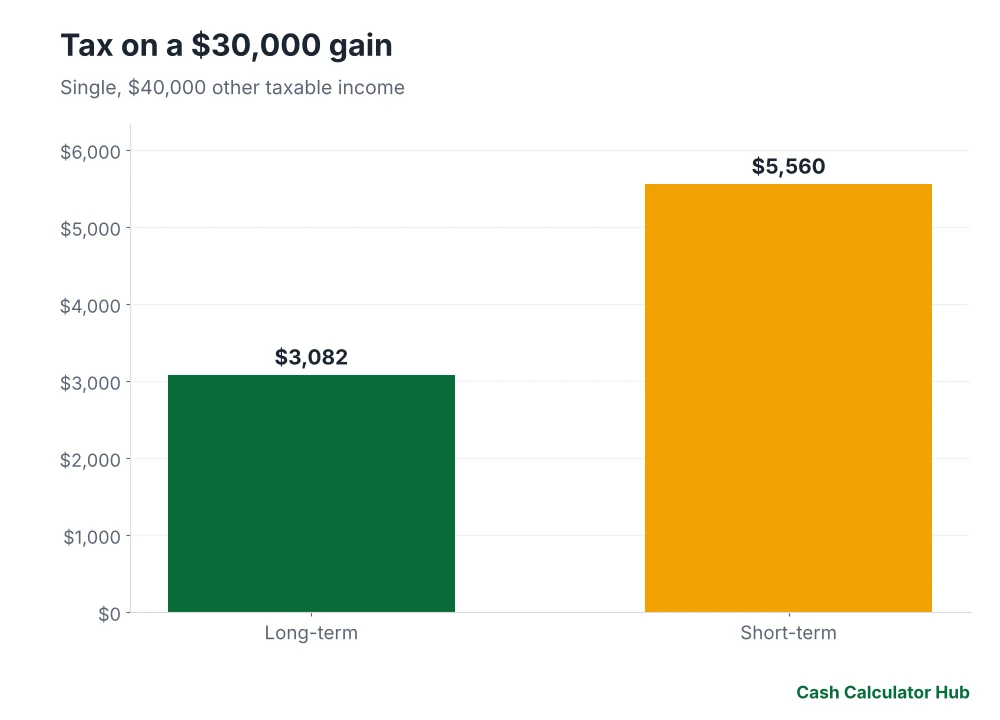
Quick answer: For 2026, long-term capital gains (assets held over one year) are taxed at 0% up to $49,450 of taxable income for single filers ($98,900 married filing jointly), 15% up to $545,500 ($613,700 joint) and 20% above. Short-term gains are taxed at ordinary rates. A $30,000 long-term gain stacked on $40,000 of taxable income owes about $3,082; as a short-term gain it would owe about $5,560.
Selling an investment for more than you paid creates a capital gain. How it is taxed depends on how long you held it and where the gain falls in your taxable income. Gains are stacked on top of ordinary income, so the rate for each slice depends on where that slice lands.
Key takeaways
- Long-term (held over 1 year): 0%, 15% or 20%. Short-term: ordinary income tax rates up to 37%.
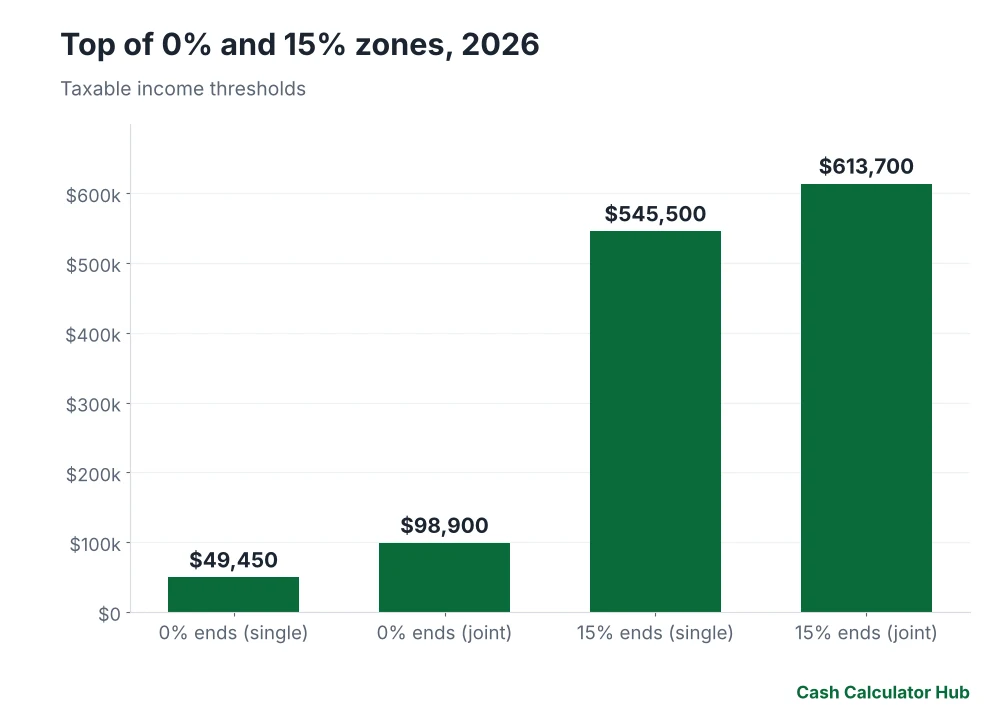
- 2026 0% bracket ends at $49,450 single, $98,900 married filing jointly, $66,200 head of household.
- 15% applies up to $545,500 single and $613,700 joint; 20% above.
- Higher earners may also owe the 3.8% net investment income tax above $200,000 single or $250,000 joint.
- Losses offset gains, and up to $3,000 of net loss offsets ordinary income each year.
2026 long-term rate thresholds (taxable income)
| Rate | Single | Married filing jointly | Head of household |
|---|---|---|---|
| 0% | up to $49,450 | up to $98,900 | up to $66,200 |
| 15% | to $545,500 | to $613,700 | see IRS |
| 20% | above | above | above |
Special categories: collectibles are taxed up to 28%, and unrecaptured depreciation on real estate up to 25%.
How stacking works
Your ordinary taxable income fills the brackets first. Gains fill what is above it.
Example: single filer with $40,000 of taxable income sells shares for a $30,000 long-term gain.
| Slice of gain | Amount | Rate | Tax |
|---|---|---|---|
| Within the 0% zone (up to $49,450) | $9,450 | 0% | $0 |
| In the 15% zone | $20,550 | 15% | $3,082 |
| Total | $30,000 | $3,082 |
Short-term versus long-term
The same $30,000 gain taxed as short-term income on top of $40,000 would owe about $5,560: $2,478 more. Waiting one day past a year can matter.
| Holding period | Tax on the $30,000 gain |
|---|---|
| Short-term (under 1 year) | $5,560 |
| Long-term (over 1 year) | $3,082 |
Extra tax for high incomes
The net investment income tax (NIIT) adds 3.8% on investment income when modified AGI exceeds $200,000 (single) or $250,000 (married filing jointly). These thresholds are not indexed to inflation.
Reducing capital gains tax
- Hold more than a year.
- Harvest losses to offset gains. Net losses of up to $3,000 offset ordinary income; the rest carries forward.
- Use tax-advantaged accounts. Gains inside a 401(k), IRA or Roth are not taxed each year; see which account first.
- Choose tax-efficient funds. Index funds and ETFs distribute fewer gains; see index funds, ETFs and mutual funds.
- Gift or donate appreciated shares instead of cash.
- Realize gains in low-income years, perhaps within the 0% zone.
- Home sale exclusion: up to $250,000 ($500,000 married) of gain on a primary residence if you lived there two of the last five years. See home equity.
Dividends
Qualified dividends use the same 0%, 15% and 20% rates; non-qualified dividends are ordinary income. See dividend investing.
Estimate your tax
Use the income tax calculator and ROI calculator to see after-tax returns, and compare brackets in 2026 brackets. More: tax tools.
Frequently asked questions
What are the long-term capital gains rates for 2026?
0%, 15% and 20%, depending on taxable income and filing status.
How long must I hold an asset for long-term treatment?
More than one year.
Are capital gains added to my income?
They are stacked on top of ordinary income to determine which capital gains rate applies, but are taxed at their own rates.
What is the net investment income tax?
A 3.8% tax on investment income for individuals with modified AGI above $200,000 or married couples above $250,000.
Can I deduct capital losses?
Losses offset capital gains, and up to $3,000 of extra losses can offset other income each year, with the remainder carried forward.
Sources and further reading
How the numbers were made: Every figure on this page was calculated from the formulas and assumptions stated above and rounded to the nearest dollar. Rates, limits and rules are for 2026 unless noted; confirm current figures with the sources listed before acting.
Keep reading
- Dollar-Cost Averaging vs Lump Sum: Which Is Better for $120,000?
- 2026 Federal Tax Brackets and Standard Deduction, Explained With Examples
- ROI vs IRR vs CAGR: Which Return Number Should You Trust?
- How to Read Your Paycheck: Gross Pay, Withholding and Net Pay Explained
- FICA Taxes Explained: Social Security and Medicare Withholding in 2026
- W-2 vs 1099: How Much More You Must Charge to Match an Employee Salary
This guide is general information, not financial, tax or legal advice. Figures use stated assumptions and 2026 rules and will differ from your situation; check current rules and talk to a licensed professional before you decide. Full disclaimer.