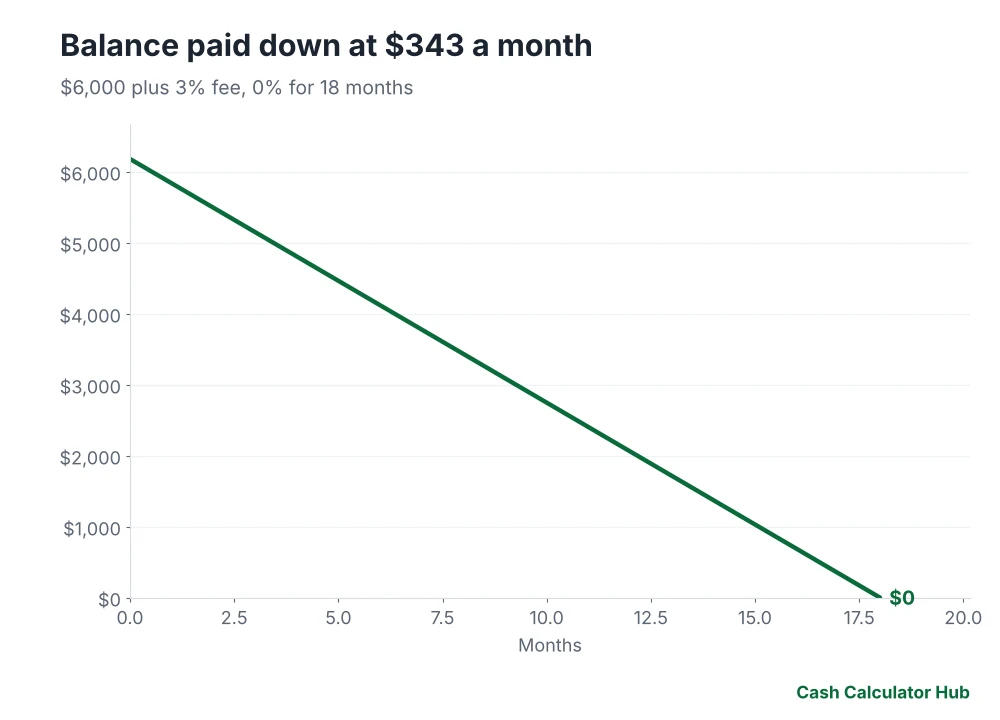
Quick answer: A balance transfer moves debt to a card with a 0% introductory APR for typically 12 to 21 months, usually for a 3% to 5% fee. Transferring $6,000 from a 24% card to a 0% card with a 3% fee ($180) and paying $343 a month clears the debt in 18 months; the same payments at 24% would cost about $1,360 in interest, so the transfer saves about $1,180 net.
A balance transfer can turn a high-interest card into an interest-free loan for a limited time, which lets every payment reduce principal. It works when you have a plan to pay off the balance during the promotion. It backfires when the promotion ends with a balance left.
Key takeaways
- Typical terms: 0% APR for 12 to 21 months, 3% to 5% transfer fee.
- Savings = interest you would have paid − the transfer fee.
- Missing a payment can end the promotional rate on some cards.
- Divide the balance plus fee by the number of promo months to set the payment.
- After the promotion, the regular APR (often 20% or higher) applies to what remains.
The example
Balance $6,000 at 24% APR; offer: 0% for 18 months, 3% fee.
| Stay at 24% | Transfer at 0% | |
|---|---|---|
| Fee | $0 | $180 |
| Monthly payment | $343 | $343 |
| Months to pay off | 1 yr 10 mo | 18 months |
| Interest paid | $1,360 | $0 |
| Total cost of borrowing | $1,360 | $180 |
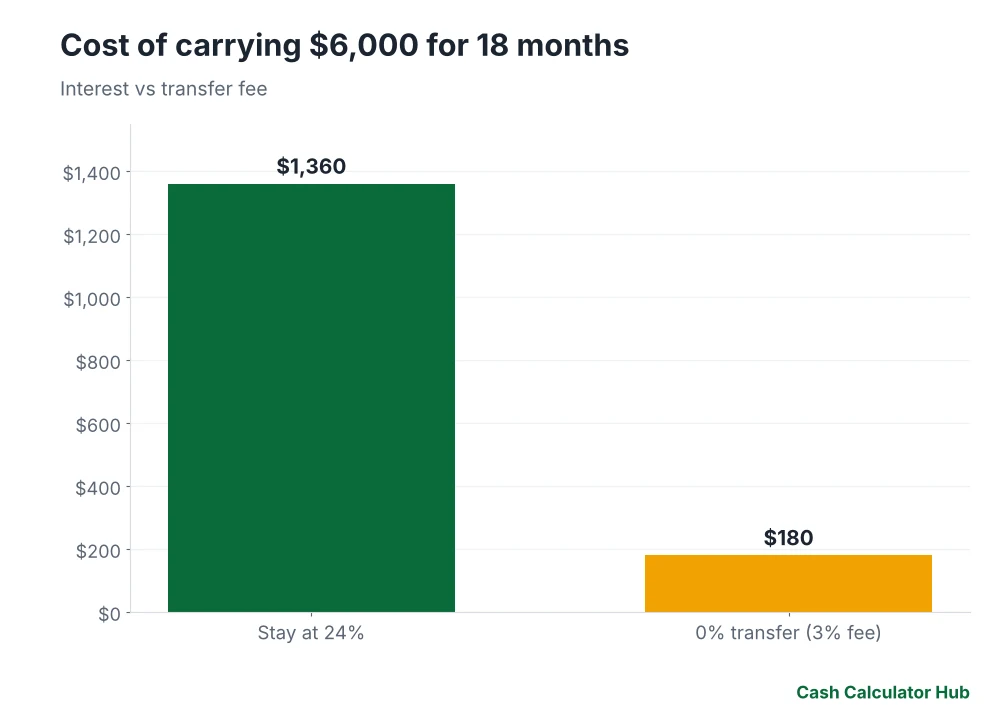
Net saving: $1,180.
Check the break-even
The fee is fixed; interest saved depends on the balance and time. For the same payments, the saving is larger the higher your rate and the longer the promotion.
| Balance | 3% fee | Interest avoided at 24% over 12 months of 0% (approx.) | Net |
|---|---|---|---|
| $2,000 | $60 | $264 | $204 |
| $6,000 | $180 | $792 | $612 |
| $10,000 | $300 | $1,320 | $1,020 |
(Approximation assumes an average balance of about 55% of the starting balance while paying it down over the year.)
Pitfalls
- Missing a payment may forfeit the promo rate.
- New purchases may accrue interest at the standard APR.
- Cards that count transfers differently (promo for purchases vs transfers).
- Credit score: a hard inquiry and a new account lower your average account age; utilization on the new card matters; see credit score factors.
- Not closing the old card can invite new debt.
Alternatives
- A fixed-rate personal loan; see personal loan vs card.
- Debt consolidation; see consolidation.
- Paying with the avalanche or snowball method.
- Contact the issuer to ask for a lower rate or a hardship plan, or a nonprofit credit counseling agency.
Tools
Use the credit card payoff calculator, debt payoff calculator and debt consolidation calculator. More: loan calculators.
Frequently asked questions
Are balance transfers worth it?
Yes, if the interest saved exceeds the transfer fee and you can pay off the balance within the promotional period.
How much is a balance transfer fee?
Typically 3% to 5% of the amount transferred.
What happens when the 0% period ends?
Any remaining balance is charged the regular APR, often 20% or more.
Does a balance transfer hurt credit?
There may be a small temporary dip from the new account and inquiry, but paying down balances can improve your score.
Can I transfer balances between cards from the same bank?
Usually not; issuers generally do not allow transfers within the same bank.
Sources and further reading
How the numbers were made: Every figure on this page was calculated from the formulas and assumptions stated above and rounded to the nearest dollar. Rates, limits and rules are for 2026 unless noted; confirm current figures with the sources listed before acting.
Keep reading
- How Long to Pay Off a Credit Card Making Only the Minimum?
- Is Debt Consolidation Worth It? A $18,000 Credit Card Example
- Debt Avalanche vs Snowball: A Four-Debt Example With Real Numbers
- APR vs APY: What’s the Difference and Why It Matters for Loans and Savings
- Credit Score Factors: What Moves Your Score and by How Much
- Personal Loan vs Credit Card: Which Costs Less for a Big Expense?
This guide is general information, not financial, tax or legal advice. Figures use stated assumptions and 2026 rules and will differ from your situation; check current rules and talk to a licensed professional before you decide. Full disclaimer.