Quick answer: A FICO credit score is built from five factors: payment history (35%), amounts owed or credit utilization (30%), length of credit history (15%), new credit (10%) and credit mix (10%). The most effective actions are paying every bill on time and keeping card balances below 30% of limits, and ideally below 10%.
Scores range from 300 to 850 and affect the rates you pay on mortgages, car loans and cards, and sometimes insurance and rentals. The exact formula is proprietary, but the weights are public. Understanding them tells you where to spend effort.
Key takeaways
- Payment history is the largest factor: one 30-day late payment can drop a score significantly.
- Utilization = card balances ÷ credit limits; lower is better.
- Older accounts help; avoid closing your oldest card without a reason.
- Too many hard inquiries in a short time can reduce the score modestly.
- Check your free credit reports at AnnualCreditReport.com and dispute errors.
The five factors
| Factor | Weight | What helps |
|---|---|---|
| Payment history | 35% | Pay every bill on time; set autopay |
| Amounts owed (utilization) | 30% | Keep balances below 30% of limits, ideally under 10% |
| Length of credit history | 15% | Keep old accounts open and in use |
| New credit | 10% | Open accounts only when needed |
| Credit mix | 10% | A mix of cards and installment loans, if you need them |

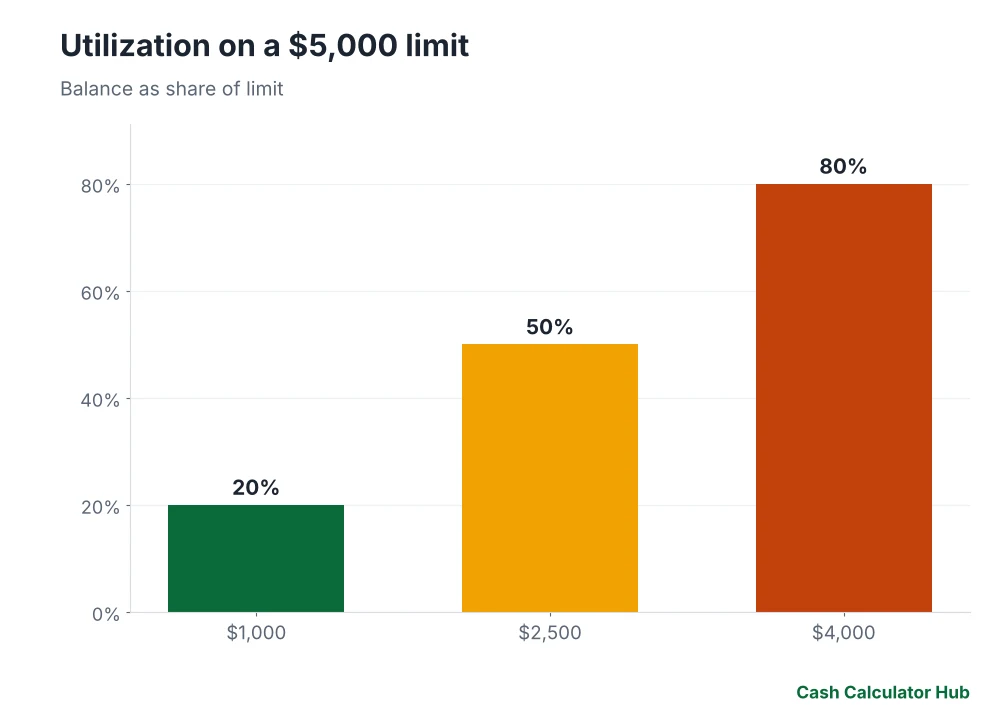
Utilization examples
Credit limit $5,000:
| Balance | Utilization |
|---|---|
| $1,000 | 20% |
| $2,500 | 50% |
| $4,000 | 80% |
Aim to pay balances before the statement closes so the reported balance is low.
Score ranges
| Range | Typical description |
|---|---|
| 800–850 | Exceptional |
| 740–799 | Very good |
| 670–739 | Good |
| 580–669 | Fair |
| 300–579 | Poor |
How the score affects cost
A better score lowers rates. See credit score and mortgage rate for the dollar impact on a home loan and car loan affordability.
Steps to improve
- Pay on time; set autopay for at least the minimum.
- Reduce balances, targeting the highest utilization cards first. Use avalanche or snowball.
- Request credit limit increases (without a hard inquiry if possible).
- Do not close old accounts needlessly.
- Dispute errors with the credit bureaus.
- Be patient: derogatory items fade over time (late payments up to seven years).
Myths
- Checking your own score does not hurt it.
- Income is not part of the score.
- Carrying a balance is not needed to build credit; pay in full.
Tools
Use the credit card calculator to plan payoff and the debt-to-income calculator for lenders’ other test. See also DTI guide. More: loan calculators.
Frequently asked questions
What affects my credit score the most?
Payment history (35%) and amounts owed (30%).
What is a good credit utilization ratio?
Below 30% is commonly advised; below 10% is even better.
How long do late payments stay on a credit report?
Up to seven years, with the impact fading over time.
Does checking my credit score lower it?
No. Checking your own score is a soft inquiry and does not affect it.
How can I improve my credit score fast?
Pay down card balances, make all payments on time and fix any report errors.
Sources and further reading
- CFPB: Credit reports and scores
- FTC: Consumer advice on money and credit
- Consumer Financial Protection Bureau
How the numbers were made: Every figure on this page was calculated from the formulas and assumptions stated above and rounded to the nearest dollar. Rates, limits and rules are for 2026 unless noted; confirm current figures with the sources listed before acting.
Keep reading
- How Long to Pay Off a Credit Card Making Only the Minimum?
- FHA vs Conventional Loan: Which Costs Less?
- Is Debt Consolidation Worth It? A $18,000 Credit Card Example
- APR vs APY: What’s the Difference and Why It Matters for Loans and Savings
- Balance Transfer Cards: Are They Worth the 3% to 5% Fee?
- Personal Loan vs Credit Card: Which Costs Less for a Big Expense?
This guide is general information, not financial, tax or legal advice. Figures use stated assumptions and 2026 rules and will differ from your situation; check current rules and talk to a licensed professional before you decide. Full disclaimer.