Quick answer: Consolidating $18,000 of 22% card debt into a 12% loan saves about $9,088 versus keeping the cards, once the 5% fee is counted.
Consolidation means replacing several debts with one new one. It is useful when the new loan has a lower interest rate and you stop using the old accounts. It is a disaster when it just feels like relief while the balances build again.
Three ways to consolidate
- A personal loan: a fixed-rate installment loan, typically 2 to 7 years, with an origination fee of 0% to 8%.
- A balance transfer card: a 0% introductory APR for 12 to 21 months, with a transfer fee of 3% to 5%.
- A home equity loan or HELOC: the lowest rate, but you pledge your home. Read HELOC versus home equity loan first.
The example
You owe $18,000 across several cards averaging 22% APR, and you pay $450 a month.
| Strategy | Monthly payment | Time | Total paid |
|---|---|---|---|
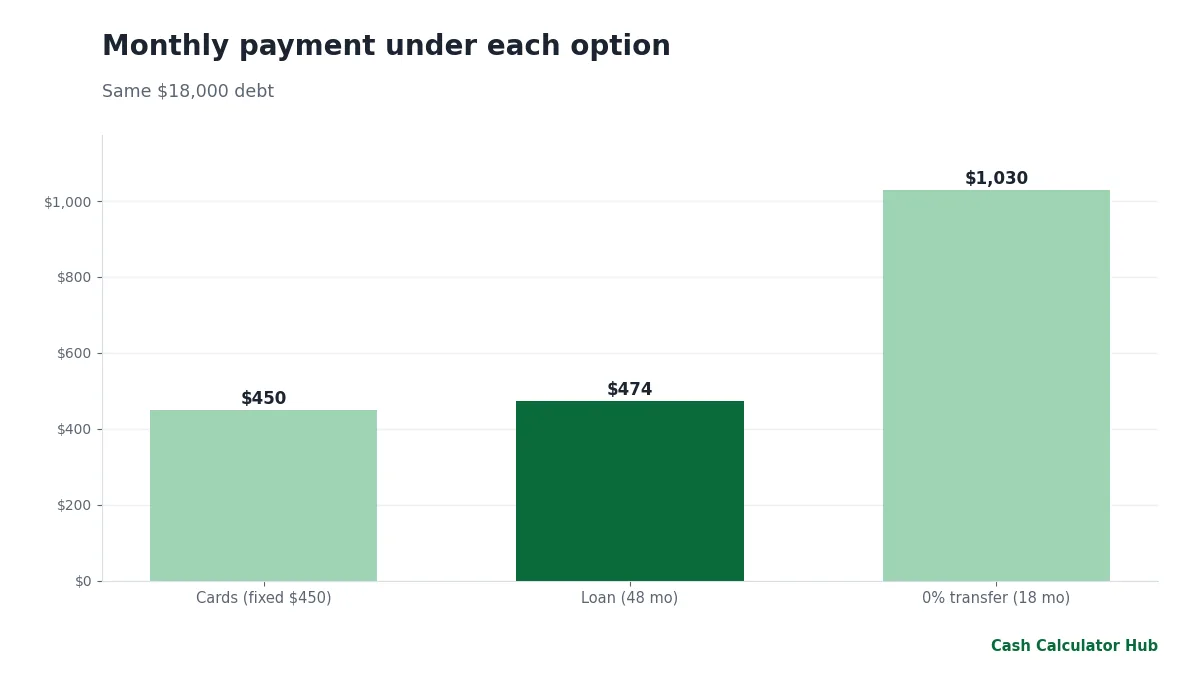
| Keep paying the cards | $450 | 6 yrs 1 mo | $32,740 |
| 12% personal loan, 4 years, 5% fee | $474 | 4 years | $23,652 |
| 0% balance transfer, 3% fee, 18 months | $1,030 | 1.5 years | $18,540 |
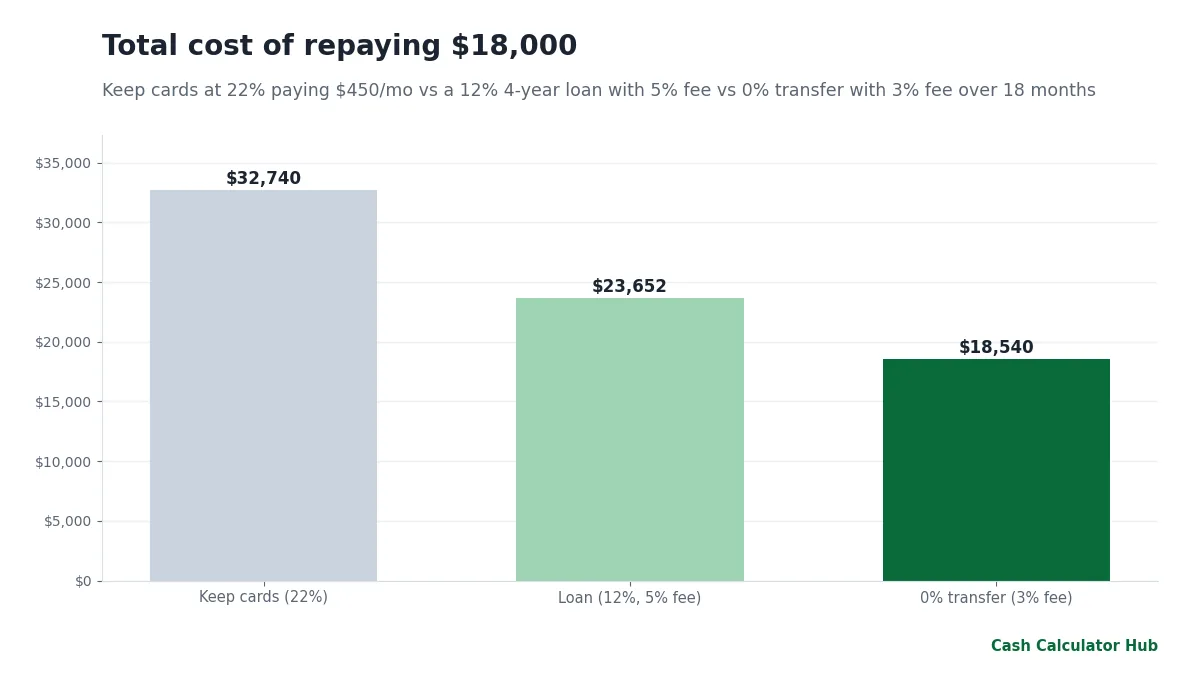
The loan saves $9,088 against the status quo and costs roughly the same monthly payment (about $474 versus $450). The balance transfer is cheapest in total, but it requires $1,030 a month and a very good credit score.
What the calculation leaves out
- Your approval rate. The best rates go to higher credit scores. A fair-credit borrower may be offered 20% or more, which erases the benefit.
- The “shorter than the original” trap. Lower payments from a longer term feel better but can cost more in total.
- The fee. A 5% origination fee on $18,000 is $900, deducted from the proceeds or added to the loan.
- Behavior. If the cards refill, you now have the loan plus new card debt.
When consolidation is worth it
- The new APR (including fees) is meaningfully lower, by at least 4 to 5 points.
- You can pay the new loan off in the same time or faster than your current plan.
- You will stop using the cards, or close all but one.
- You have a stable income and a credit score high enough to qualify.
When to skip it
- Your debt is small and a fixed payment would clear it in under a year.
- Your credit score will give you a rate near your current one.
- You are consolidating to lower the monthly payment without changing the rate. Fix the budget instead.
- Your main problem is spending, not interest.
Alternatives
- Avalanche or snowball: no new credit needed. See the avalanche vs snowball example.
- Credit counseling and a debt management plan: a nonprofit agency can negotiate lower rates. Use accredited agencies.
- Negotiating with the issuer. A hardship plan may lower the rate.
Compare yours
Enter each debt in the debt consolidation calculator with the new rate and fee, and use the personal loan calculator for the real APR including the origination fee. The APR calculator also shows the true cost of fees and points. If you’re paying cards now, the minimum payment guide shows how long it takes. More in debt calculators.
How to shop without hurting your credit
Many lenders let you “prequalify” with a soft credit check that does not affect your score. Collect several offers, compare the APR (not just the interest rate) and the total cost including fees. Only when you pick one do you submit a full application. Rate-shopping for installment loans within a short window is usually treated as a single inquiry by scoring models.
Red flags
- Upfront fees before any service is delivered.
- Debt settlement companies that tell you to stop paying creditors. This can damage your credit and lead to lawsuits.
- Guaranteed approval with no credit check.
- A longer term disguised as a lower rate. Compare total cost.
- Using retirement accounts or home equity to pay off unsecured debt without weighing the risk; see home equity options.
A final check
After consolidating, track the new balance and make a plan for the cards. Some people keep the oldest card open with a tiny recurring charge paid in full, and put the others in a drawer. The debt payoff calculator is useful after consolidation too, for testing extra payments on the new loan.
Does consolidation hurt my credit?
A hard inquiry and a new account can cause a small dip. Paying off cards often lifts your score through lower utilization, if you do not rack up new balances.
Is a balance transfer better than a personal loan?
It is cheaper if you can pay off the balance within the 0% period. Otherwise the loan’s fixed payoff date is safer.
Can I consolidate student loans this way?
Do not roll federal student loans into a private loan without understanding what protections you lose.
Does a lower payment mean a better deal?
Not necessarily. Compare the total cost.
Sources and further reading
How the numbers were made: Every figure on this page was calculated from the formulas and assumptions stated above and rounded. Rates, limits and rules are for 2026 unless noted; confirm current figures with the sources listed before acting.
Keep reading
- HELOC vs Home Equity Loan: How to Choose
- Debt Avalanche vs Snowball: A Four-Debt Example With Real Numbers
- How Long to Pay Off a Credit Card Making Only the Minimum?
- Debt-to-Income Ratio: What Lenders Count and What They Ignore
- Personal Loan vs Credit Card: Which Costs Less for a Big Expense?
- Balance Transfer Cards: Are They Worth the 3% to 5% Fee?
This guide is general information, not financial, tax or legal advice. Figures use stated assumptions and 2026 rules and will differ from your situation; check current rules and talk to a licensed professional before you decide. Full disclaimer.